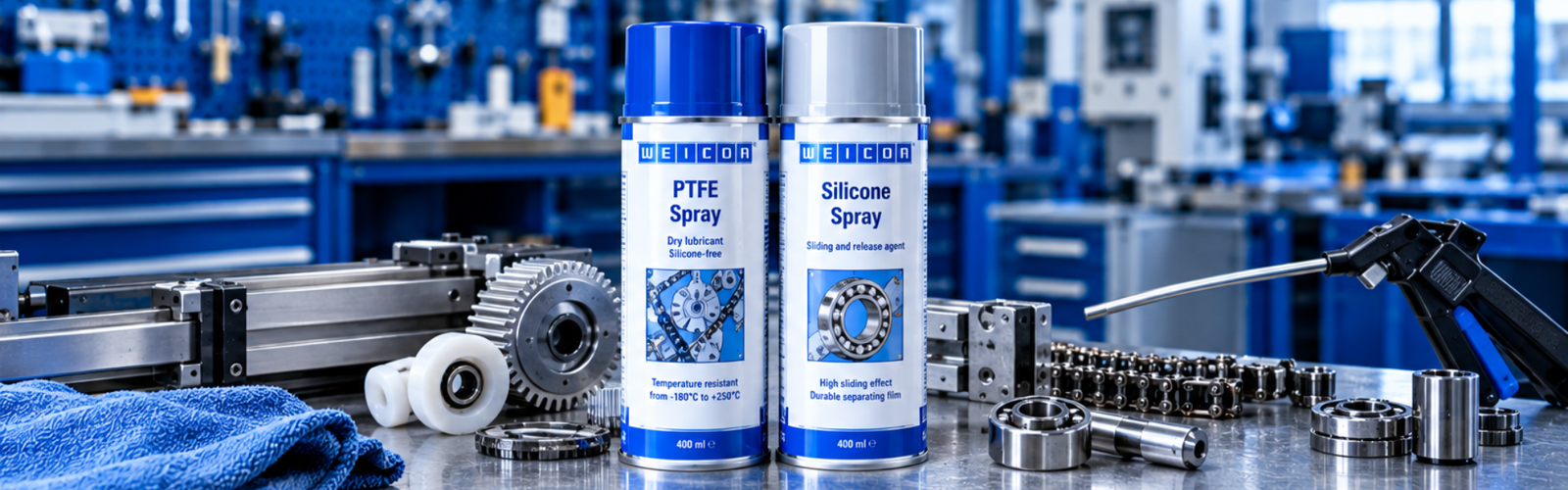
PTFE Spray vs Silicone Spray: What’s the Difference?
Admin
|
10 Oct 2026
|
16 min read
|
45 views
PTFE Spray vs Silicone Spray: What's the Difference?
Choosing the right lubricant for an industrial, mechanical, electrical or maintenance application can have a major impact on equipment performance, component life and maintenance requirements.
Two products that are frequently considered for similar applications are PTFE spray and silicone spray.
Both are available as technical aerosol sprays and both can provide lubrication, but they are not interchangeable.
The difference comes down to their chemical formulation, lubrication characteristics, temperature performance, material compatibility, water resistance and intended applications.
PTFE, or polytetrafluoroethylene, is a fluoropolymer known for its very low coefficient of friction and strong chemical resistance. Silicone-based lubricants, meanwhile, are widely used where lubrication, water resistance and compatibility with materials such as rubber and plastics are important.
So which one should you use?
The answer depends on what you are trying to lubricate and what environmental conditions the component operates under.
In this guide, we explain the difference between PTFE spray and silicone spray, their advantages, common industrial applications, limitations, and how to choose the right technical spray for your maintenance requirements.
What Is PTFE Spray?
PTFE spray is a technical lubricant containing PTFE (polytetrafluoroethylene).
PTFE is a fluoropolymer recognised for its low-friction characteristics and chemical resistance.
When used in a suitable lubricant formulation, PTFE can provide a smooth lubricating film between surfaces and help reduce friction and wear.
PTFE spray is commonly considered for applications involving:
- Sliding components
- Plastic parts
- Metal components
- Bearings
- Bushes
- Guides
- Hinges
- Rollers
- Conveyor components
- Mechanical assemblies
- Precision mechanisms
One of the major advantages of PTFE-based lubrication is its ability to provide low-friction performance without necessarily creating the same type of heavy, sticky lubricating film associated with some conventional oils and greases.
Depending on the formulation, PTFE spray may also provide good resistance to chemicals and temperature.
However, not every PTFE spray has the same characteristics.
The actual performance depends on:
- PTFE concentration
- Carrier solvent
- Base lubricant
- Additives
- Application method
- Temperature range
- Surface material
Therefore, always check the manufacturer's technical data before selecting a PTFE spray for a critical application.
What Is Silicone Spray?
Silicone spray is a technical lubricant based on silicone compounds.
It is widely used for lubricating and protecting surfaces where water resistance, material compatibility and smooth operation are important.
Silicone spray is commonly used on:
- Rubber seals
- Plastic components
- Door mechanisms
- Sliding surfaces
- Guides
- Windows
- Gaskets
- O-rings
- Conveyor components
- Automotive components
- Mechanical assemblies
Silicone lubricants are particularly useful where the lubricant needs to work with materials such as rubber and plastic.
They can help reduce friction while also providing water-repellent characteristics.
For this reason, silicone spray is frequently used for applications where protection from moisture is important.
PTFE Spray vs Silicone Spray: Quick Comparison
| Feature | PTFE Spray | Silicone Spray |
| Primary purpose | Low-friction lubrication | Lubrication and protection |
| Lubrication | Excellent for many sliding applications | Good for many general applications |
| Friction reduction | Very strong | Good |
| Plastic compatibility | Depends on formulation | Often suitable for many plastics |
| Rubber compatibility | Product dependent | Commonly used with rubber |
| Water resistance | Good depending on formulation | Generally excellent |
| Chemical resistance | Generally strong | Generally good |
| Suitable for precision mechanisms | Often | Sometimes |
| Suitable for seals | Application dependent | Common application |
| Dry-film options | Available | Less common |
| Heavy-load applications | Product dependent | Product dependent |
| Best known for | Low friction | Lubrication + water protection |
Important: This table is a general comparison. Always follow the individual product manufacturer's specifications.
PTFE Spray vs Silicone Spray: Which Is Better?
There is no universal winner.
The correct question is:
Which lubricant is better for your specific application?
PTFE spray may be preferable when your priority is:
- Low friction
- Smooth sliding
- Precision movement
- Reduced sticking
- Mechanical guides
- Low-residue lubrication
- Chemical resistance
Silicone spray may be preferable when your priority is:
- Rubber compatibility
- Plastic compatibility
- Water resistance
- Seal protection
- Smooth movement
- Moisture protection
- General-purpose lubrication
Choosing between the two should therefore start with the component rather than the product.
When Should You Use PTFE Spray?
PTFE spray can be particularly useful when a low-friction lubricating film is required.
1. Sliding Components
PTFE is well suited to applications where two surfaces slide against each other.
Examples include:
- Guides
- Rails
- Slides
- Bushes
- Mechanical tracks
- Sliding mechanisms
2. Plastic Components
Some PTFE lubricant formulations are suitable for plastic components.
This can make them useful for mechanisms where traditional mineral oils may not be the preferred option.
However, compatibility must always be confirmed with the particular plastic.
3. Precision Mechanisms
PTFE-based technical sprays can be useful for mechanisms where smooth movement and low friction are important.
Examples may include:
- Small mechanical mechanisms
- Adjustment systems
- Guides
- Control mechanisms
- Moving assemblies
4. Conveyor Systems
Depending on the application and product specifications, PTFE lubrication may be suitable for selected conveyor components where low-friction movement is required.
The lubricant should be selected according to:
- Conveyor material
- Load
- Operating speed
- Temperature
- Food-contact requirements, if applicable
- Manufacturer recommendations
5. Industrial Machinery
PTFE sprays can be used in suitable industrial machinery applications where a low-friction lubricant is required.
Potential applications include:
- Hinges
- Slides
- Guides
- Rollers
- Bushes
- Mechanical linkages
When Should You Use Silicone Spray?
Silicone spray is often preferred where lubrication needs to be combined with water resistance and compatibility with rubber or plastic components.
1. Rubber Seals
Silicone spray is commonly used for rubber seals and gaskets where the product formulation is compatible.
It can help maintain smooth movement and reduce friction.
2. O-Rings
Silicone-based products can be useful for suitable O-ring applications.
However, compatibility varies according to both the lubricant and the elastomer.
Always check manufacturer specifications.
3. Plastic Components
Silicone spray can be useful for selected plastic components where a suitable lubricant is required.
Applications may include:
- Plastic guides
- Sliding components
- Bushes
- Mechanisms
- Moving panels
4. Weather Seals
Silicone-based products are commonly considered for rubber weather seals and similar components.
They can provide lubrication while helping resist moisture.
5. Door and Window Mechanisms
Silicone spray can be useful for suitable:
- Door seals
- Window guides
- Sliding mechanisms
- Hinges
- Locks
- Rubber components
PTFE Spray for Industrial Applications
Industrial environments often contain mechanical components that require reliable lubrication without excessive grease buildup.
PTFE spray can be considered for applications involving:
- Conveyor systems
- Guides
- Sliding rails
- Bushes
- Rollers
- Hinges
- Mechanical linkages
- Precision components
- Machinery mechanisms
One of its main advantages is the low-friction characteristics associated with PTFE.
This can make PTFE-based lubrication attractive where smooth mechanical movement is important.
Silicone Spray for Industrial Applications
Silicone spray can be useful in industrial maintenance where components contain:
- Rubber
- Plastic
- Elastomers
- Seals
- Gaskets
- Sliding surfaces
Applications can include:
- Machine doors
- Rubber seals
- Guides
- Plastic components
- Conveyors
- Sliding mechanisms
- Sealing systems
Silicone spray may also be considered where water resistance is an important part of the application.
PTFE Spray for Plastic Components
One common reason maintenance teams choose PTFE spray is its potential suitability for plastic components.
However, the phrase "PTFE is plastic-safe" should never be treated as a universal rule.
The complete formulation matters.
The carrier solvent or other ingredients in an aerosol lubricant may interact differently with different plastics.
Before using a PTFE spray on:
- ABS
- PVC
- Polycarbonate
- Acrylic
- Nylon
- Polypropylene
- Engineering plastics
check the manufacturer's compatibility information.
Silicone Spray for Rubber Components
Silicone spray is particularly well known for applications involving rubber and elastomeric components.
It can be useful for:
- Rubber seals
- Weather strips
- Gaskets
- O-rings
- Rubber guides
- Flexible components
However, compatibility should still be checked.
Different rubber compounds can respond differently to chemical products.
Never assume that because a product is silicone-based, it is automatically suitable for every rubber compound.
PTFE Spray vs Silicone Spray for Rubber
If your main requirement is lubrication of a rubber seal, silicone spray is often the more obvious starting point.
Silicone-based lubricants are commonly selected for rubber-related applications because of their lubrication and water-resistant characteristics.
PTFE products may also be suitable for certain rubber applications, but this depends heavily on the specific product formulation and manufacturer's compatibility information.
General rule:
Rubber + seal protection → consider silicone spray first.
Low-friction mechanical movement → consider PTFE spray first.
Always verify compatibility before application.
PTFE Spray vs Silicone Spray for Plastic
Both products may be suitable for certain plastics.
The deciding factor is the specific formulation and the plastic involved.
For example, a lubricant may contain a carrier solvent that behaves differently from the PTFE or silicone component itself.
Therefore, when selecting a lubricant for plastic:
- Identify the plastic.
- Identify the operating environment.
- Check the lubricant's compatibility information.
- Test where appropriate.
- Follow manufacturer recommendations.
PTFE Spray vs Silicone Spray for Metal
Both PTFE and silicone lubricants can be used in suitable metal applications.
PTFE may be preferable when:
- Low friction is the priority
- Smooth sliding is required
- Precision movement matters
- A specific PTFE-based lubrication film is desired
Silicone may be preferable where:
- Water resistance matters
- Rubber or plastic is present
- General-purpose lubrication is required
- The application involves seals
For high-load metal-to-metal applications, however, neither should automatically be selected simply because it is available as a spray.
The lubricant needs to be rated for the load, speed and temperature involved.
PTFE Spray vs Silicone Spray for Bearings
Bearings require careful lubricant selection.
The correct lubricant depends on:
- Bearing type
- Speed
- Load
- Temperature
- Operating environment
- Manufacturer specifications
A light technical spray should not automatically replace a bearing grease or oil specified by the equipment manufacturer.
PTFE spray may be suitable for certain light-duty mechanisms and components, but not every bearing application.
Likewise, silicone spray should not be assumed to be suitable for every bearing.
Always follow the bearing manufacturer's lubrication requirements.
PTFE Spray vs Silicone Spray for Hinges
For hinges, the choice depends on the hinge material and operating environment.
PTFE spray
Can be useful when:
- Low friction is important
- A smooth mechanical movement is required
- The hinge is part of a precision mechanism
Silicone spray
Can be useful when:
- Rubber or plastic components are involved
- Water resistance is important
- The hinge operates in a damp environment
For heavy-duty industrial hinges, choose a lubricant designed for the actual load and operating conditions.
PTFE Spray vs Silicone Spray for Conveyor Systems
Conveyor systems contain multiple moving components.
Depending on the design, lubrication may be required for:
- Guides
- Rollers
- Bearings
- Bushes
- Chains
- Sliding surfaces
- Mechanical linkages
PTFE spray can be considered for selected low-friction applications.
Silicone spray can be useful for suitable rubber and plastic components.
However, conveyor lubrication needs to be carefully controlled because excessive lubricant can attract dust and contamination or contaminate products.
In food-processing environments, use only products specifically approved and rated for the intended food-contact or incidental-contact application.
PTFE Spray vs Silicone Spray for Electrical Applications
Neither PTFE spray nor silicone spray should automatically be treated as an electrical contact cleaner.
This is an important distinction.
If you need to clean:
- Electrical contacts
- Connectors
- Switches
- Relays
- Electrical components
use a product specifically designed for electrical contact cleaning where required.
Likewise, if you need to lubricate a particular electrical mechanism, confirm that the lubricant is compatible with the component.
Lubrication and electrical contact cleaning are different applications.
PTFE Spray vs Silicone Spray for Outdoor Applications
Outdoor equipment can be exposed to:
- Rain
- Humidity
- Dust
- Temperature changes
- UV exposure
- Corrosion
Silicone spray can be attractive for applications where water resistance and protection of suitable rubber or plastic components are important.
PTFE-based products may be preferable where low-friction mechanical movement is the primary requirement.
In outdoor applications, consider both lubrication and environmental protection rather than focusing on friction alone.
PTFE Spray vs Silicone Spray: Temperature
Temperature performance varies significantly between individual products.
Do not assume that all PTFE sprays have the same temperature range or that all silicone sprays have the same temperature range.
When selecting a lubricant, check:
- Minimum operating temperature
- Maximum operating temperature
- Short-term temperature limits
- Continuous operating temperature
- Application method
For high-temperature applications, always use a product specifically rated for the required operating conditions.
PTFE Spray vs Silicone Spray: Water Resistance
Silicone-based lubricants are commonly chosen when water resistance and moisture protection are important.
PTFE-based products can also offer useful resistance characteristics depending on the formulation.
However, water resistance and corrosion protection are not exactly the same thing.
If corrosion protection is the primary requirement, consider using a product specifically designed for corrosion prevention rather than relying only on a lubricant.
PTFE Spray vs Silicone Spray: Chemical Resistance
PTFE itself has strong chemical-resistance characteristics.
This is one reason PTFE-based products are used in demanding industrial environments.
However, the complete spray formulation determines the real-world chemical compatibility.
The same principle applies to silicone products.
Before using either product around:
- Solvents
- Acids
- Alkalis
- Cleaning chemicals
- Process chemicals
check the technical documentation.
Dry PTFE Spray vs Silicone Spray
Some PTFE products are formulated as dry-film lubricants.
A dry PTFE lubricant can be useful when a low-friction film is required without leaving a heavy wet lubricant layer.
This may be beneficial in environments where:
- Dust accumulation is a concern
- A clean surface is important
- Excessive wet lubricant is undesirable
- Sliding friction needs to be reduced
Silicone sprays are generally associated more with wet-film lubrication and protection.
Again, the exact formulation is more important than the name on the can.
Does PTFE Spray Attract Dust?
This depends on the formulation.
A dry-film PTFE product may attract less contamination than a heavy wet lubricant because it does not leave the same type of oily film.
However, some PTFE aerosol products contain oils or other carriers.
Therefore, don't assume every PTFE spray is dust-free.
Check the manufacturer's technical specification.
Does Silicone Spray Attract Dust?
Silicone spray can leave a lubricating film.
In dusty environments, any wet or sticky lubricant can potentially collect airborne contamination.
If the application is in a dusty manufacturing environment, a suitable dry-film lubricant may be more appropriate.
The right choice depends on the equipment and operating conditions.
Common Mistakes When Choosing Between PTFE and Silicone Spray
Mistake 1: Choosing Based Only on Price
The cheapest spray is not necessarily the most suitable.
A technically incorrect lubricant can lead to:
- Poor performance
- Material damage
- Increased maintenance
- Premature component failure
Mistake 2: Assuming All Sprays Are Interchangeable
They are not.
PTFE, silicone, mineral oil and other lubricant technologies have different properties.
Mistake 3: Ignoring Material Compatibility
Always check compatibility with plastics, rubber, seals and coatings.
Mistake 4: Using a Light Spray for Heavy Loads
A technical spray is not automatically suitable for high-load applications.
Mistake 5: Ignoring Temperature
A lubricant that works at room temperature may not perform correctly at elevated temperatures.
Mistake 6: Applying Too Much Lubricant
Excess lubricant can attract contamination and create other maintenance problems.
How to Choose Between PTFE Spray and Silicone Spray
Use this simple decision process.
Choose PTFE spray when your priority is:
- Low friction
- Smooth sliding
- Precision mechanisms
- Mechanical guides
- Low-residue lubrication
- Suitable plastic or metal applications
- Dry-film lubrication
Choose silicone spray when your priority is:
- Rubber lubrication
- Seal maintenance
- Plastic components
- Water resistance
- Moisture protection
- Smooth movement
- General-purpose technical lubrication
Consider another lubricant when:
- Heavy loads are involved
- Extreme temperatures are involved
- High-pressure lubrication is required
- Food-grade certification is required
- The equipment manufacturer specifies a particular lubricant
- Corrosion protection is the primary purpose
PTFE Spray vs Silicone Spray: Decision Table
| Application | Usually Consider | Why |
| Plastic guides | PTFE | Low-friction movement |
| Rubber seals | Silicone | Lubrication and water resistance |
| O-rings | Silicone | Commonly used for suitable elastomers |
| Precision mechanisms | PTFE | Low-friction characteristics |
| Door seals | Silicone | Rubber compatibility |
| Sliding mechanisms | PTFE | Smooth movement |
| Outdoor rubber components | Silicone | Water-resistant characteristics |
| Electrical contacts | Contact cleaner | Designed specifically for electrical cleaning |
| Heavy-duty bearings | Application-specific lubricant | Requires load/speed assessment |
| Conveyor guides | PTFE or application-specific product | Depends on material and environment |
| Corrosion prevention | Corrosion-protection product | Purpose-specific protection |
How to Apply Technical Lubricant Spray Correctly
Regardless of whether you choose PTFE or silicone spray, application technique matters.
Step 1: Clean the Surface
Remove dirt and old contamination where appropriate.
If electrical components are involved, use an appropriate electrical contact cleaner rather than an unsuitable general-purpose solvent.
Step 2: Check Compatibility
Confirm that the product is suitable for the surface.
Step 3: Apply a Controlled Amount
Avoid flooding the component.
Step 4: Move the Component
Where appropriate, operate the mechanism to distribute the lubricant.
Step 5: Remove Excess
If the manufacturer's instructions recommend it, wipe away excess lubricant.
Step 6: Inspect
Check for smooth movement and unwanted contamination.
Safety Considerations
Technical sprays are chemical products and should be handled responsibly.
Before use:
- Read the label.
- Read the SDS.
- Follow the manufacturer's instructions.
- Ensure suitable ventilation.
- Use appropriate PPE.
- Keep away from ignition sources where required.
- Avoid contact with eyes and skin.
- Do not spray onto live equipment unless the product specifically permits it.
- Store according to the manufacturer's requirements.
Aerosol products can be pressurised and may contain flammable propellants.
Never assume that a lubricant is harmless simply because it is sold for maintenance purposes.
PTFE Spray and Silicone Spray in Preventive Maintenance
Lubrication is an important part of preventive maintenance for many mechanical systems.
A maintenance team can use inspection programs to identify:
- Increased friction
- Sticking mechanisms
- Noise
- Dry movement
- Seal deterioration
- Contamination
- Corrosion
- Wear
The appropriate lubricant can then be selected according to the equipment manufacturer's requirements.
For example:
Low-friction sliding component → consider PTFE.
Rubber seal requiring lubrication → consider silicone.
Electrical contact requiring cleaning → use contact cleaner.
Heavy-load bearing → use the specified bearing lubricant.
This application-first approach helps avoid inappropriate product substitution.
Frequently Asked Questions
Is PTFE spray better than silicone spray?
Neither is universally better. PTFE spray is often selected for low-friction mechanical applications, while silicone spray is commonly selected for rubber, plastic, seal and water-resistant applications.
Can I use silicone spray instead of PTFE spray?
Sometimes, but not universally. The correct choice depends on the component, material, operating conditions and manufacturer's recommendations.
Can I use PTFE spray on rubber?
Some PTFE formulations may be compatible with rubber, but compatibility must be checked for the specific product and rubber compound.
Is silicone spray good for plastic?
Silicone spray is commonly used on suitable plastic components, but always check the manufacturer's compatibility information first.
Is PTFE spray good for plastic?
Some PTFE sprays are designed for plastic-compatible lubrication. Always verify the specific formulation.
Which is better for door hinges?
Both may work depending on the hinge. PTFE can be useful where low-friction mechanical movement is the priority, while silicone may be useful where rubber or plastic components and moisture resistance are involved.
Which is better for rubber seals?
Silicone spray is commonly considered for rubber seals because of its lubrication and water-resistant characteristics, subject to compatibility.
Which is better for sliding mechanisms?
PTFE spray is often a strong option for suitable sliding mechanisms because of PTFE's low-friction characteristics.
Can PTFE spray prevent corrosion?
Some PTFE lubricant products may provide protection as part of their formulation, but if corrosion prevention is the main objective, use a product specifically designed for corrosion protection.
Can silicone spray prevent corrosion?
Silicone can provide some moisture-resistant protection depending on the formulation, but it should not automatically be treated as a dedicated corrosion inhibitor.
Can PTFE spray be used on bearings?
It depends on the bearing and lubricant specification. For load-bearing applications, follow the bearing manufacturer's lubrication requirements.
Can silicone spray be used on bearings?
Not automatically. Bearing lubrication should be selected according to load, speed, temperature and manufacturer requirements.
Is PTFE spray a dry lubricant?
Some PTFE sprays are formulated as dry-film lubricants, while others leave a wet lubricating film. Check the individual product specification.
Final Verdict: PTFE Spray or Silicone Spray?
The best choice depends on the application.
Choose PTFE spray when low friction and smooth mechanical movement are the main priorities.
Choose silicone spray when rubber, plastic, seals, water resistance and general-purpose technical lubrication are more important.
Neither product should be treated as a universal lubricant.
Before making a selection, consider:
- Component material
- Load
- Speed
- Temperature
- Moisture
- Chemical exposure
- Required lubrication film
- Manufacturer specifications
- Material compatibility
- Maintenance requirements
Selecting the right technical spray can help improve equipment maintenance while reducing the risk of using an unsuitable lubricant.
Need Help Choosing the Right Technical Spray?
Spleca supplies industrial products and technical solutions for businesses across Australia.
If you are unsure whether PTFE spray, silicone spray, contact cleaner or another technical spray is right for your application, our team can help you identify the appropriate product based on your equipment and operating conditions.
Explore Industrial Automation Products