COMPLETE GUIDE TO TECHNICAL SPRAYS FOR INDUSTRIAL MAINTENANCE
Admin
|
08 Oct 2026
|
17 min read
|
21 views
Complete Guide to Technical Sprays for Industrial Maintenance
Industrial machinery operates under demanding conditions.
Manufacturing equipment, pumps, motors, conveyors, compressors, tools, vehicles, production systems and mechanical assemblies are continuously exposed to friction, contamination, moisture, corrosion, temperature changes and mechanical wear.
Without appropriate maintenance, these conditions can gradually affect equipment performance and reliability.
This is where technical sprays for industrial maintenance become valuable.
Technical sprays are specialised chemical products designed for specific maintenance tasks such as:
- Lubrication
- Cleaning
- Degreasing
- Rust removal
- Corrosion protection
- Moisture displacement
- Surface treatment
- Component protection
- Assembly
- Release applications
- Electrical contact cleaning
- General equipment care
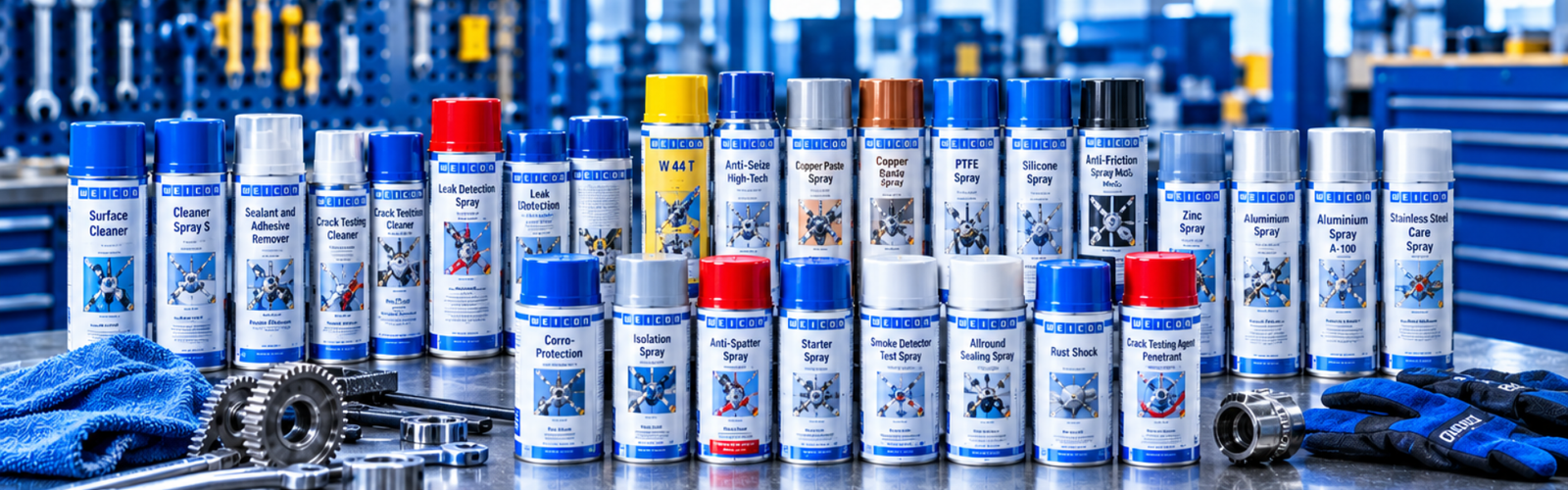
WEICON's technical spray portfolio includes products for cleaning, care, lubrication, protection and maintenance across industrial and workshop applications. (weicon.de)
However, not every technical spray performs the same function.
A lubricant should not automatically be used as a cleaner.
A corrosion-protection coating should not automatically replace a penetrating oil.
A contact cleaner should not automatically be used as a general-purpose degreaser.
Understanding the different categories makes it easier to choose the right product for the maintenance problem.
What Are Technical Sprays?
Technical sprays are specialised aerosol products developed for technical, mechanical, electrical, industrial and maintenance applications.
They are different from ordinary household sprays because they are formulated around specific technical requirements.
Depending on the formulation, a technical spray can:
Lubricate
Clean
Protect
Penetrate
Remove rust
Displace moisture
Reduce friction
Protect against corrosion
Prepare surfaces
Assist assembly
Provide temporary preservation
WEICON's technical spray portfolio includes lubricants, multifunctional oils, cleaners and degreasers, corrosion protection products, release agents, rust removers and specialised sprays. (weicon.de)
Why Are Technical Sprays Important for Industrial Maintenance?
Industrial maintenance is about more than repairing equipment after it fails.
A modern maintenance program aims to:
- Prevent avoidable failures
- Reduce equipment downtime
- Maintain component condition
- Protect machinery
- Improve maintenance efficiency
- Extend component service life where possible
- Keep production running reliably
Technical sprays can support many of these activities.
For example:
Cleaning
Removes contaminants from suitable surfaces.
Lubrication
Helps reduce friction and wear.
Corrosion protection
Protects suitable metal surfaces from environmental exposure.
Rust removal
Helps loosen corroded components.
Surface preparation
Helps prepare surfaces for subsequent operations.
Moisture displacement
Helps protect suitable components from moisture.
This makes technical sprays useful across both preventive maintenance and corrective maintenance.
The Main Technical Spray Categories
Industrial technical sprays can be divided into several major categories.
1. Lubricant Sprays
For reducing friction and supporting moving components.
2. Multifunctional Sprays
For several general maintenance functions.
3. Penetrating Oils
For helping loosen seized or corroded components.
4. Rust Removers
For helping treat rust and corrosion.
5. Corrosion Protection Sprays
For protecting suitable metal surfaces.
6. PTFE Sprays
For dry or low-friction lubrication applications.
7. Silicone Sprays
For suitable lubrication and release applications.
8. Grease Sprays
For sprayable grease lubrication.
9. Cleaners and Degreasers
For removing oils, grease and contaminants.
10. Contact Cleaners
For appropriate electrical-contact cleaning.
11. Surface Coatings
For corrosion protection and surface treatment.
12. Release Agents
For suitable moulding and manufacturing applications.
13. Specialised Technical Sprays
For specific industrial requirements.
WEICON's technical spray portfolio follows a similar broad structure, including lubricants, multifunctional oils, cleaners, degreasers, rust removers, protection products, release agents and specialised sprays. (weicon.de)
1. Industrial Lubricant Sprays
Lubrication is one of the most common maintenance requirements.
Moving components can experience friction between surfaces.
Over time, friction can contribute to:
- Wear
- Heat
- Noise
- Surface damage
- Increased resistance
- Reduced component performance
A suitable lubricant can help reduce friction.
Where Are Lubricant Sprays Used?
Depending on the product, applications may include:
- Hinges
- Chains
- Bearings
- Gears
- Sliding mechanisms
- Guides
- Mechanical joints
- Moving components
- Machinery
The correct lubricant depends on:
- Load
- Speed
- Temperature
- Material
- Movement
- Environment
2. Multifunctional Maintenance Sprays
Multifunctional sprays are designed to perform several maintenance functions.
They can be particularly useful in:
- Maintenance workshops
- Manufacturing facilities
- Repair departments
- Engineering workshops
- Industrial service vehicles
For example, WEICON W 44 T Multi-Spray is described as providing five functions:
- Corrosion protection
- Water repellency
- Lubrication
- Preservation
- Cleaning
WEICON also describes it as useful for loosening seized screws, bolts, fittings and valves and penetrating rust. (weicon.de)
When Should You Use a Multifunctional Spray?
A multifunctional spray is useful when a maintenance task requires several general-purpose functions.
For example:
A technician finds a rusty mechanical connection that needs cleaning, lubrication and loosening.
A multifunctional spray may be suitable if the product's specifications match the application.
However, specialised products can still be preferable where a specific technical performance requirement exists.
3. Penetrating Oils
Penetrating products are designed to work their way into tight spaces and interfaces.
They can help with:
- Seized bolts
- Rusted nuts
- Corroded fittings
- Stuck mechanical parts
- Difficult disassembly
The goal is to help reduce resistance and make disassembly easier.
How Penetrating Sprays Help
A typical process is:
Apply → Allow penetration → Attempt loosening → Reapply if required
The amount of time required depends on:
- Corrosion severity
- Component size
- Product
- Temperature
- Joint condition
Severely corroded components may require additional mechanical or specialist treatment.
4. Rust Remover Sprays
Rust can make mechanical maintenance difficult.
Corrosion can cause:
- Seized threads
- Stuck components
- Surface deterioration
- Increased friction
- Difficult disassembly
A suitable rust remover can assist maintenance teams when dealing with corrosion.
Rust Removal Applications
Potential applications include:
- Bolts
- Nuts
- Screws
- Hinges
- Fittings
- Valves
- Mechanical joints
- Tools
The correct product depends on the component material and severity of corrosion.
5. Corrosion Protection Sprays
Corrosion occurs when suitable materials react with their environment.
Industrial environments can expose metal components to:
- Water
- Humidity
- Salt
- Chemicals
- Outdoor weather
- Condensation
Corrosion protection sprays can create a protective layer on suitable surfaces.
WEICON's technical spray portfolio includes dedicated surface and anti-corrosion coating products. (weicon.de)
Temporary vs Long-Term Corrosion Protection
Not every corrosion-protection spray has the same purpose.
Some products provide:
Temporary preservation
Others are designed to provide:
A more durable surface coating
Always check the product's technical documentation to understand the intended protection period and environment.
6. PTFE Technical Sprays
PTFE sprays are used for suitable low-friction and dry-lubrication applications.
WEICON PTFE Spray is described as a grease-free dry lubricant. (weicon.de)
PTFE can be useful where a clean lubricating layer is preferred over conventional oil or grease.
Applications for PTFE Spray
Depending on the product and material compatibility, applications can include:
- Sliding surfaces
- Guides
- Plastic components
- Rubber components
- Mechanical assemblies
- Moving parts
Always verify compatibility before use.
7. Silicone Technical Sprays
Silicone sprays can provide lubrication and release properties for suitable applications.
WEICON Silicone Spray is described as a lubricant and release agent. (weicon.de)
Potential applications include:
- Rubber components
- Plastic components
- Sliding surfaces
- Guides
- Mould-release applications
- Equipment maintenance
Silicone contamination can be undesirable in some manufacturing processes, so application-specific suitability should always be checked.
8. Grease Sprays
Grease sprays allow grease-based lubrication to be applied in an aerosol format.
They can be useful for:
- Hinges
- Bearings
- Chains
- Mechanical joints
- Sliding surfaces
- Moving components
Grease selection depends on:
- Load
- Temperature
- Speed
- Environment
- Component type
9. Industrial Cleaners and Degreasers
Cleaning is often the first maintenance step.
Industrial cleaners can remove:
- Oil
- Grease
- Dirt
- Dust
- Adhesive residue
- Contaminants
WEICON includes cleaners and degreasers as a specific technical spray category. (weicon.de)
Why Degreasing Matters
A contaminated surface can affect subsequent processes.
For example:
Dirty surface → poor adhesion
Oily surface → poor coating
Contaminated component → ineffective lubrication
Therefore:
Clean first, then perform the maintenance operation.
10. Electrical Contact Cleaners
Electrical contacts can become contaminated through:
- Dust
- Oil
- Moisture
- Oxidation
- Environmental exposure
Dedicated contact cleaners can be used for appropriate electrical-maintenance applications.
Potential applications include:
- Connectors
- Terminals
- Switches
- Electrical contacts
- Suitable electrical components
Electrical equipment must always be handled according to appropriate safety procedures.
11. Surface Treatment Sprays
Some technical sprays are designed to modify or protect the surface.
Examples include:
- Zinc coatings
- Stainless-steel coatings
- Anti-corrosion coatings
- Protective coatings
WEICON Zinc-Alu Spray is an example of a zinc-aluminium coating product for suitable metal surfaces. WEICON describes it as providing protection against rust and corrosion. (media.weicon.de)
12. Release Agent Sprays
Release agents are used to reduce sticking between suitable surfaces.
They are particularly relevant to:
- Moulding
- Plastics processing
- Rubber processing
- Manufacturing
- Composite production
WEICON includes release agents within its technical spray portfolio. (weicon.de)
13. Specialised Technical Sprays
Industrial applications can require highly specialised sprays.
Examples include:
- Cutting sprays
- Leak detection sprays
- Food-sector lubricants
- Special cleaners
- Anti-friction coatings
- Surface preparation products
The advantage of specialised products is that their formulation can be targeted toward a particular maintenance requirement.
Technical Sprays by Maintenance Problem
Instead of choosing a product based only on its name, start with the problem.
| Maintenance Problem | Product Category |
| Component needs lubrication | Lubricant |
| Several basic maintenance tasks | Multifunctional spray |
| Rusted bolt needs loosening | Penetrating/rust-removing spray |
| Metal needs corrosion protection | Corrosion protection spray |
| Clean dry lubrication needed | PTFE spray |
| Suitable rubber/plastic lubrication | Silicone spray |
| Heavy lubrication required | Grease spray |
| Oil or grease needs removing | Cleaner/degreaser |
| Electrical contacts need cleaning | Contact cleaner |
| Metal surface needs coating | Zinc/metal coating |
| Mould surface needs release | Release agent |
Technical Sprays in Preventive Maintenance
Preventive maintenance aims to identify and address potential problems before equipment failure.
A typical maintenance routine might include:
Inspection
Look for:
- Rust
- Leakage
- Wear
- Contamination
- Loose components
Cleaning
Remove:
- Dirt
- Grease
- Dust
- Residue
Lubrication
Lubricate suitable moving components.
Protection
Apply appropriate corrosion protection where required.
Monitoring
Record changes and recurring issues.
Technical sprays can support several of these steps.
Technical Sprays in Corrective Maintenance
Corrective maintenance occurs when an existing problem needs to be addressed.
Examples:
Seized bolt
Use an appropriate penetrating or multifunctional product.
Rusted component
Use a suitable rust-removing solution.
Dirty component
Use a suitable cleaner.
Dry moving component
Use an appropriate lubricant.
Corroded metal surface
Use an appropriate corrosion-protection coating after suitable preparation.
Technical Sprays for Machinery
Machinery contains many maintenance points.
Examples include:
- Motors
- Bearings
- Shafts
- Chains
- Gears
- Hinges
- Guides
- Fasteners
- Electrical connections
Each component can have different requirements.
Therefore, don't use one spray across the entire machine without verifying compatibility.
Technical Sprays for Pumps
Pumps can contain:
- Bearings
- Shafts
- Seals
- Fasteners
- Flanges
- Electrical components
Maintenance may involve:
- Lubrication
- Cleaning
- Corrosion protection
- Thread maintenance
- Surface preparation
The specific product must match the component and application.
Technical Sprays for Motors
Motors may require maintenance around:
- Bearings
- Housings
- Fasteners
- Electrical connections
- External metal surfaces
Technical sprays can support suitable external maintenance operations.
Electrical safety is critical when working around powered equipment.
Technical Sprays for Conveyors
Conveyor systems can contain:
- Chains
- Rollers
- Bearings
- Fasteners
- Guides
Depending on the equipment, maintenance sprays may be used for:
- Lubrication
- Cleaning
- Rust removal
- Corrosion protection
The lubricant must be appropriate for the specific conveyor component.
Technical Sprays for Compressors
Compressors can operate under demanding mechanical and thermal conditions.
Maintenance may include:
- External cleaning
- Corrosion protection
- Mechanical component care
Always follow the compressor manufacturer's maintenance requirements.
Technical Sprays for Hydraulic Systems
Hydraulic equipment contains pressurised fluid.
Technical sprays may be used for appropriate external maintenance tasks such as:
- Cleaning
- Corrosion protection
- Lubrication of suitable external components
- Rust removal
Do not introduce an unsuitable spray into a hydraulic fluid circuit.
Technical Sprays for Pneumatic Systems
Pneumatic systems use compressed air.
Maintenance sprays may support:
- Component cleaning
- External lubrication
- Corrosion protection
- General maintenance
Product compatibility should always be confirmed.
Technical Sprays for Manufacturing
Manufacturing plants can use technical sprays across:
- Production lines
- Assembly stations
- Maintenance workshops
- Tool rooms
- Machine shops
Typical applications include:
Cleaning
Lubrication
Corrosion protection
Rust removal
Surface treatment
Component maintenance
WEICON lists mechanical engineering, automotive, mining, maritime, energy, oil and gas and hydraulic/pneumatic applications within its technical spray portfolio. (weicon.de)
Technical Sprays for Mining
Mining environments can be particularly demanding due to:
- Dust
- Water
- Vibration
- Heavy machinery
- Corrosion
- High mechanical loads
Technical sprays can support routine equipment maintenance.
Applications may include:
- Lubrication
- Cleaning
- Rust removal
- Corrosion protection
- Component care
Technical Sprays for Automotive
Automotive workshops use technical sprays for many maintenance tasks.
Potential applications include:
- Hinges
- Fasteners
- Mechanical components
- Electrical contacts
- Moving components
- Rusted connections
A dedicated product should be selected according to the component and intended use.
Technical Sprays for Marine Environments
Marine equipment faces:
- Salt water
- Humidity
- Corrosion
- Outdoor exposure
Corrosion protection and lubrication can therefore become particularly important.
Suitable technical sprays can support:
- Metal protection
- Lubrication
- Rust removal
- Cleaning
Technical Sprays for Oil and Gas
Oil and gas operations can involve demanding environmental and operating conditions.
Maintenance products may need to handle:
- Temperature
- Moisture
- Corrosion
- Oils
- Chemicals
WEICON lists oil and gas among the sectors served by its technical spray portfolio. (weicon.de)
Technical Sprays for Food Industry
Food-processing environments have additional requirements.
Products may need specific approvals.
For example, WEICON Bio-Fluid is listed as a food-sector lubricating and care oil with NSF H1 classification. (weicon.de)
Never assume a general-purpose technical spray is suitable for food-processing environments.
Always verify the exact certification and intended application.
Technical Sprays for High-Temperature Applications
High-temperature maintenance requires specialised products.
Before selecting a product, determine:
- Continuous temperature
- Maximum temperature
- Duration of exposure
- Load
- Surface material
- Chemical environment
For example, WEICON Anti-Friction Spray MoS₂ is specified in its technical documentation for a temperature range of -200°C to +450°C, with brief exposure up to 500°C. (media.weicon.de)
This demonstrates why technical data matters when selecting maintenance products for demanding environments.
Technical Sprays for Corrosion Protection
Corrosion protection is especially important for:
- Outdoor machinery
- Tools
- Metal components
- Storage equipment
- Marine equipment
- Fabricated structures
Before applying a corrosion-protection spray:
Clean → Degrease → Dry → Apply
For products such as WEICON Zinc-Alu Spray, technical documentation provides specific preparation and application requirements. (media.weicon.de)
Technical Sprays for Surface Preparation
Surface preparation is critical before:
- Painting
- Coating
- Bonding
- Sealing
- Lubrication
A surface may need to be:
- Clean
- Dry
- Degreased
- Free of loose rust
- Free of dust
A suitable cleaner can help prepare the surface for the next process.
How to Apply Technical Sprays Correctly
Always follow the specific product instructions.
A general process is:
Step 1 — Identify the Application
Determine what you are trying to achieve.
Step 2 — Check Compatibility
Check the surface material.
Step 3 — Clean
Remove loose contamination.
Step 4 — Prepare
Degrease or otherwise prepare the surface if required.
Step 5 — Shake
Shake the aerosol if instructed.
Step 6 — Apply
Spray using the recommended technique and distance.
Step 7 — Allow the Product to Work
Allow appropriate penetration, evaporation or curing.
Step 8 — Inspect
Check whether the required result has been achieved.
Why Application Technique Matters
A technically excellent product can still perform poorly if applied incorrectly.
Common problems include:
- Spraying too close
- Spraying too far
- Applying excessive product
- Applying to contaminated surfaces
- Failing to shake the can
- Applying too few coats
- Ignoring drying time
For example, WEICON technical documentation provides specific application distances and preparation requirements for its coating products. (media.weicon.de)
How Much Technical Spray Should You Use?
There is no universal answer.
It depends on:
- Product type
- Application
- Surface area
- Required film thickness
- Product instructions
More product doesn't automatically mean better performance.
Apply only the amount recommended for the application.
Technical Spray Safety
Technical sprays are chemical products, and many are supplied in pressurised aerosol containers.
Before use:
- Read the label.
- Read the Safety Data Sheet.
- Ensure adequate ventilation.
- Wear suitable PPE.
- Keep away from ignition sources where applicable.
- Avoid inhaling spray mist.
- Do not puncture aerosol cans.
- Do not expose cans to excessive heat.
WEICON aerosol documentation includes storage precautions such as protecting containers from direct sunlight and temperatures above +50°C. (media.weicon.de)
Technical Spray Storage
Correct storage helps maintain product integrity.
Store technical sprays:
- In the recommended temperature range
- Away from direct sunlight
- Away from excessive heat
- In accordance with the manufacturer's instructions
Never store damaged aerosol containers in unsuitable conditions.
Common Technical Spray Mistakes
1. Using the Wrong Product
A lubricant isn't automatically a corrosion-protection coating.
2. Using Too Much
Excessive application creates waste and may contaminate surrounding components.
3. Ignoring Compatibility
Always check plastics, rubber, paint and coatings.
4. Ignoring Temperature
Every technical product has operating limitations.
5. Applying to Dirty Surfaces
Contamination can compromise performance.
6. Ignoring Chemical Exposure
Oil, solvents, acids and other chemicals can affect materials differently.
7. Ignoring Approvals
Food, pharmaceutical, drinking-water and other specialised environments may have specific requirements.
8. Using Aerosols Without Proper Ventilation
Follow the product's safety instructions and ensure suitable ventilation.
How to Build a Technical Spray Maintenance Kit
A maintenance department can consider keeping different categories available.
General Maintenance
Multifunctional spray
Lubrication
Industrial lubricant
Dry Lubrication
PTFE / MoS₂ spray
Cleaning
Industrial cleaner / degreaser
Rust
Rust remover / penetrating spray
Corrosion
Corrosion protection spray
Electrical Maintenance
Contact cleaner
Surface Protection
Zinc / protective coating
This creates a structured maintenance toolkit rather than relying on one generic product.
WEICON Technical Spray Portfolio
WEICON's technical spray range is designed to cover a wide range of industrial maintenance requirements.
The portfolio includes categories such as:
- Adhesive lubricants
- Adhesive sprays
- Assembly sprays
- Cleaners and degreasers
- Grease sprays
- Lubricants and multifunctional oils
- Protection and care
- Release agents
- Rust removers
- Solvents
- Special sprays
- Surface and anti-corrosion coatings
- Surface pre-treatment products (weicon.de)
This breadth allows maintenance teams to choose products according to the actual problem instead of relying on a single general-purpose spray.
WEICON W 44 T Multi-Spray
W 44 T is one of the best examples of a multifunctional maintenance spray.
WEICON describes its five functions as:
Corrosion Protection
Water Repellency
Lubrication
Preservation
Cleaning
It is also described as helping loosen seized components and penetrate rust. (weicon.de)
WEICON AT-44 Allround Spray
AT-44 is a silicone-free multifunctional spray containing PTFE.
WEICON describes it as providing:
- Corrosion protection
- Cleaning
- Water displacement
- Lubrication
- Preservation
It is also designed to help loosen seized threads and components. (weicon.de)
WEICON PTFE Spray
WEICON PTFE Spray is a grease-free dry lubricant.
It is intended for suitable applications where dry lubrication is preferred. (weicon.de)
WEICON Silicone Spray
WEICON Silicone Spray is a lubricant and release agent for suitable applications.
It can be useful where silicone-based lubrication or release characteristics are appropriate. (weicon.de)
WEICON Anti-Friction Spray MoS₂
MoS₂ is used for dry lubrication applications where suitable.
WEICON specifies this product for demanding temperature conditions and describes it as a grease-free dry lubricant. (media.weicon.de)
Choosing Between WEICON Technical Sprays
Use this basic approach:
Need general maintenance?
Consider a multifunctional spray.
Need dry lubrication?
Consider PTFE or MoS₂ depending on the application.
Need rust removal?
Consider a rust remover or penetrating spray.
Need corrosion protection?
Consider a corrosion-protection coating.
Need cleaning?
Consider a cleaner or degreaser.
Need electrical contact cleaning?
Consider a dedicated contact cleaner.
Need specialised performance?
Select from the appropriate technical spray category based on the technical requirements.
When Should You Use a Specialist Instead of a Multifunctional Spray?
Use a specialised product when the application requires a specific performance characteristic.
Examples:
High temperature
Choose a product designed for the required temperature.
Dry lubrication
Choose a dry lubricant.
Electrical contacts
Choose a suitable contact cleaner.
Corrosion protection
Choose a dedicated protective coating.
Food processing
Choose a product with the required food-sector approval.
Chemical exposure
Choose a product with documented compatibility.
The key principle is:
Use multifunctional products for general maintenance and specialised products for specialised requirements.
Technical Spray Selection Checklist
Before purchasing a technical spray, collect:
Application:
Maintenance problem:
Component:
Surface material:
Operating temperature:
Maximum temperature:
Pressure:
Moisture exposure:
Chemical exposure:
Indoor / outdoor:
Movement:
Required lubrication:
Required corrosion protection:
Required cleaning:
Required approval:
Current product:
Photos:
This information can help technical teams identify a suitable product.
Frequently Asked Questions
What are technical sprays used for?
Technical sprays are used for industrial cleaning, lubrication, corrosion protection, rust removal, moisture displacement, surface treatment, component care and other maintenance applications.
What is the best technical spray for industrial maintenance?
There is no single best technical spray for every application. The correct product depends on the maintenance problem, material, temperature, environment and required performance.
What is a multifunctional technical spray?
A multifunctional technical spray performs several maintenance functions. WEICON W 44 T, for example, provides lubrication, cleaning, corrosion protection, water repellency and preservation. (weicon.de)
What is PTFE spray used for?
PTFE spray is used for suitable dry-lubrication and low-friction applications. WEICON PTFE Spray is described as a grease-free dry lubricant. (weicon.de)
What is silicone spray used for?
Silicone spray can be used for suitable lubrication and release applications. WEICON Silicone Spray is described as a lubricant and release agent. (weicon.de)
What technical spray should I use for rust?
A rust remover or penetrating/multifunctional spray may be suitable depending on the corrosion and component. Always check material compatibility.
What technical spray should I use for corrosion protection?
Use a product specifically designed for corrosion protection and suitable for the surface and environment.
Can technical sprays be used on electrical components?
Some products are specifically designed for suitable electrical-contact applications. Always follow the product instructions and electrical safety procedures.
Can technical sprays be used on plastic?
Some can, but compatibility varies. Check the technical documentation before applying a product to plastic.
Can technical sprays be used on rubber?
Some products are suitable for particular rubber materials, but compatibility must be verified.
What is the difference between technical spray and lubricant?
Technical spray is a broad category. Lubricant spray is one specific type of technical spray designed primarily for lubrication.
What is the difference between technical spray and contact cleaner?
Technical spray is a broad category covering many applications. Contact cleaner is specifically formulated for suitable electrical-contact cleaning.
How often should technical sprays be used?
There is no universal maintenance interval. Follow the equipment manufacturer's maintenance schedule and the technical spray manufacturer's recommendations.
Are technical sprays suitable for preventive maintenance?
Yes. Suitable technical sprays can support cleaning, lubrication, corrosion protection and other preventive-maintenance activities.
Are technical sprays safe?
They must be handled according to their labels, Safety Data Sheets and manufacturer's instructions. Aerosol products require particular attention to ventilation, heat and ignition sources.
How should technical sprays be stored?
Follow the manufacturer's storage instructions. Aerosol products should generally be protected from direct sunlight and excessive heat. WEICON documentation specifies protection from temperatures above +50°C for relevant aerosol products. (media.weicon.de)
Conclusion
Technical sprays are essential maintenance tools across modern industrial environments.
They can help maintenance teams:
- Lubricate machinery
- Clean components
- Remove rust
- Protect metal surfaces
- Displace moisture
- Prepare surfaces
- Maintain electrical contacts
- Reduce friction
- Support assembly
- Protect equipment
But the key is choosing the right technical spray for the right application.
A multifunctional spray can be excellent for general maintenance.
A PTFE spray can be appropriate for dry lubrication.
A rust remover can help with seized components.
A corrosion-protection coating can protect suitable metal surfaces.
A cleaner can prepare contaminated surfaces.
A contact cleaner can address suitable electrical-contact cleaning requirements.
A specialised spray should be selected whenever the application has specific technical requirements.
WEICON offers a broad technical spray portfolio covering lubrication, cleaning, corrosion protection, rust removal, surface treatment, protection and specialised maintenance applications. (weicon.de)
For Australian manufacturers, maintenance departments, engineers, workshops and industrial businesses, Spleca can help identify suitable WEICON technical spray solutions based on the actual application.
Need the right technical spray for your application?
Explore Industrial Automation Products