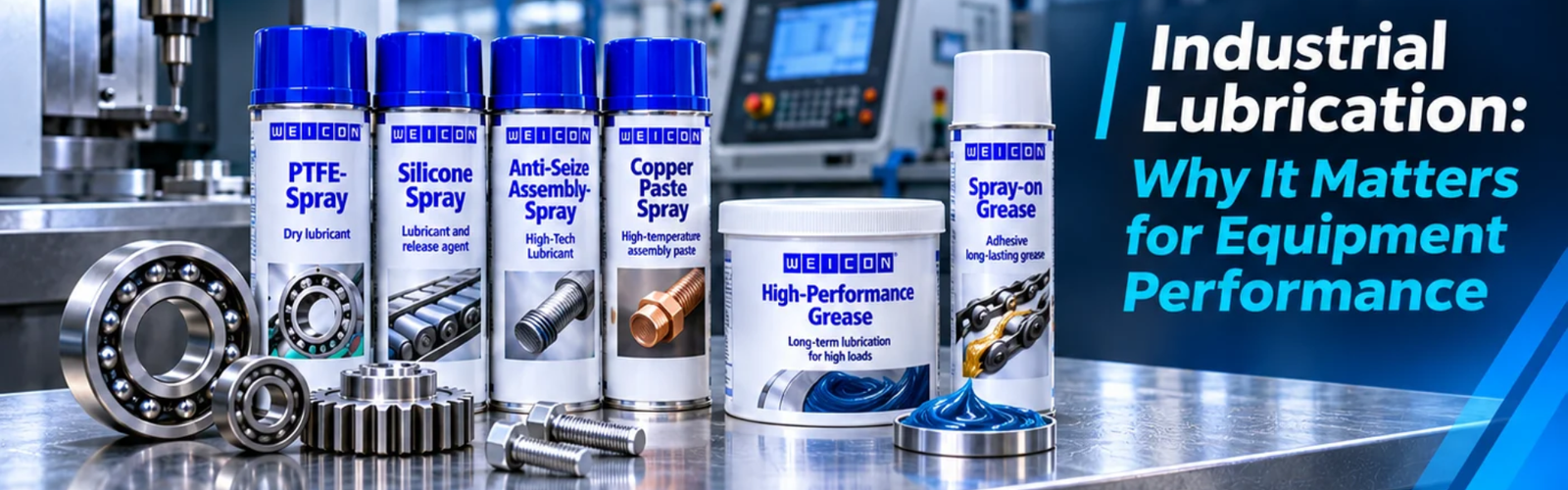
Industrial Lubrication: Why It Matters for Equipment Performance
Admin
|
05 Nov 2026
|
22 min read
|
9 views
Industrial Lubrication: Why It Matters for Equipment Performance
Industrial machinery is made up of moving components that operate under load, speed, temperature and environmental stress.
Bearings rotate.
Gears mesh.
Shafts turn.
Chains move.
Motors operate continuously.
Pumps circulate fluids.
Conveyors transport materials.
Without proper lubrication, the surfaces of these components can experience excessive friction, heat and wear.
Over time, poor lubrication can contribute to:
- Increased friction
- Excessive heat
- Component wear
- Bearing damage
- Gear damage
- Corrosion
- Higher energy consumption
- Unexpected equipment failures
- Increased maintenance requirements
- Production downtime
This is why industrial lubrication is an important part of equipment reliability and preventive maintenance.
Lubrication is not simply a matter of adding grease or oil whenever a machine appears dry.
The correct lubrication strategy considers:
- Equipment design
- Load
- Speed
- Temperature
- Operating environment
- Lubricant type
- Viscosity
- Lubricant quantity
- Application method
- Relubrication interval
- Contamination
- Compatibility
SKF's lubrication training material specifically highlights speed, temperature, load, viscosity, lubricant type, application method, contamination and relubrication as important factors in lubrication management. SKF Media Hub
A well-designed lubrication program can therefore become an important part of a broader maintenance strategy.
What Is Industrial Lubrication?
Industrial lubrication is the controlled application of a suitable lubricant to machinery and mechanical components to reduce friction, control wear and support reliable operation.
Lubricants can also perform additional functions depending on the formulation and application.
These may include:
- Heat transfer
- Corrosion protection
- Contamination removal or suspension
- Sealing
- Noise reduction
- Protection against wear
- Prevention of component seizure
- Improved equipment life
Common industrial lubricants include:
- Lubricating oils
- Greases
- Assembly pastes
- Anti-seize compounds
- Specialised solid lubricants
- Synthetic lubricants
- Mineral-based lubricants
The correct lubricant depends on the application.
A lubricant suitable for a high-speed bearing may not be suitable for a heavily loaded gearbox.
A grease suitable for a moderate-temperature application may not be appropriate for a high-temperature environment.
This is why lubricant selection should be based on the equipment manufacturer's requirements and the actual operating conditions.
Why Is Lubrication Important?
The primary purpose of lubrication is to control friction and wear between surfaces that move relative to one another.
Consider two metal surfaces moving against each other.
Without adequate lubrication, direct surface interaction can increase.
This can result in:
Friction → Heat → Wear → Damage → Failure
With an appropriate lubricant, a lubricating film can separate or partially separate the interacting surfaces.
The result can be reduced friction and wear, depending on the application and lubrication regime.
What Happens Without Proper Lubrication?
Insufficient or incorrect lubrication can create a chain reaction.
For example:
Insufficient lubricant
↓
Increased friction
↓
Higher operating temperature
↓
Lubricant degradation
↓
Increased component wear
↓
Bearing or gear damage
↓
Equipment failure
↓
Unplanned downtime
This is why lubrication should be treated as a planned maintenance activity rather than an emergency response.
SKF identifies lubrication and contamination among the common causes associated with bearing damage. Evolution
Friction in Industrial Equipment
Friction occurs when two surfaces resist relative movement.
In machinery, friction can occur in:
- Bearings
- Gears
- Chains
- Bushes
- Sliding surfaces
- Shafts
- Seals
- Linear guides
- Mechanical joints
Some friction is unavoidable.
The objective of lubrication is not necessarily to eliminate every instance of friction.
Instead, the objective is to control friction and wear at an acceptable level for the application.
How Lubrication Reduces Friction
A lubricant can form a film between interacting surfaces.
Depending on the operating conditions, different lubrication regimes can occur.
These include:
- Boundary lubrication
- Mixed lubrication
- Hydrodynamic lubrication
- Elastohydrodynamic lubrication
The actual lubrication regime depends on factors such as:
- Load
- Speed
- Viscosity
- Surface characteristics
- Temperature
- Lubricant properties
This is one reason why simply choosing a lubricant because it is "thick" or "high performance" is not enough.
The lubricant needs to match the machine and operating conditions.
Industrial Lubrication and Equipment Performance
Proper lubrication can influence several aspects of equipment performance.
These include:
1. Friction
Appropriate lubrication can help control friction between moving surfaces.
2. Wear
Lubrication can reduce direct surface interaction and help protect components.
3. Temperature
Reducing friction can help control heat generation.
4. Reliability
Correct lubrication practices can contribute to more reliable equipment operation.
5. Maintenance
Appropriate lubrication can help reduce premature component wear.
6. Equipment Life
Maintaining suitable lubrication conditions can help extend the service life of components.
Main Types of Industrial Lubricants
Industrial lubrication products can be broadly divided into several categories.
1. Lubricating Oils
Industrial oils are used in applications including:
- Gearboxes
- Hydraulic systems
- Compressors
- Turbines
- Circulation systems
- Bearings
- Chains
- Machine tools
Oil can provide lubrication while also allowing heat to be carried away from certain components.
Oil lubrication systems can include methods such as:
- Oil bath
- Splash lubrication
- Circulating oil
- Spray lubrication
- Ring-oil systems
- Forced lubrication
The correct method depends on the equipment design.
2. Grease
Grease is widely used in industrial equipment.
Grease generally consists of a base oil held within a thickener structure, along with additives where required.
Greases can be used for:
- Bearings
- Bushes
- Chassis components
- Gears in suitable applications
- Joints
- Guides
- Low-to-moderate speed mechanisms
One advantage of grease is that it can remain in place more easily than a low-viscosity oil in certain applications.
However, grease selection and quantity remain important.
What Is NLGI Grade?
Grease consistency is commonly described using an NLGI grade.
NLGI grades indicate the consistency of a grease.
A higher NLGI number generally represents a stiffer grease, while a lower number represents a softer grease.
For example:
NLGI 1
is generally softer than:
NLGI 2
However, NLGI grade alone does not determine whether a grease is suitable.
You also need to consider:
- Base oil
- Thickener
- Operating temperature
- Load
- Speed
- Water exposure
- Chemical exposure
- Compatibility
SKF's lubrication training specifically identifies grease composition, thickener types, compatibility and NLGI consistency as important aspects of grease lubrication. SKF Media Hub
3. Synthetic Lubricants
Synthetic lubricants are formulated using synthetic base fluids and are used where particular performance characteristics are required.
Depending on the formulation, synthetic lubricants can offer advantages for applications involving:
- High temperatures
- Low temperatures
- High loads
- Wide operating temperature ranges
- Long service intervals
- Special environmental conditions
However, synthetic does not automatically mean "better" for every application.
The lubricant still needs to be compatible with the machine and its operating conditions.
4. Mineral-Based Lubricants
Mineral oils are derived from refined petroleum-based base stocks.
They are widely used across industrial applications.
Their suitability depends on:
- Viscosity
- Additive package
- Operating temperature
- Load
- Equipment design
- Manufacturer requirements
5. Assembly Pastes
Assembly pastes are designed for specific applications involving assembly, protection and lubrication.
They can be particularly useful where components are exposed to:
- High loads
- High temperatures
- Corrosion
- Seizure
- Difficult dismantling conditions
WEICON Anti-Seize Ceramic Paste, for example, is described by WEICON as a metal-free, high-performance assembly paste providing release, protection and lubrication at high temperatures and pressures. It is listed for applications including bolts, screws, pipe connections, nuts and mechanical seals. WEICON
This illustrates an important point:
Industrial lubrication is not limited to conventional oils and greases.
Specialised lubrication and assembly products can address particular industrial requirements.
6. Anti-Seize Compounds
Anti-seize products are designed to help prevent components from becoming seized together.
They may be useful for suitable:
- Bolts
- Nuts
- Studs
- Threads
- Flanges
- Pipe connections
- Mechanical assemblies
They can also provide protection against corrosion and wear depending on the formulation.
For example, WEICON Anti-Seize Ceramic Paste is designed for release, protection and lubrication and is suitable for high-temperature and high-pressure applications. WEICON
Lubrication of Bearings
Bearings are among the most important components requiring correct lubrication.
Bearings operate under:
- Load
- Rotation
- Temperature
- Vibration
- Environmental contamination
A suitable lubricant helps control friction and wear between bearing surfaces.
However, more lubricant does not automatically mean better lubrication.
Both insufficient and excessive lubrication can create problems.
Under-Lubrication
Under-lubrication means the bearing does not receive sufficient lubricant for its operating requirements.
Potential consequences include:
- Increased friction
- Increased temperature
- Wear
- Noise
- Vibration
- Premature bearing damage
The correct relubrication interval depends on the bearing, lubricant and operating conditions.
Over-Lubrication
Over-lubrication occurs when excessive lubricant is introduced.
This can be particularly problematic in certain high-speed bearing applications.
Excess grease can create:
- Increased churning
- Heat generation
- Increased resistance
- Lubricant degradation
- Seal problems
Therefore:
Correct quantity matters.
Lubrication should follow the equipment manufacturer's specifications and an appropriate lubrication program.
Lubrication of Gears
Gears operate under combinations of:
- Sliding
- Rolling
- Load
- Speed
- Temperature
Gear lubrication helps control friction and wear at the gear tooth interfaces.
Gearboxes may use:
- Gear oils
- Greases
- Specialised lubricants
depending on the equipment design.
The lubricant must be selected according to the gearbox manufacturer's requirements.
Important factors include:
- Gear type
- Speed
- Load
- Operating temperature
- Lubricant viscosity
- Additives
- Contamination
Why Viscosity Matters
Viscosity describes a fluid's resistance to flow.
It is one of the most important characteristics when selecting an industrial lubricating oil.
SKF specifically highlights viscosity as a fundamental consideration in lubrication selection. SKF Media Hub
If viscosity is too low for the application, the lubricant film may not provide adequate separation under the operating conditions.
If viscosity is too high, the lubricant may increase resistance and generate unnecessary losses in some applications.
Therefore:
Higher viscosity does not automatically mean better protection.
The correct viscosity must be matched to the equipment and operating conditions.
What Determines Lubricant Selection?
Selecting an industrial lubricant requires more than simply looking at the machine name.
Consider the following factors.
1. Load
Heavy loads can require different lubricant characteristics from lightly loaded applications.
2. Speed
High-speed bearings may require different lubrication approaches from slow, heavily loaded mechanisms.
3. Temperature
Temperature affects lubricant viscosity and performance.
Consider:
- Minimum temperature
- Normal operating temperature
- Maximum temperature
- Temperature cycles
4. Environment
Industrial equipment may operate in environments containing:
- Dust
- Water
- Chemicals
- Salt
- Humidity
- High temperatures
- Abrasive particles
The lubricant needs to be suitable for the environment.
5. Contamination
Contamination can significantly affect lubrication performance.
Potential contaminants include:
- Dust
- Dirt
- Metal particles
- Water
- Process chemicals
- Old lubricant
- Incorrect lubricants
SKF notes that contamination can involve solids, water or air, and also highlights cross-contamination from mixing different greases. SKF
6. Component Type
Different components have different lubrication requirements.
Examples include:
- Bearings
- Gears
- Chains
- Bushes
- Hydraulic systems
- Compressors
- Motors
- Pumps
- Linear guides
7. Lubricant Compatibility
Different lubricants should not automatically be mixed.
This is particularly important with greases because different thickener systems may not be compatible.
When changing lubricant type, compatibility should be checked before introducing the new product.
Industrial Lubrication in Mining
Mining equipment often operates under demanding conditions.
Equipment can experience:
- Heavy loads
- Dust
- Moisture
- Vibration
- Abrasive materials
- Long operating periods
- Difficult maintenance access
Equipment requiring lubrication may include:
- Conveyors
- Crushers
- Pumps
- Motors
- Gearboxes
- Bearings
- Fans
- Processing equipment
A structured lubrication program can therefore form an important part of mining equipment maintenance.
The lubricant must be selected according to the individual equipment and operating conditions.
Industrial Lubrication in Manufacturing
Manufacturing facilities may contain hundreds or thousands of lubrication points.
These can include:
- Motors
- Gearboxes
- Bearings
- Conveyor systems
- Pumps
- Compressors
- Machine tools
- Production equipment
If lubrication is inconsistent, equipment reliability can suffer.
A lubrication program can help maintenance teams identify:
- What needs lubrication
- Which lubricant to use
- How much to apply
- When to apply it
- Who is responsible
- What condition the lubricant is in
Industrial Lubrication for Motors
Electric motors commonly contain bearings that require appropriate lubrication.
The correct lubrication requirements depend on:
- Motor design
- Bearing type
- Speed
- Load
- Temperature
- Manufacturer specifications
Not every motor bearing should be lubricated at the same interval.
Some bearings may be sealed or designed for specific maintenance arrangements.
Always follow the motor manufacturer's lubrication instructions.
Industrial Lubrication for Pumps
Industrial pumps can contain components requiring lubrication depending on their design.
Potential lubrication points can include:
- Bearings
- Couplings
- Mechanical components
- Gearboxes
- Seals and associated assemblies where applicable
Pump performance can be affected by:
- Incorrect lubricant
- Contamination
- Insufficient lubrication
- Excessive lubrication
- Incorrect maintenance intervals
A pump lubrication program should therefore be part of the broader maintenance strategy.
Industrial Lubrication for Conveyors
Conveyor systems can have numerous lubrication points.
These may include:
- Bearings
- Chains
- Gearboxes
- Rollers
- Drive components
Conveyor lubrication can be challenging because equipment may operate continuously and may be located in dusty or difficult-to-access environments.
Automatic lubrication systems can be considered for suitable applications where manual lubrication is difficult or inconsistent.
Industrial Lubrication for Gearboxes
Gearboxes are particularly dependent on appropriate lubricant selection.
Gear lubricant selection should consider:
- Gear type
- Speed
- Load
- Temperature
- Operating environment
- Manufacturer specifications
Incorrect lubricant viscosity can affect the lubrication film and operating efficiency.
Contamination can also contribute to wear.
SKF's lubrication-management material provides examples where incorrect lubricant selection and water contamination significantly affected gearbox lubrication conditions. SKF
What Is Lubrication Contamination?
Lubrication contamination occurs when unwanted substances enter the lubricant or lubrication system.
Common contaminants include:
Solid contamination
- Dust
- Dirt
- Sand
- Metal particles
- Wear debris
Liquid contamination
- Water
- Coolant
- Process fluids
- Chemicals
Other contamination
- Air
- Incorrect lubricant
- Other grease
- Cleaning chemicals
Why Water Contamination Is Dangerous
Water can affect lubricants and components in several ways.
SKF notes that water contamination can degrade lubricant performance and, in bearing applications, contribute to reduced viscosity, increased temperature and metal-to-metal contact. Evolution
Water can also contribute to:
- Corrosion
- Lubricant degradation
- Bearing damage
- Reduced equipment reliability
For equipment operating in wet environments, contamination control should therefore be an important part of lubrication management.
Why Dust and Particles Matter
Industrial environments can introduce abrasive particles into machinery.
Examples include:
- Mining dust
- Metal particles
- Dirt
- Sand
- Production debris
Hard particles can damage bearing and other machine surfaces.
SKF research describes how hard contaminant particles can damage bearing surfaces and significantly shorten bearing life. Evolution
This is why lubricant storage, handling, filtration and sealing are important.
Cross-Contamination of Lubricants
Cross-contamination occurs when incompatible or incorrect lubricants are mixed.
For example:
A maintenance technician may accidentally use the wrong grease on a bearing.
This can change the lubricant's characteristics.
Potential consequences depend on the products involved.
Therefore:
Never assume two lubricants are compatible simply because they look similar.
Check:
- Manufacturer documentation
- Grease thickener
- Base oil
- Additive system
- Compatibility information
before mixing products.
Lubrication and Equipment Temperature
Temperature is closely connected with lubrication.
As temperature changes, lubricant properties can change.
High temperatures can contribute to:
- Oxidation
- Lubricant degradation
- Reduced service life
- Changes in viscosity
Low temperatures can increase lubricant viscosity and affect flow.
This is particularly important for:
- Outdoor equipment
- Mining machinery
- Refrigeration equipment
- High-temperature machinery
- Industrial ovens
- Furnaces
- High-speed equipment
Lubrication and Energy Efficiency
Friction requires energy.
When mechanical systems experience unnecessary friction, additional energy can be required to maintain operation.
Appropriate lubrication can help control friction.
However, lubrication should not be viewed as a simple guarantee of energy savings.
Actual energy performance depends on:
- Machine design
- Load
- Speed
- Lubricant properties
- Temperature
- Alignment
- Component condition
- Maintenance
Correct lubrication is one part of an overall equipment-efficiency strategy.
Lubrication and Preventive Maintenance
Lubrication is one of the most important activities that can be incorporated into preventive maintenance.
A preventive lubrication program should identify:
What?
Which component requires lubrication?
Which?
Which lubricant should be used?
How much?
What quantity is required?
When?
What is the appropriate interval?
How?
What application method should be used?
Who?
Who is responsible for the task?
What condition?
Does the lubricant show signs of contamination or degradation?
Lubrication Schedule
A lubrication schedule should be based on:
- Equipment manufacturer's recommendations
- Operating conditions
- Lubricant type
- Component type
- Load
- Speed
- Temperature
- Environmental conditions
- Previous maintenance history
A basic lubrication register can include:
| Equipment | Component | Lubricant | Quantity | Interval | Method |
| Motor | Bearing | Specified grease | As specified | As specified | Grease gun |
| Gearbox | Gears | Specified gear oil | As specified | As specified | Oil fill |
| Conveyor | Bearings | Specified grease | As specified | As specified | Manual/automatic |
| Pump | Bearing | Specified lubricant | As specified | As specified | Manufacturer method |
The actual lubricant and quantities should always be taken from the equipment manufacturer's technical documentation.
Manual vs Automatic Lubrication
There are two common approaches to lubricant application.
Manual Lubrication
A technician applies lubricant manually.
Advantages can include:
- Simple implementation
- Low equipment cost
- Flexible for small systems
Potential disadvantages include:
- Human error
- Incorrect quantity
- Missed lubrication points
- Inconsistent intervals
Automatic Lubrication
Automatic lubrication systems deliver controlled amounts of lubricant according to a programmed or predetermined schedule.
Potential advantages include:
- Consistent lubrication
- Reduced manual intervention
- Better access to difficult locations
- Controlled lubricant quantities
They can be particularly useful for suitable equipment with:
- Numerous lubrication points
- Difficult access
- Continuous operation
- High maintenance requirements
However, automatic systems still require inspection and maintenance.
Automation does not eliminate the need for lubrication management.
How Often Should Industrial Equipment Be Lubricated?
There is no single lubrication interval that applies to every machine.
The correct interval depends on:
- Component
- Lubricant
- Load
- Speed
- Temperature
- Environment
- Manufacturer recommendations
- Operating hours
For example, a bearing operating at high speed and high temperature may have very different lubrication requirements from a slow-moving bearing operating in a clean environment.
Therefore:
Do not create a universal lubrication interval for an entire plant.
Develop equipment-specific requirements.
Signs of Poor Lubrication
Maintenance teams should look for warning signs such as:
- Unusual noise
- Increased vibration
- Excessive temperature
- Grease leakage
- Oil leakage
- Discoloured lubricant
- Contaminated lubricant
- Increased component wear
- Repeated bearing failures
- Gear damage
- Unexpected equipment downtime
These symptoms do not automatically prove a lubrication problem.
However, they can indicate that further investigation is required.
Lubricant Condition Monitoring
Lubricant condition can provide useful information about equipment health.
Depending on the application, monitoring can include:
- Visual inspection
- Viscosity testing
- Particle analysis
- Water contamination testing
- Wear debris analysis
- Oil analysis
- Temperature monitoring
Oil analysis can sometimes identify:
- Wear particles
- Contamination
- Lubricant degradation
- Incorrect viscosity
- Water contamination
This can support predictive maintenance programs.
Lubrication and Predictive Maintenance
Modern maintenance strategies increasingly combine lubrication management with condition monitoring.
For example:
Lubrication Management
Vibration Monitoring
Temperature Monitoring
Oil Analysis
Inspection
can provide a broader picture of equipment condition.
Instead of waiting for a bearing to fail, maintenance teams can monitor changes in equipment behaviour and investigate potential problems earlier.
Common Industrial Lubrication Mistakes
Mistake 1 — Using the Wrong Lubricant
A lubricant that works in one machine may not be suitable for another.
Always check manufacturer requirements.
Mistake 2 — Using Too Much Lubricant
More lubricant does not automatically mean better lubrication.
Excessive grease can create heat and resistance in suitable applications.
Mistake 3 — Using Too Little Lubricant
Insufficient lubrication can increase friction, temperature and wear.
Mistake 4 — Mixing Lubricants
Different oils or greases may not be compatible.
Check before mixing.
Mistake 5 — Ignoring Contamination
Dirty grease guns, open containers and contaminated tools can introduce unwanted material into the lubrication system.
SKF specifically identifies open reservoirs, open grease containers and improvised tools as potential sources of contamination. SKF
Mistake 6 — Ignoring Temperature
Lubricants must be suitable for the actual operating temperature.
Mistake 7 — Ignoring Speed
High-speed applications can have very different lubrication requirements from slow, heavily loaded applications.
Mistake 8 — Using the Same Lubricant Everywhere
A plant may have many different lubrication requirements.
Standardising lubricants can sometimes simplify inventory, but only when compatibility and equipment requirements allow it.
Mistake 9 — Poor Lubricant Storage
Lubricants should be stored according to manufacturer recommendations and protected from:
- Water
- Dust
- Excessive heat
- Contamination
- Incorrect handling
Mistake 10 — No Lubrication Documentation
If nobody knows:
- What lubricant to use
- Where to use it
- How much to apply
- When to apply it
then the lubrication program can become inconsistent.
Industrial Lubrication Storage
Proper storage is an important part of lubrication management.
Keep lubricant containers:
- Clearly labelled
- Closed when not in use
- Protected from contamination
- Stored appropriately for the product
- Separated where compatibility is a concern
Grease guns and application equipment should also be kept clean.
Using a contaminated grease gun can introduce contaminants into a bearing.
Industrial Lubrication and Equipment Downtime
Unexpected equipment failures can interrupt production.
A failed bearing can stop:
- Conveyor systems
- Pumps
- Motors
- Fans
- Production lines
- Processing equipment
The cost of the failure may include:
Replacement component
Labour
Emergency maintenance
Production downtime
Lost productivity
Potential secondary damage
This is why lubrication should be considered in terms of equipment reliability, not simply lubricant consumption.
Lubrication vs Maintenance
Lubrication should not be considered separately from the overall maintenance strategy.
A comprehensive maintenance program can include:
- Lubrication
- Inspection
- Cleaning
- Alignment
- Vibration monitoring
- Temperature monitoring
- Oil analysis
- Component replacement
- Condition monitoring
A well-lubricated machine can still fail because of:
- Misalignment
- Overload
- Contamination
- Electrical problems
- Incorrect installation
- Component defects
Lubrication is therefore one important part of equipment reliability, not the only factor.
Industrial Lubrication in Harsh Environments
Some industries operate under particularly demanding conditions.
Mining
Potential challenges include:
- Dust
- Abrasion
- Heavy loads
- Vibration
- Moisture
Marine
Potential challenges include:
- Salt water
- Humidity
- Corrosion
- Temperature variation
Manufacturing
Potential challenges include:
- Continuous operation
- High production cycles
- Metal particles
- Heat
- Coolants
Chemical Processing
Potential challenges include:
- Chemical exposure
- Elevated temperatures
- Process fluids
Each environment can require a different lubrication strategy.
Specialised Industrial Lubrication Products
Some industrial applications require more than conventional lubricating oil or grease.
Specialised products can include:
- Anti-seize pastes
- High-temperature pastes
- Ceramic assembly pastes
- Specialised greases
- Chain lubricants
- Technical sprays
- Dry lubricants
- Food-compatible lubricants where specifically approved
WEICON's industrial portfolio includes high-performance assembly pastes and lubricants intended for industrial production, repair, maintenance and servicing applications. WEICON
For example, WEICON Anti-Seize Ceramic Paste is designed to provide release, protection and lubrication under high-temperature and high-pressure conditions and is listed for industrial environments including chemical plants, oil refineries, power stations, steelworks, foundries and shipping. WEICON
Industrial Lubrication for High-Temperature Applications
High-temperature environments require careful lubricant selection.
Potential applications include:
- Furnaces
- Ovens
- Industrial heaters
- Exhaust systems
- Hot machinery
- High-temperature bearings
- Manufacturing equipment
Important considerations include:
- Continuous temperature
- Peak temperature
- Load
- Speed
- Exposure duration
- Lubricant stability
- Reapplication requirements
A lubricant's maximum temperature rating should never be considered in isolation.
The complete application needs to be evaluated.
Industrial Lubrication for Corrosion Protection
Some lubrication and assembly products can also provide corrosion protection.
This can be valuable for equipment exposed to:
- Moisture
- Humidity
- Salt
- Chemicals
- Outdoor environments
WEICON's Anti-Seize Ceramic Paste, for example, is described as providing protection against corrosion, wear and extreme weather conditions in addition to lubrication and release properties. WEICON
How to Build an Industrial Lubrication Program
A structured lubrication program can be developed in several stages.
Step 1 — Identify All Lubrication Points
Create a complete equipment register.
Identify:
- Bearings
- Gearboxes
- Motors
- Pumps
- Chains
- Bushes
- Other lubrication points
Step 2 — Identify the Correct Lubricant
Record the manufacturer's specified:
- Lubricant
- Viscosity
- Grade
- Quantity
- Application method
Step 3 — Establish Lubrication Intervals
Create equipment-specific intervals based on:
- Manufacturer recommendations
- Operating conditions
- Experience
- Condition monitoring
Step 4 — Standardise Where Appropriate
Where technically suitable, reduce unnecessary lubricant variety.
This can simplify:
- Inventory
- Storage
- Training
- Purchasing
- Maintenance
However, standardisation should never override equipment requirements.
Step 5 — Label Lubrication Points
Use clear identification systems.
For example:
LUBE-001
Grease: Product X
Quantity: As specified
Interval: As specified
Step 6 — Train Maintenance Personnel
Maintenance personnel should understand:
- Correct lubricant
- Correct quantity
- Application method
- Contamination control
- Storage
- Safety requirements
Step 7 — Track Lubrication
Record:
- Date
- Equipment
- Lubricant
- Quantity
- Technician
- Observations
Step 8 — Monitor Results
Track:
- Bearing failures
- Lubricant consumption
- Equipment temperature
- Vibration
- Downtime
- Maintenance costs
The objective is continuous improvement.
Industrial Lubrication Checklist
Before lubricating a machine, ask:
Equipment
What component am I lubricating?
Lubricant
What exact lubricant is specified?
Quantity
How much should be applied?
Temperature
What temperature does the component operate at?
Speed
What is the operating speed?
Load
What load does the component experience?
Environment
Is the machine exposed to:
- Water?
- Dust?
- Chemicals?
- Salt?
- Heat?
Contamination
Is the lubricant clean?
Compatibility
Is the lubricant compatible with the existing lubricant?
Application
Am I using the correct application method?
Documentation
Has the lubrication activity been recorded?
Industrial Lubrication Selection Table
| Application | Lubrication Approach to Consider |
| Rolling bearings | Application-specific grease or oil |
| Gearboxes | Manufacturer-specified gear lubricant |
| Chains | Suitable chain lubricant |
| High-temperature assemblies | High-temperature lubricant or assembly paste |
| Threaded assemblies | Suitable anti-seize/assembly compound |
| Hydraulic systems | Manufacturer-specified hydraulic fluid |
| Compressors | Compressor-specific lubricant |
| Pumps | Application-specific lubricant |
| Linear guides | Manufacturer-specified grease or oil |
| Heavy-load assemblies | Suitable high-load lubricant |
| Wet environments | Lubricant suitable for water/environmental exposure |
| Specialised industrial environments | Application-specific lubricant |
This table is a starting point only.
The correct lubricant should always be selected using the equipment manufacturer's documentation and the lubricant manufacturer's technical information.
How to Choose the Right Industrial Lubricant
A practical selection process can be:
Equipment → Component → Load → Speed → Temperature → Environment → Lubricant → Quantity → Application Method → Interval
For example:
Equipment
Industrial conveyor.
Component
Drive gearbox.
Load
High.
Speed
Continuous operation.
Temperature
Elevated operating temperature.
Environment
Dusty industrial environment.
Lubricant
Select the gearbox manufacturer's specified lubricant matching these conditions.
Application
Fill according to the manufacturer's specified level and procedure.
Monitoring
Inspect temperature, leakage, noise and vibration.
This approach is much more reliable than simply selecting a lubricant based on price or general-purpose marketing claims.
Industrial Lubrication and Sustainability
Effective lubrication management can also support resource efficiency.
Potential benefits include:
- Reduced lubricant waste
- Longer component life
- Fewer premature replacements
- Reduced maintenance waste
- Better equipment efficiency
- Lower unnecessary consumption
However, sustainability should not be used as a reason to extend lubrication intervals beyond what the equipment or lubricant manufacturer recommends.
Reliability and environmental considerations need to be balanced.
Frequently Asked Questions
What is industrial lubrication?
Industrial lubrication is the controlled use of oils, greases, pastes and other lubricating products to reduce friction, control wear and support reliable operation of industrial equipment.
Why is lubrication important for machinery?
Correct lubrication can help control friction, wear and heat generation while supporting equipment reliability and component life.
What are the main types of industrial lubricants?
Common types include lubricating oils, greases, synthetic lubricants, mineral-based lubricants, assembly pastes, anti-seize compounds and specialised lubricants.
What happens if a machine is not lubricated?
Insufficient lubrication can increase friction and wear and may contribute to higher temperatures, component damage and premature equipment failure.
Can you over-lubricate a bearing?
Yes. Excessive lubrication can create heat, churning and other problems in suitable applications. Always follow the manufacturer's specified quantity.
Can you use any grease on an industrial bearing?
No. Grease selection depends on factors such as bearing design, load, speed, temperature, environment and compatibility.
What is lubricant viscosity?
Viscosity is a measure of a fluid's resistance to flow. It is an important factor when selecting lubricating oils.
What is NLGI grease grade?
NLGI grade describes grease consistency. It is one consideration in grease selection, but it does not by itself determine whether a grease is suitable for an application.
Can different greases be mixed?
Do not assume different greases are compatible. Compatibility should be checked using manufacturer information before mixing.
How does water affect industrial lubricant?
Water can degrade lubricant performance and contribute to corrosion and component damage. SKF notes that water contamination can reduce lubricant viscosity in bearing applications and contribute to increased temperature and metal-to-metal contact. Evolution
How does contamination affect lubrication?
Contaminants such as dust, metal particles and water can degrade lubricant performance and damage machine surfaces.
How often should industrial equipment be lubricated?
There is no universal interval. The correct interval depends on the equipment, component, lubricant, load, speed, temperature, environment and manufacturer recommendations.
What is preventive lubrication?
Preventive lubrication is the planned application of the correct lubricant at appropriate intervals to help maintain equipment performance and reduce the risk of lubrication-related failures.
What is automatic lubrication?
Automatic lubrication uses a system to deliver controlled quantities of lubricant at predetermined intervals or according to a defined lubrication strategy.
What is anti-seize paste?
Anti-seize paste is a specialised assembly compound used on suitable components to help prevent seizure, facilitate future disassembly and provide protection and lubrication. Product suitability depends on the application.
Can lubrication reduce equipment downtime?
Correct lubrication can contribute to equipment reliability and help reduce lubrication-related failures. However, downtime is affected by many factors beyond lubrication.
Is synthetic lubricant always better?
No. Synthetic lubricants can offer specific advantages in certain operating conditions, but the correct lubricant depends on the equipment and application.
What is the difference between oil and grease?
Oil is a fluid lubricant, while grease generally consists of a base oil held within a thickener structure. The choice depends on equipment design and operating requirements.
What is lubricant contamination?
Lubricant contamination occurs when unwanted substances such as water, dust, metal particles, chemicals or incorrect lubricants enter the lubrication system.
How can I improve my plant's lubrication program?
Start by identifying every lubrication point, documenting the correct lubricant and quantity, establishing appropriate intervals, controlling contamination, training maintenance personnel and recording lubrication activities.
Conclusion
Industrial lubrication is much more than simply adding grease or oil to a machine.
It is a structured part of equipment maintenance and reliability.
The correct lubrication strategy considers:
Equipment + Component + Load + Speed + Temperature + Environment + Lubricant + Quantity + Application Method + Interval
When these factors are properly considered, lubrication can help control friction and wear and support reliable equipment operation.
Poor lubrication, on the other hand, can contribute to:
- Increased friction
- Excessive heat
- Wear
- Contamination
- Bearing damage
- Gear damage
- Equipment failures
- Maintenance costs
- Unplanned downtime
The key is not simply more lubrication.
The goal is:
The right lubricant, in the right quantity, applied at the right location, at the right time, using the right method.
For Australian manufacturers, mining operations, maintenance teams, machine builders and industrial businesses, selecting the right industrial lubrication products should always begin with understanding the equipment and its operating conditions.
LECA can assist businesses in identifying suitable industrial maintenance, lubrication and equipment solutions for their specific applications.
Need help choosing the right industrial lubrication solution?
Explore Industrial Maintenance & Automation Products
Request a Quote
Talk to a LECA Technical Expert
Explore Industrial Automation Products