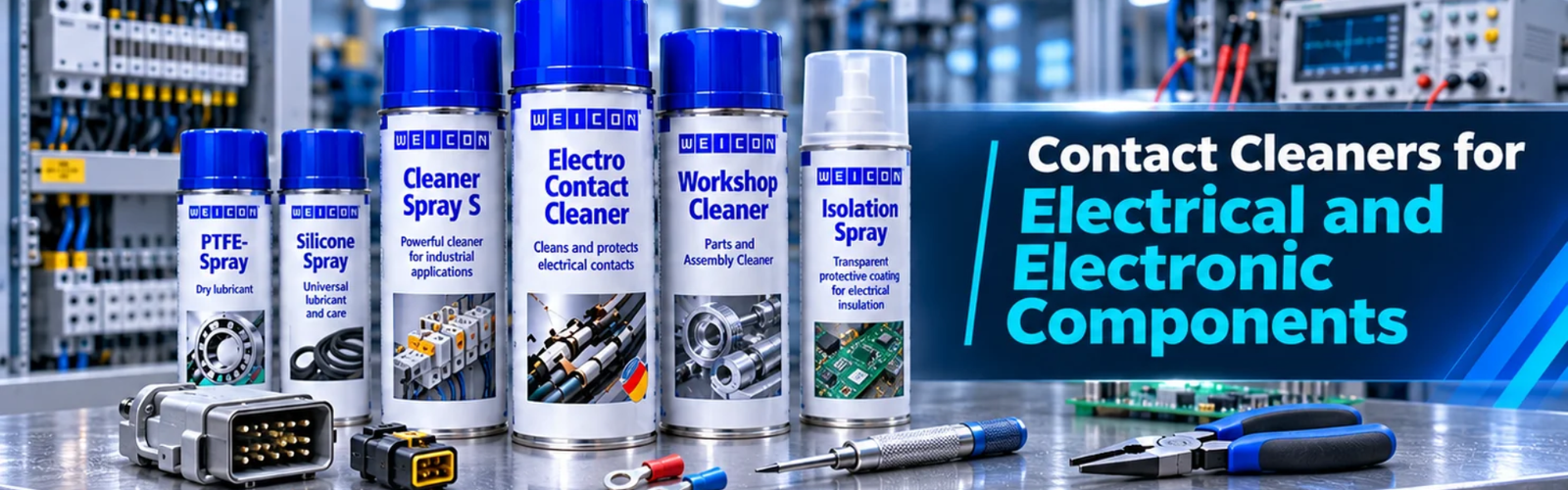
Contact Cleaners for Electrical and Electronic Components: How They Work, Where to Use Them and How to Choose the Right Product
Admin
|
06 Nov 2026
|
29 min read
|
5 views
Contact Cleaners for Electrical and Electronic Components: How They Work, Where to Use Them and How to Choose the Right Product
Electrical and electronic systems depend on something that is often taken for granted: clean, reliable electrical contact.
A connector may look perfectly normal from the outside while contamination, oxidation, dust, moisture, oil, grease, flux residues or other deposits are affecting the contact surfaces inside.
The result can be surprisingly difficult to diagnose.
A machine may:
- Start intermittently
- Lose a signal
- Produce unstable readings
- Experience voltage drops
- Show communication errors
- Trigger sensor faults
- Develop intermittent control problems
- Experience relay or switch failure
- Stop unexpectedly
In many cases, the problem is not the electronic component itself. It may simply be contamination at the electrical contact interface.
This is where electrical contact cleaners become an important maintenance solution.
Contact cleaners are specialised cleaning products designed to remove contaminants from electrical and electronic contacts and components. Depending on the formulation, they can be designed to evaporate rapidly, leave little or no residue, be non-conductive, and be compatible with sensitive materials. CRC, for example, describes its QD Electronic Cleaner as a fast-evaporating, residue-free cleaner for sensitive electronics and lists applications including connectors, terminals, pins, fuse blocks, wires and various sensors. CRC Industries
But choosing and using contact cleaner correctly requires more than simply spraying a can onto an electrical component.
The cleaner must be appropriate for:
- The electrical system
- The component
- The contamination
- The material
- The plastic or polymer
- The required evaporation characteristics
- The operating environment
- The safety requirements
This guide explains what electrical contact cleaners are, how they work, where they should be used, how to choose the right product, common mistakes, and best practices for industrial maintenance.
1. What Is an Electrical Contact Cleaner?
An electrical contact cleaner is a specialised cleaning formulation designed to remove contaminants from electrical contacts and electronic components.
Depending on the formulation, a contact cleaner may be designed to remove:
- Dust
- Dirt
- Oil
- Grease
- Flux residues
- Fingerprints
- Oxidation-related contamination
- Moisture
- Other deposits
The objective is to restore a cleaner contact surface without leaving an unwanted conductive or insulating residue.
Typical applications include:
- Electrical connectors
- Switches
- Relays
- Terminals
- Circuit boards
- Sensors
- Plugs
- Sockets
- Fuse blocks
- Control equipment
- Electronic modules
- Electrical panels
- Communication connectors
CRC describes electronic contact cleaners as precision cleaners designed to remove contaminants from sensitive electronic components and contacts, with certain formulations designed to evaporate rapidly and leave no residue. CRC Industries
2. Why Clean Electrical Contacts Matter
Electrical current and signals depend on reliable contact between conductive surfaces.
A connector may contain two or more conductive surfaces that need to make consistent contact.
When contaminants accumulate between them, the contact interface can be affected.
Possible consequences include:
- Increased contact resistance
- Intermittent electrical signals
- Voltage drops
- Heating
- Signal instability
- Communication errors
- Component malfunction
- Unexpected equipment shutdown
The problem can become particularly difficult when the failure is intermittent.
For example:
Machine works → vibration occurs → connection changes → sensor signal drops → machine stops → connection returns → machine appears normal again
This can make troubleshooting difficult.
Cleaning the appropriate contact surfaces can therefore be an important part of electrical maintenance.
3. What Causes Electrical Contacts to Become Dirty?
Electrical contacts can become contaminated for many reasons.
3.1 Dust
Industrial environments can contain significant amounts of airborne particulate matter.
Common sources include:
- Manufacturing processes
- Mining
- Cement
- Construction
- Packaging
- Wood processing
- Material handling
Dust can accumulate around:
- Connectors
- Relays
- Control panels
- Sensors
- Switches
- Electrical cabinets
4. Oil and Grease Contamination
Industrial machinery often operates around lubricants.
A connector may become contaminated through:
- Lubricant leaks
- Maintenance activities
- Hydraulic-fluid exposure
- Grease application
- Oil mist
- Improper handling
Oil films can interfere with contact surfaces depending on the component and electrical application.
This is why using the correct electrical cleaner is important.
5. Flux Residues
Flux is commonly associated with soldering and electronic assembly.
Residual flux can remain on circuit boards or electrical connections if cleaning is not completed properly.
Depending on the flux chemistry, residues can contribute to:
- Contamination
- Corrosion
- Leakage paths
- Reliability problems
Electronic cleaners may be used for appropriate flux-removal applications, but the exact cleaner should be selected according to the flux type and component materials.
CRC, for example, lists flux removal among applications for some of its electronic-cleaning formulations. CRC Industries
6. Moisture and Humidity
Water is another major concern.
Moisture can contribute to:
- Corrosion
- Oxidation
- Electrical leakage
- Contact degradation
- Connector problems
Industrial equipment operating outdoors or in humid environments can be particularly vulnerable.
Examples include:
- Mining machinery
- Agricultural equipment
- Marine equipment
- Outdoor control systems
- Pumps
- Construction machinery
A suitable contact cleaner may help remove contaminants, but it should not be viewed as a replacement for proper sealing and environmental protection.
7. Oxidation and Corrosion
Metal electrical contacts can oxidise or corrode over time.
The exact behaviour depends on:
- Metal type
- Environment
- Humidity
- Temperature
- Contamination
- Electrical conditions
A contaminated or oxidised contact may exhibit increased resistance or intermittent operation.
Contact cleaning can help remove deposits, but heavily damaged or severely corroded contacts may need replacement rather than repeated cleaning.
8. How Does Contact Cleaner Work?
A typical contact-cleaning process involves several functions.
Step 1 — Wetting
The cleaner reaches the contaminated surface.
Step 2 — Dissolution
The solvent system dissolves or loosens suitable contaminants.
Step 3 — Physical removal
The contamination is carried away as the cleaner runs or evaporates.
Step 4 — Evaporation
A suitable electronic contact cleaner may evaporate rapidly, leaving little or no residue.
Step 5 — Restored contact surface
The conductive surfaces are left cleaner and ready for further operation.
CRC describes its QD electronic cleaner as a hydrocarbon/alcohol-based precision cleaner that removes contaminants from sensitive electronic components and evaporates without leaving residue. CRC Industries
9. Why Residue-Free Cleaning Is Important
This is one of the most important characteristics of an electrical contact cleaner.
After cleaning an electrical contact, you generally do not want a heavy film remaining on the contact surface.
Unwanted residue can:
- Attract dust
- Alter contact behaviour
- Affect electrical performance
- Interfere with moving contacts
- Contaminate sensitive components
For this reason, many electronic contact cleaners are formulated to evaporate quickly and leave little or no residue.
CRC's QD Electronic Cleaner specifically states that it leaves no residue and evaporates quickly. CRC Industries
10. Contact Cleaner Is Not the Same as Electrical Lubricant
This distinction is extremely important.
A contact cleaner is primarily designed to clean.
A contact lubricant/protectant may be designed to leave a controlled protective or lubricating film.
These products should not automatically be substituted for one another.
Contact cleaner
Generally focuses on:
- Cleaning
- Contaminant removal
- Rapid evaporation
- Low/no residue
Contact lubricant/protectant
May focus on:
- Lubrication
- Corrosion protection
- Protection against environmental exposure
- Maintaining moving electrical contact surfaces
Some products combine cleaning and protection, but you must follow the manufacturer's intended application.
CRC, for example, separately markets QD Contact Cleaner and Contact Cleaner & Protectant products with different performance characteristics. CRC Industries
11. Where Are Contact Cleaners Used?
Electrical contact cleaners can be used in many industries.
Common applications include:
- Industrial control panels
- Electrical connectors
- Sensors
- Relays
- Switches
- Terminals
- PLC systems
- Electronic modules
- Instrumentation
- Motor controls
- Automotive electronics
- Communication equipment
- Control cabinets
- Circuit boards
The exact application depends on the product's technical specifications.
12. Cleaning Electrical Connectors
Connectors are among the most common applications.
Industrial connectors can be exposed to:
- Dust
- Moisture
- Oil
- Corrosion
- Vibration
- Repeated connection/disconnection
A contaminated connector can create intermittent electrical problems.
A suitable contact cleaner can help remove contamination from:
- Pins
- Sockets
- Terminals
- Connector interfaces
CRC specifically identifies connectors, terminals and pins among electronic-cleaner applications. CRC Industries
13. Contact Cleaners for Switches
Switches can develop problems due to:
- Dust
- Oxidation
- Contamination
- Environmental exposure
- Repeated operation
Examples include:
- Push buttons
- Toggle switches
- Rotary switches
- Selector switches
- Limit switches
- Control switches
The cleaner must be compatible with the switch's internal materials.
Some switches may contain lubricated mechanisms, so aggressive solvent cleaning may remove lubrication that is intentionally present.
Therefore, always check the manufacturer's recommendations before spraying into a switch assembly.
14. Contact Cleaners for Relays
Industrial relays contain electrical contacts that repeatedly open and close.
Over time, problems can develop from:
- Contact contamination
- Arcing-related deposits
- Dust
- Oxidation
- Mechanical wear
Contact cleaner may be useful for appropriate relay maintenance, particularly where the product is specifically approved for the relay construction.
CRC lists relays among applications for its non-flammable contact-cleaner formulation. CRC Industries
However, heavily worn or damaged relay contacts should not simply be cleaned indefinitely.
If the contacts are physically damaged, replacement may be the correct solution.
15. Contact Cleaners for Circuit Boards
Printed circuit boards, or PCBs, can accumulate:
- Dust
- Flux residues
- Oil contamination
- Fingerprints
- Other deposits
A suitable electronics cleaner can be used where the product is approved for the PCB and its components.
The key requirement is material compatibility.
A cleaner that works well on metal contacts may not be suitable for:
- Plastic housings
- Coatings
- Adhesives
- Elastomers
- Certain PCB components
CRC lists printed circuit boards among applications for one of its non-flammable contact-cleaner products. CRC Industries
16. Contact Cleaners for Sensors
Sensors are increasingly important in industrial automation.
Examples include:
- Proximity sensors
- Photoelectric sensors
- Pressure sensors
- Temperature sensors
- Position sensors
- Encoders
- Industrial instrumentation
Contamination can affect the sensor connection or, depending on sensor type, its sensing surface.
Contact cleaner can be appropriate for electrical connectors and terminals where the cleaner is approved.
However:
Do not assume that every sensor's sensing element should be sprayed with contact cleaner.
The manufacturer's cleaning instructions should always take priority.
CRC, for example, specifically lists certain sensors but excludes mass-air-flow sensors from one of its electronic-cleaner applications. CRC Industries
17. Contact Cleaners for PLC Systems
Programmable Logic Controllers (PLCs) are central to many industrial automation systems.
A PLC installation may contain:
- CPU modules
- I/O modules
- Terminal blocks
- Communication ports
- Connectors
- Power connections
- Sensor wiring
Contamination or poor connections can cause:
- I/O faults
- Communication problems
- Intermittent signals
- Unexpected alarms
- Machine stoppages
Contact cleaner can be useful for appropriate connectors and contacts during maintenance.
However, cleaning should be performed only under the correct electrical isolation and maintenance procedure.
18. Contact Cleaners for Control Panels
Industrial control panels can contain:
- Contactors
- Relays
- PLCs
- Terminal blocks
- Circuit breakers
- Fuses
- Power supplies
- Communication devices
- Sensors
- HMI equipment
A dirty control panel may experience both electrical and thermal problems.
Dust accumulation can interfere with:
- Cooling
- Electrical connections
- Component operation
Contact cleaner may help with appropriate electrical contacts, but it should not be treated as a substitute for:
- Panel cleaning
- Filtration
- Ventilation
- Sealing
- Proper enclosure maintenance
19. Contact Cleaners in Mining
Mining environments can be particularly challenging for electrical systems.
Equipment may experience:
- Fine dust
- Moisture
- Mud
- Vibration
- Temperature changes
- Oil contamination
- Heavy mechanical movement
Electrical systems can include:
- Sensors
- Connectors
- Control modules
- Motors
- Switches
- Instrumentation
- Communication equipment
Regular inspection and appropriate cleaning can form part of a broader electrical-maintenance program.
However, the root cause of contamination should also be addressed.
For example:
Dirty connector
→ Clean connector
But also ask:
Why did the connector become contaminated?
Possible answers:
- Failed seal
- Damaged enclosure
- Incorrect cable gland
- Poor connector design
- Environmental exposure
Fixing the underlying problem is often more valuable than repeatedly cleaning the same connector.
20. Contact Cleaners in Manufacturing
Manufacturing plants can have hundreds or thousands of electrical connection points.
Examples include:
- Production machinery
- PLC cabinets
- Robotics
- Sensors
- Conveyors
- Motors
- Drives
- Control panels
- Vision systems
A single intermittent connector can stop an entire production line.
Electrical contact cleaning can therefore become part of:
- Preventive maintenance
- Corrective maintenance
- Shutdown maintenance
- Troubleshooting
- Equipment refurbishment
21. Contact Cleaners in Automotive Electrical Systems
Modern vehicles contain increasingly large numbers of electronic components.
Contact cleaners may be used on appropriate:
- Connectors
- Terminals
- Pins
- Fuse blocks
- Wiring connections
- Modules
CRC specifically identifies automotive connectors, terminals, pins, fuse blocks, wires and certain sensors as applications for its electronic cleaner. CRC Industries
However, automotive systems can contain sensitive plastics, coatings and sensors, so the exact product must be checked before use.
22. Choosing the Right Contact Cleaner
Not every contact cleaner is suitable for every application.
When selecting a product, consider:
1. Electrical properties
Look for relevant information such as:
- Non-conductivity
- Dielectric strength
- Residue characteristics
2. Evaporation rate
Fast evaporation can be desirable where rapid return to service is important.
3. Residue
For many electronic applications, a residue-free formulation is preferred.
4. Material compatibility
Check compatibility with:
- Plastics
- Rubber
- Elastomers
- Coatings
- Adhesives
- PCB materials
5. Cleaning strength
Different contaminants require different solvent systems.
6. Flammability
This is critical in industrial environments.
7. Environmental requirements
Consider:
- VOC requirements
- Workplace regulations
- Ozone-depleting substances
- Waste handling
8. Application method
Choose between:
- Aerosol
- Bulk liquid
- Precision nozzle
- Brush application
- Swab
- Lint-free cloth
23. Plastic Compatibility Is Critical
One of the biggest mistakes when choosing an electronic cleaner is assuming:
"If it is safe for electronics, it must be safe for all plastics."
That is not necessarily true.
Different contact cleaners use different solvents.
Different plastics can react differently to those solvents.
Potential problems can include:
- Cracking
- Softening
- Swelling
- Discoloration
- Surface damage
- Loss of mechanical strength
CRC illustrates why product-specific compatibility matters: some of its contact-cleaner products are labelled plastic-safe, while another electronic component cleaner is specifically listed as not suitable for polycarbonate plastics. CRC Industries
Therefore:
Always check the exact product's material compatibility rather than relying on the generic term "contact cleaner."
24. What Does "Plastic Safe" Actually Mean?
"Plastic safe" is a product-specific claim.
It does not mean:
"Safe for every plastic ever manufactured."
It means the manufacturer has designed or tested that particular formulation for specified materials or applications.
Before widespread use:
- Identify the plastic.
- Check the product technical data.
- Check the SDS.
- Review manufacturer compatibility information.
- Test on an inconspicuous area where appropriate.
This is especially important for expensive electronic equipment.
25. Residue-Free vs Protective Contact Cleaners
There are two broad approaches.
Residue-free cleaner
Designed to:
- Dissolve contaminants
- Evaporate rapidly
- Leave minimal/no residue
Best suited to many:
- Connectors
- Circuit boards
- Sensors
- Switches
- Electronic assemblies
Cleaner + protectant
Designed to:
- Clean
- Provide some lubrication
- Leave a protective film
- Reduce corrosion
Useful where the application specifically calls for protection.
Do not assume that one is better.
The correct choice depends on the application.
26. Dry Contact Cleaner vs Lubricated Contact Cleaner
A dry contact cleaner is typically intended to clean without leaving a significant lubricating film.
A lubricated contact product may deliberately leave a film.
This distinction matters for moving electrical contacts.
For example, a rotary switch may have internal mechanical surfaces that require lubrication.
Using an aggressive residue-free solvent may remove that lubricant.
In such cases, the manufacturer's maintenance specification should be followed.
27. Isopropyl Alcohol vs Contact Cleaner
Isopropyl alcohol, or IPA, is widely used for electronics cleaning.
It can be useful for:
- General electronics cleaning
- PCB cleaning
- Removing some oils
- Removing fingerprints
- Removing flux residues depending on chemistry
However, IPA is not identical to every specialised contact cleaner.
A contact cleaner may be formulated for:
- Faster evaporation
- Specific material compatibility
- Better contaminant removal
- Electrical applications
- Residue-free cleaning
- Particular component types
The right choice depends on the contamination and component.
28. Contact Cleaner vs Electrical Cleaner
The terms are often used interchangeably in the industrial market.
However, product formulations can differ considerably.
Always focus on the technical specification and intended application, rather than the name printed on the front of the can.
Look for:
- Electrical properties
- Plastic compatibility
- Evaporation
- Residue
- Flammability
- Application instructions
29. Contact Cleaner vs Brake Cleaner
This is an extremely important distinction.
Do not assume that brake cleaner can replace electronic contact cleaner.
Brake cleaners are generally designed around heavy-duty cleaning of mechanical components and brake assemblies.
Electronic components may contain:
- Sensitive plastics
- Insulation
- Coatings
- Seals
- Adhesives
- Delicate components
A solvent that is excellent for metal mechanical parts may be inappropriate for electronics.
Use a cleaner specifically approved for the electrical/electronic application.
30. Contact Cleaner vs WD-Type Multi-Purpose Products
Multi-purpose sprays can provide:
- Lubrication
- Moisture displacement
- Corrosion protection
- Light cleaning
But many electrical contact applications specifically require a rapid-evaporating, residue-free cleaner.
CRC, for example, distinguishes its QD Contact Cleaner from its 3-36 multi-purpose lubricant/corrosion inhibitor, describing the QD product as fast-evaporating and residue-free while the 3-36 product leaves a non-drying protective film. CRC Industries
This illustrates an important maintenance principle:
Cleaning and protecting are not always the same operation.
31. How to Use Contact Cleaner Safely
Electrical safety comes first.
Before applying contact cleaner:
Step 1 — Isolate the equipment
Where required, switch off and isolate the equipment according to the site's electrical safety procedure.
Step 2 — Verify the equipment is de-energised
Do not assume that switching something off means the circuit is safe.
Follow appropriate lockout/tagout and verification procedures.
Step 3 — Identify the component
Make sure the cleaner is suitable for:
- The component
- The materials
- The contamination
Step 4 — Remove loose contamination
Use appropriate methods such as:
- Dry air where permitted
- Soft brush
- Lint-free cloth
Step 5 — Apply the cleaner
Use a controlled amount.
Step 6 — Allow it to evaporate
Do not re-energise until the product has fully evaporated and the manufacturer's instructions permit return to service.
CRC's electronic-cleaner instructions explicitly state not to apply the product while equipment is energised. CRC Industries
32. Why You Should Not Spray Energised Equipment
This is one of the most important safety rules.
Many contact cleaners are flammable aerosols.
An energized circuit can contain:
- Sparks
- Arcing
- Hot surfaces
- Switching contacts
- Electrical ignition sources
Even products marketed for electrical/electronic use may carry specific restrictions.
For example, CRC's QD electronic cleaner is classified as extremely flammable in its aerosol specification, while its label instructions say not to apply it to energized equipment. CRC Industries
Therefore:
Never assume that "electronic cleaner" means "safe to spray on live electrical equipment."
Always follow the exact product label, SDS and site safety procedure.
33. Ventilation Matters
Many contact cleaners use volatile solvents.
During application:
- Provide adequate ventilation.
- Avoid unnecessary inhalation.
- Follow PPE requirements.
- Keep away from ignition sources.
- Follow the SDS.
This is especially important when cleaning:
- Large control cabinets
- Enclosed equipment
- Workshops
- Confined spaces
- Multiple components simultaneously
34. Aerosol Contact Cleaners
Aerosol products are popular because they provide:
- Easy application
- Controlled spray
- Access to difficult areas
- Precision nozzles
- Portable storage
They are particularly useful for:
- Connectors
- Terminals
- Switches
- Relays
- Small electronic assemblies
But aerosols also introduce:
- Pressurised-container hazards
- Flammability considerations
- Storage requirements
- Overspray
Follow the product's safety instructions.
35. Bulk Contact Cleaners
For large maintenance operations, contact cleaner may also be available in bulk formats.
Advantages can include:
- Reduced packaging
- Controlled dispensing
- Lower cost per application
- Suitability for workshops
- Integration into maintenance stations
However, bulk solvents require careful:
- Storage
- Labelling
- Dispensing
- Spill control
- Waste management
- PPE
36. Using Contact Cleaner on Connectors: Step-by-Step
Consider a contaminated industrial connector.
Step 1
Isolate the equipment.
Step 2
Disconnect the connector according to the manufacturer's procedure.
Step 3
Inspect the connector.
Look for:
- Corrosion
- Bent pins
- Burn marks
- Cracked housing
- Damaged seals
- Contamination
Step 4
Remove loose dirt.
Step 5
Apply an appropriate contact cleaner.
Step 6
Allow it to evaporate.
Step 7
Inspect again.
Step 8
Reconnect correctly.
Step 9
Restore power according to the site's procedure.
Step 10
Test the equipment.
If the problem continues, the connector may have mechanical or electrical damage that cleaning cannot solve.
37. Cleaning a Relay
For an appropriate relay:
- Isolate power.
- Identify the relay and manufacturer's maintenance instructions.
- Inspect for damage.
- Use an approved cleaner.
- Apply a small amount.
- Allow complete evaporation.
- Check contact condition.
- Reassemble.
- Test operation.
Do not repeatedly clean heavily pitted, burned or worn relay contacts when replacement is required.
38. Cleaning a PCB
For a PCB:
Before cleaning
Check:
- Component sensitivity
- Coatings
- Plastics
- Connectors
- Manufacturer instructions
During cleaning
- Use an appropriate cleaner.
- Apply controlled amounts.
- Avoid unnecessary flooding.
- Prevent contamination from spreading to sensitive areas.
After cleaning
- Allow complete drying.
- Inspect the board.
- Confirm no residue remains where required.
- Reassemble only when safe.
39. Contact Cleaner and Preventive Maintenance
Contact cleaning should not be treated only as an emergency repair.
A planned maintenance program can identify electrical connection points that are particularly vulnerable.
Examples include:
- Outdoor connectors
- High-vibration connections
- Frequently disconnected connectors
- Sensor connections
- Mobile equipment
- Harsh-environment panels
However, cleaning frequency should be based on actual operating conditions.
Over-cleaning can be unnecessary.
The objective should be:
Inspect → identify contamination → clean when required → correct the root cause.
40. Contact Cleaner and Predictive Maintenance
Electrical maintenance increasingly involves condition monitoring.
Technicians can monitor:
- Contact temperature
- Voltage drop
- Current
- Signal stability
- Alarm history
- Communication errors
- Intermittent faults
An increase in contact resistance may sometimes manifest as:
- Localised heating
- Unstable signals
- Equipment alarms
- Communication faults
Contact cleaning can be one corrective action, but the actual fault should always be diagnosed rather than assuming contamination is the cause.
41. Why Contact Cleaning Can Reduce Troubleshooting Time
Electrical faults can be difficult because they may not be permanent.
Consider a sensor connector.
At 9:00 AM:
Signal normal
At 10:15 AM:
Vibration increases
At 10:16 AM:
Signal becomes intermittent
At 10:17 AM:
PLC detects sensor fault
At 10:18 AM:
Machine stops
Technician checks sensor:
Sensor appears functional
The actual problem may be:
Connector contamination or poor contact
This is why connector inspection should be part of systematic electrical troubleshooting.
42. Contact Cleaners in Industrial Automation
Modern industrial automation depends heavily on reliable electrical communication.
A plant may use:
- PLCs
- HMIs
- VFDs
- Servo drives
- Industrial Ethernet
- Sensors
- Encoders
- Remote I/O
- Safety systems
- Vision systems
A single poor connection can affect machine performance.
For automation systems, contact cleaning may therefore support maintenance of:
- I/O connectors
- Terminal interfaces
- Sensor plugs
- Communication connectors
- Control interfaces
But again, the cleaner must be approved for the exact application.
43. Contact Cleaners and VFD Systems
Variable Frequency Drives contain sensitive electronic components and control connections.
Potential contamination issues can involve:
- Control terminals
- Signal connectors
- Communication interfaces
- External wiring
However, the inside of a VFD should not simply be sprayed with contact cleaner as a routine procedure.
VFD manufacturers may specify:
- Approved cleaning procedures
- Compressed-air requirements
- ESD precautions
- Waiting periods
- Component replacement procedures
Follow the manufacturer's maintenance instructions.
44. Contact Cleaners and Sensors
Sensors can be particularly sensitive.
Before cleaning, determine:
Are you cleaning the electrical connector or the sensing element?
These are not necessarily the same thing.
A contact cleaner may be appropriate for:
Connector
but inappropriate for:
Sensor optical surface
or:
Specialised sensing membrane
Always follow the sensor manufacturer's cleaning procedure.
45. Contact Cleaner and ESD-Sensitive Electronics
Electrostatic discharge can damage sensitive electronic components.
When working on sensitive electronics, consider:
- ESD-safe workstation
- Grounding
- Appropriate wrist straps
- ESD-safe tools
- Controlled handling
Contact cleaning does not eliminate ESD risk.
A cleaner can be chemically appropriate while the maintenance process is electrically unsafe.
Both need to be controlled.
46. Common Mistakes When Using Contact Cleaner
Mistake 1: Spraying live equipment
This can create serious safety and fire hazards.
Always follow the product label and electrical isolation procedures.
Mistake 2: Using the wrong solvent
A strong solvent may damage plastics, coatings or seals.
Mistake 3: Assuming all contact cleaners are identical
They are not.
Formulations vary significantly.
Mistake 4: Using brake cleaner on electronics
A mechanical cleaner is not automatically suitable for electronic components.
Mistake 5: Leaving residue
Residue can attract dust or interfere with sensitive contacts.
Mistake 6: Removing intentional lubrication
Some electrical mechanisms require lubrication.
A cleaner can remove that lubrication.
Mistake 7: Cleaning without finding the root cause
If water repeatedly enters a connector, cleaning it every week is not a solution.
Fix the failed seal.
Mistake 8: Ignoring corrosion damage
Cleaning cannot restore metal that has been severely corroded or physically damaged.
Mistake 9: Ignoring drying time
Equipment should not be re-energised until the cleaner has fully evaporated and the manufacturer's instructions permit operation.
47. When Should a Contact Be Replaced Instead of Cleaned?
Cleaning is appropriate when the contact is contaminated but structurally sound.
Replacement may be more appropriate when there is:
- Severe corrosion
- Burn damage
- Pitting
- Broken pins
- Loose terminals
- Cracked housings
- Melted plastic
- Damaged insulation
- Mechanical deformation
A cleaner cannot repair physical damage.
48. Contact Cleaner Selection Guide
| Requirement | What to Look For |
| Sensitive electronics | Electronics/contact cleaner |
| Fast return to service | Fast evaporation |
| PCB cleaning | PCB/electronics-compatible formulation |
| Connectors | Residue-free contact cleaner |
| Plastic components | Verified plastic compatibility |
| Outdoor equipment | Appropriate cleaner + corrosion strategy |
| Harsh industrial environment | Material and environmental compatibility |
| Food-processing area | Relevant certification/application approval |
| Flammable environment | Appropriate non-flammable formulation where available |
| Heavy contamination | Stronger compatible cleaning formulation |
| Moving electrical contacts | Product with appropriate lubrication characteristics if specified |
| Precision electronics | Low residue and material compatibility |
49. Non-Flammable Contact Cleaners
Where fire risk is a major concern, a non-flammable formulation may be preferable where it meets the required cleaning performance.
For example, CRC markets a non-flammable contact cleaner with:
- Plastic-safe formulation
- Rapid evaporation
- No VOCs
- No residue
- Applications including connectors, PCBs, relays and switches. CRC Industries
This illustrates an important selection principle:
The "best" contact cleaner is determined by the application and environment—not simply by cleaning strength.
50. Residue-Free Cleaning for Precision Electronics
Precision electronics often require particularly careful cleaning.
Examples include:
- Instrumentation
- Measurement equipment
- Communication systems
- Control electronics
- Sensors
- Industrial computers
A residue-free cleaner can be advantageous because there is less material left behind after evaporation.
CRC describes its QD Electronic Cleaner as leaving no residue and drying quickly, specifically positioning it for sensitive electronic components. CRC Industries
51. Electrical Contact Cleaner vs Electronic Component Cleaner
The terminology can sometimes become confusing.
Electrical contact cleaner
Usually emphasises:
- Contacts
- Connectors
- Switches
- Terminals
- Relays
Electronic component cleaner
May emphasise:
- PCBs
- Sensors
- Electronic modules
- Circuit assemblies
- Sensitive components
There can be significant overlap.
The technical data sheet is more important than the marketing name.
52. Understanding Dielectric Strength
Some contact-cleaner specifications include dielectric strength.
This provides information about the electrical insulating characteristics of the liquid under a specified test condition.
However, this does not mean:
"The product can safely be sprayed onto live equipment."
Dielectric strength is a product property—not permission to ignore electrical safety procedures.
Always follow the product label and site electrical safety requirements.
53. Material Compatibility Checklist
Before applying a contact cleaner, identify:
Metal
- Steel
- Copper
- Brass
- Aluminium
- Plated contacts
Plastic
- ABS
- Polycarbonate
- Nylon
- PVC
- Engineering plastics
Elastomers
- Rubber
- Seals
- Gaskets
Other materials
- Adhesives
- Conformal coatings
- Insulation
- Printed markings
Then verify compatibility against the specific product.
This is particularly important because manufacturers can have different compatibility limitations even within the same product category. CRC's product range demonstrates this variation, with some cleaners labelled plastic-safe while another explicitly excludes polycarbonate. CRC Industries
54. Contact Cleaner Storage
Proper storage matters.
For aerosol products:
- Store according to label instructions.
- Keep away from excessive heat.
- Protect from ignition sources.
- Do not puncture or burn containers.
- Follow local storage requirements.
For bulk products:
- Keep containers closed.
- Label correctly.
- Prevent contamination.
- Store in the recommended environment.
- Maintain appropriate spill-control procedures.
Always consult the product SDS.
55. Contact Cleaner and Workplace Safety
A professional maintenance program should include:
Product identification
Know exactly what product is being used.
SDS access
Technicians should have access to the current Safety Data Sheet.
PPE
Follow product-specific requirements.
Ventilation
Ensure adequate ventilation.
Electrical isolation
De-energise equipment where required.
Fire control
Understand the product's flammability classification.
Waste management
Dispose of contaminated materials and empty containers according to applicable requirements.
56. A Practical Example: Intermittent Sensor Fault
Imagine a conveyor system repeatedly reporting a sensor fault.
The sensor itself tests correctly.
The PLC input is functional.
The wiring appears intact.
The technician inspects the connector and finds:
- Dust
- Oil contamination
- Slight oxidation
A suitable contact cleaner is selected based on the connector materials.
The equipment is isolated.
The connector is cleaned and allowed to dry completely.
The connection is reassembled.
The machine is tested.
If the fault disappears, contamination may have been contributing to the problem.
But the investigation should continue:
Why was oil entering the connector?
If the connector seal is damaged, replacing the connector or seal may be necessary.
This is the difference between:
Treating the symptom
and
Fixing the root cause.
57. A Practical Example: Industrial Control Panel
A manufacturing machine has intermittent control issues.
Inspection reveals contamination around several control connections.
The maintenance team should:
- Follow electrical isolation procedures.
- Inspect the panel.
- Identify contamination sources.
- Check enclosure sealing.
- Clean suitable contacts using an approved product.
- Allow complete drying.
- Inspect terminals and connectors.
- Restore the equipment.
- Test the machine.
- Address the contamination source.
The cleaning step is only one part of the maintenance process.
58. A Practical Example: Mining Equipment Connector
Consider a mobile mining machine operating in a dusty environment.
A connector is repeatedly experiencing communication errors.
Inspection finds:
- Dust ingress
- Moisture
- Contaminated connector pins
A suitable contact cleaner can help remove contamination.
But the maintenance team should also inspect:
- Connector seal
- Cable gland
- Enclosure
- Cable routing
- Mechanical protection
Otherwise:
Clean → contaminate → clean → contaminate
becomes a repeating maintenance cycle.
59. How to Build a Contact-Cleaning Maintenance Program
For larger industrial facilities, contact cleaning can be integrated into preventive maintenance.
Step 1 — Identify critical electrical connections
Prioritise:
- Safety systems
- Critical sensors
- Communication connections
- High-vibration equipment
- Outdoor equipment
Step 2 — Identify contamination risks
Record:
- Dust
- Water
- Oil
- Chemicals
- Heat
- Vibration
Step 3 — Establish inspection intervals
Base intervals on actual equipment conditions.
Step 4 — Standardise approved products
Create a list of approved:
- Contact cleaners
- Electrical cleaners
- Protective products
Step 5 — Train technicians
Training should cover:
- Electrical isolation
- Product selection
- Material compatibility
- Application
- Drying
- Safety
Step 6 — Record recurring failures
If the same connector repeatedly requires cleaning, investigate the root cause.
60. Contact Cleaner Troubleshooting Guide
| Problem | Possible Cause | Corrective Action |
| Intermittent connection | Contamination | Inspect and clean |
| Connector corrosion | Moisture | Clean and address ingress |
| Sticky switch | Contamination | Check manufacturer-approved cleaner |
| Relay malfunction | Contact contamination/wear | Inspect and clean or replace |
| PCB contamination | Dust/flux/oil | Use suitable PCB cleaner |
| Cleaner damages plastic | Solvent incompatibility | Stop and verify product/material |
| Problem returns quickly | Root contamination source | Fix seal/environment |
| Cleaner leaves film | Wrong product | Use suitable residue-free cleaner |
| Component remains faulty | Physical damage | Inspect/replace |
| Electrical fault after cleaning | Residual solvent/moisture | Allow complete drying and inspect |
61. Contact Cleaner Selection: The 10 Questions to Ask
Before selecting a product, ask:
1. What am I cleaning?
Connector, PCB, relay, switch, sensor or another component?
2. What contamination am I removing?
Dust, oil, grease, flux, oxidation or another deposit?
3. What materials are involved?
Metal, plastic, rubber, coating or composite?
4. Does the product leave residue?
For many electronics applications, a residue-free formulation is preferred.
5. How quickly does it evaporate?
Is rapid return to service important?
6. Is it flammable?
This is critical for workplace safety.
7. Is it compatible with the component?
Check the manufacturer's technical information.
8. Does the application require lubrication?
If yes, a cleaner-only product may not be appropriate.
9. What are the environmental requirements?
Consider VOCs, certifications and workplace requirements.
10. What does the equipment manufacturer recommend?
This should always be considered before using a chemical on sensitive equipment.
62. Common Myths About Contact Cleaners
Myth 1: All contact cleaners are the same
False.
Formulations can vary significantly in solvent chemistry, evaporation, residue, flammability and material compatibility.
Myth 2: Contact cleaner can be sprayed on live equipment
False.
Product labels may specifically prohibit application to energized equipment, and many aerosol products are flammable. CRC Industries
Myth 3: Plastic-safe means every plastic is safe
False.
Compatibility is product-specific.
Myth 4: Stronger solvent means better cleaner
False.
The strongest solvent may also damage plastics, coatings or other sensitive materials.
Myth 5: Cleaning always fixes a bad connection
False.
A connector may have:
- Broken pins
- Burned contacts
- Loose terminals
- Severe corrosion
- Mechanical damage
In these situations, replacement may be necessary.
Myth 6: Contact cleaner is permanent protection
Not necessarily.
Many cleaners are designed primarily to clean and evaporate.
Long-term protection may require another appropriate product.
63. Best Practices for Industrial Electrical Cleaning
A professional approach should follow these principles:
Use the right cleaner
Match the formulation to the component.
Isolate first
Follow electrical safety procedures.
Inspect before cleaning
Understand the actual failure.
Clean carefully
Avoid unnecessary flooding.
Verify material compatibility
Especially plastics and coatings.
Allow complete drying
Do not rush re-energisation.
Inspect after cleaning
Look for physical damage.
Fix the root cause
Do not create a recurring cleaning job.
Document recurring faults
Patterns can identify environmental or equipment problems.
64. Contact Cleaner Quick Reference
| Requirement | Recommended Approach |
| Dirty connector | Suitable residue-free contact cleaner |
| Dust on PCB | Electronics-compatible cleaner |
| Flux residue | Cleaner approved for that flux/application |
| Oil contamination | Compatible precision/contact cleaner |
| Corroded contact | Inspect, clean if appropriate, assess damage |
| Plastic connector | Verify plastic compatibility |
| Outdoor connector | Clean + address environmental ingress |
| Relay contacts | Follow relay manufacturer guidance |
| Switch mechanism | Check whether lubrication must be retained |
| High fire-risk area | Consider appropriate non-flammable formulation |
| Critical electronics | Use manufacturer-approved cleaning procedure |
| Long-term corrosion protection | Consider separate protectant if required |
65. Frequently Asked Questions
What is electrical contact cleaner used for?
Electrical contact cleaner is used to remove contaminants from electrical contacts and electronic components such as connectors, terminals, switches, relays and certain circuit boards. CRC Industries
Does contact cleaner improve electrical connections?
It can help where contamination is contributing to poor contact.
Removing dirt, oil, flux residues or other deposits can restore a cleaner contact interface.
However, cleaning cannot repair mechanically damaged or severely corroded contacts.
Can contact cleaner be used on circuit boards?
Some products are specifically designed for electronic components and PCBs.
Always verify that the exact cleaner is compatible with the board, components, coatings and plastics.
CRC lists PCB cleaning as an application for one of its contact-cleaner formulations. CRC Industries
Can contact cleaner be used on plastic?
Some contact cleaners are specifically formulated to be plastic-safe.
But not every product is safe for every plastic.
CRC's product range demonstrates why the exact product specification matters: some products are labelled plastic-safe while another electronic component cleaner specifically says not to use it on polycarbonate. CRC Industries
Can I spray contact cleaner while equipment is running?
Do not assume that you can.
Follow the product label and electrical safety procedure.
For example, CRC's QD Electronic Cleaner label specifically instructs users not to apply it while equipment is energized. CRC Industries
Does contact cleaner leave residue?
Many electronic contact cleaners are designed to evaporate quickly and leave little or no residue.
However, this depends on the specific formulation.
Can contact cleaner remove oxidation?
It may help remove contamination and some deposits associated with oxidised contacts, but severe corrosion or physical contact damage may require replacement.
Can contact cleaner replace electrical lubricant?
Not necessarily.
A cleaning product and a contact lubricant/protectant have different purposes.
Can I use WD-type multi-purpose spray as contact cleaner?
Not automatically.
Multi-purpose products may leave a protective or lubricating film, whereas many sensitive electronics applications require rapid, residue-free evaporation.
Use a product specifically intended for the application.
Can I use brake cleaner on electronics?
It is generally inappropriate to assume that a brake cleaner is safe for electronic components.
Use a cleaner specifically designed and approved for electronics.
How long does contact cleaner take to dry?
Drying time depends on the product.
Some formulations evaporate very quickly. For example, CRC lists approximately 10 seconds for one non-flammable contact cleaner and around 30 seconds for certain electronic-cleaner formulations under its specified test conditions. CRC Industries
Always follow the specific product instructions.
66. Electrical Contact Cleaning Checklist
Before cleaning:
☐ Identify the electrical component
☐ Identify the contamination
☐ Isolate the equipment
☐ Verify de-energisation
☐ Review the equipment manufacturer's instructions
☐ Check the cleaner's technical data
☐ Check plastic/material compatibility
☐ Check flammability
☐ Ensure adequate ventilation
☐ Wear required PPE
During cleaning:
☐ Remove loose contamination
☐ Apply controlled amounts
☐ Avoid unnecessary flooding
☐ Keep the product away from ignition sources
After cleaning:
☐ Allow complete evaporation
☐ Inspect the component
☐ Check for corrosion/damage
☐ Reconnect correctly
☐ Restore power according to procedure
☐ Test the equipment
☐ Investigate the root cause if contamination returns
67. The Bigger Picture: Clean Contacts Are Part of Reliable Electrical Maintenance
Electrical contact cleaner is a relatively simple maintenance product, but its role can be significant.
Modern industrial systems depend on thousands of electrical connections.
A single contaminated connector can potentially create:
- Intermittent signals
- False alarms
- Communication errors
- Sensor failures
- Production interruptions
A systematic electrical maintenance strategy therefore needs to consider more than simply replacing failed components.
It should include:
Inspection
↓
Contamination control
↓
Correct cleaning
↓
Material compatibility
↓
Electrical safety
↓
Condition monitoring
↓
Root-cause correction
↓
Preventive maintenance
The objective is not simply to make a component look clean.
The objective is to maintain reliable electrical performance.
Conclusion
Electrical contact cleaners play an important role in maintaining connectors, switches, relays, terminals, sensors, circuit boards and other electrical/electronic components.
They work primarily by using specialised solvent formulations to loosen and remove contaminants from contact surfaces, with many products designed to evaporate rapidly and leave little or no residue. CRC Industries
But the right product matters.
A professional maintenance team should consider:
- Component type
- Contamination type
- Electrical requirements
- Material compatibility
- Plastic compatibility
- Residue
- Evaporation rate
- Flammability
- Environmental conditions
- Manufacturer recommendations
Most importantly, contact cleaner should never be treated as a universal spray for every electrical problem.
If a connector is dirty, cleaning may solve the problem.
If a connector is corroded, cleaning may help—but replacement may be required.
If a connector repeatedly becomes dirty, the root cause needs to be addressed.
And if a component is physically damaged, no cleaning product can restore the lost material.
The best electrical maintenance strategy combines correct product selection, safe application, proper inspection and root-cause prevention.
When those principles are followed, contact cleaners can become a valuable part of an industrial MRO toolkit—helping maintenance teams keep electrical and electronic systems cleaner, more reliable and easier to troubleshoot.
Need the Right Electrical Cleaning Solution?
Selecting the right contact cleaner depends on the component, contamination, material compatibility and operating environment.
LECA provides industrial maintenance and engineering solutions for demanding electrical, electronic and industrial applications.
Whether you are maintaining industrial connectors, control panels, sensors, PLC systems, relays, switches, electrical machinery or electronic equipment, choosing the correct cleaning and maintenance product is essential.
Explore Industrial Maintenance Products
Request a Quote
Talk to a LECA Technical Expert
Technical References
- CRC Industries — QD Electronic Cleaner: applications, residue-free cleaning, plastic compatibility and electrical/electronic maintenance. CRC Industries
- CRC Industries — QD Contact Cleaner: electrical contact-cleaning applications and product specifications. CRC Industries
- CRC Industries — Non-Flammable Contact Cleaner: connectors, PCBs, relays, switches, plastic compatibility and rapid evaporation. CRC Industries
- CRC Industries — Marine QD Electronic Cleaner: electronic applications, plastic compatibility and drying characteristics. CRC Industries
- CRC Industries — Electronic Parts Cleaner: example of product-specific plastic compatibility limitations. CRC Industries
- MicroCare — Contact-cleaner selection considerations including material compatibility and electrical applications.
Explore Industrial Automation Products