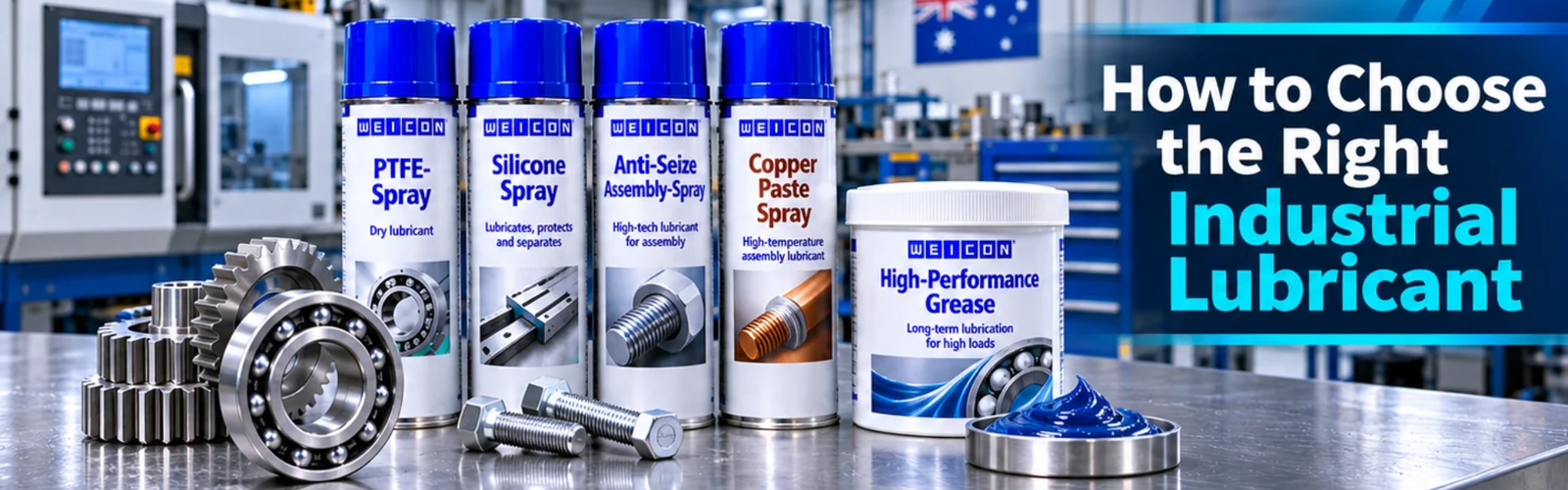
How to Choose the Right Industrial Lubricant
Admin
|
05 Nov 2026
|
23 min read
|
12 views
How to Choose the Right Industrial Lubricant
Choosing the right industrial lubricant is not simply a matter of selecting a grease or oil with a suitable price, brand, or viscosity.
The correct lubricant must match the machine, component, operating temperature, speed, load, environment, contamination level, lubrication method, materials, and maintenance requirements.
A lubricant that performs well in one application may be completely unsuitable for another.
For example, a high-speed electric motor bearing, a heavily loaded gearbox, a mining conveyor bearing, a hydraulic system, and a low-speed industrial chain can all require very different lubrication strategies.
Selecting the wrong lubricant can result in:
- Excessive friction
- Increased operating temperature
- Premature component wear
- Bearing damage
- Gear damage
- Corrosion
- Seal deterioration
- Excessive energy consumption
- Lubricant leakage
- Increased maintenance
- Unplanned downtime
- Shortened equipment life
SKF identifies lubricant selection as an application-specific engineering decision involving factors such as temperature, humidity, contamination, component geometry, speed and load. For oils, viscosity, viscosity index, temperature stability and additive selection are particularly important. SKF Media Hub
This guide explains how maintenance teams, engineers, plant managers and industrial buyers can systematically choose the right lubricant for industrial equipment.
1. What Is an Industrial Lubricant?
An industrial lubricant is a substance designed to reduce friction and wear between moving surfaces while helping equipment operate reliably under specific operating conditions.
Depending on the application, industrial lubricants can also provide:
- Cooling
- Corrosion protection
- Sealing
- Contamination removal
- Noise reduction
- Load-carrying capability
- Heat transfer
- Protection against oxidation
- Protection against extreme pressure
- Improved component life
The two major lubricant categories used across industrial equipment are:
Industrial oils
Industrial oils are commonly used where continuous lubrication, cooling, circulation or heat removal is important.
Applications include:
- Gearboxes
- Hydraulic systems
- Compressors
- Turbines
- Pumps
- Circulating systems
- Machine tools
- Bearings
- Chains
Industrial greases
Grease is commonly used where the lubricant needs to remain in place rather than continuously circulate.
Applications include:
- Bearings
- Bushings
- Pins
- Joints
- Conveyor components
- Electric motors
- Mining equipment
- Wheel bearings
- Slow-moving mechanisms
Grease is generally composed of a base oil, thickener and additives. The base oil performs much of the lubrication, while the thickener helps give grease its semi-solid structure and influences how it behaves in the application. lubrication.promo.skf.com
2. Why Choosing the Right Lubricant Matters
Lubrication is one of the most important elements of industrial maintenance.
When two surfaces move against each other, friction can generate heat and contribute to wear.
A properly selected lubricant creates an appropriate lubricating film between surfaces, helping reduce direct metal-to-metal contact.
But lubricant selection is a balancing exercise.
Too little lubrication can cause:
- Increased friction
- Excessive wear
- Heat generation
- Surface damage
- Noise
- Premature component failure
Too much lubrication can also cause problems.
For example, excessive grease in a bearing can increase friction and temperature and may contribute to premature failure. SKF specifically emphasizes that the amount of grease is critical and that bearings should not simply be overfilled. lubrication.promo.skf.com
Therefore:
Good lubrication is not about using more lubricant. It is about using the right lubricant, in the right quantity, at the right time and in the right way.
3. The First Question: What Component Are You Lubricating?
Before choosing a lubricant, identify the component.
The lubricant required for a bearing may be very different from the lubricant required for a gearbox.
Start by identifying whether you are lubricating:
| Component | Common Lubricant |
| Rolling bearings | Grease or oil |
| Plain bearings | Oil or grease |
| Gearboxes | Gear oil |
| Hydraulic systems | Hydraulic oil |
| Compressors | Compressor oil |
| Chains | Chain oil |
| Electric motors | Bearing grease |
| Pumps | Oil or grease |
| Linear systems | Grease or oil |
| Machine tools | Specialised oils/greases |
| Air tools | Pneumatic oil |
| Slides and guides | Way oils |
| High-temperature assemblies | High-temperature grease/paste |
| Threaded connections | Assembly paste / anti-seize |
| Food-processing equipment | Food-grade lubricant where required |
The component type should always be the starting point.
4. Understand the Operating Conditions
Once the component is identified, understand how it operates.
A useful lubricant-selection checklist begins with:
- Operating temperature
- Ambient temperature
- Speed
- Load
- Shock/vibration
- Environment
- Contamination
- Moisture
- Lubrication method
- Relubrication interval
- Component materials
- Seal compatibility
- Required standards or certifications
SKF's lubricant-selection guidance similarly emphasizes operating conditions such as temperature, humidity and contamination, along with component geometry, speed and load. SKF Media Hub
5. Temperature: One of the Most Important Factors
Temperature can dramatically influence lubricant performance.
Before selecting a lubricant, determine:
Minimum operating temperature
Consider:
- Winter conditions
- Outdoor equipment
- Cold starts
- Refrigeration environments
- Cold storage
- High-altitude applications
Normal operating temperature
This is the temperature at which the equipment operates during normal production.
Maximum operating temperature
Consider:
- Continuous operating temperature
- Short-term temperature spikes
- Heat generated by the machine
- Nearby heat sources
- Hot processing environments
The lubricant must remain suitable throughout the expected operating range.
SKF notes that lubricant consistency or viscosity must remain appropriate for the actual temperature conditions of the application. SKF Media Hub
6. Why Temperature Changes Lubricant Behaviour
Oil viscosity changes with temperature.
As temperature increases, oil generally becomes less viscous.
That means an oil that appears suitable at room temperature may become too thin when the machine reaches its normal operating temperature.
Conversely, an oil that is excessively viscous at low temperature may create high resistance during startup.
SKF explains that the most important lubricant parameter for many bearing applications is the viscosity at the actual operating temperature because the lubricant film depends heavily on it. Evolution
Therefore, do not select oil based only on its viscosity at ambient temperature.
Ask:
What viscosity will this lubricant have at the actual operating temperature?
7. Viscosity: What Does It Mean?
Viscosity describes a lubricant's resistance to flow.
In simple terms:
Low viscosity
The oil flows more easily.
It may be suitable for applications requiring:
- High speed
- Lower resistance
- Lower-temperature operation
- Fast circulation
High viscosity
The oil flows more slowly and provides a thicker film under appropriate conditions.
It may be useful for:
- Heavy loads
- Lower speeds
- Certain high-temperature applications
- Applications requiring greater film thickness
However, higher viscosity is not automatically better.
Excessively high viscosity can increase friction, heat generation and energy losses.
SKF research illustrates that both excessively low and excessively high viscosity can negatively affect bearing behaviour. Evolution
8. How Speed Affects Lubricant Selection
Machine speed is another critical parameter.
Consider:
- RPM
- Shaft diameter
- Bearing size
- Surface speed
- Acceleration
- Continuous vs intermittent operation
High-speed applications
Examples:
- Electric motors
- High-speed spindles
- Turbomachinery
- Certain pumps
- High-speed bearings
These may require lubricants with characteristics that minimise excessive friction and heat generation.
Low-speed applications
Examples:
- Heavy conveyor systems
- Large gears
- Mining equipment
- Heavy machinery
- Large bearings
These may require higher-viscosity lubricants or specialised formulations capable of maintaining an adequate film under heavy loads.
SKF notes that lubricant quantity, quality and application frequency need to be properly considered in high-speed applications, where centrifugal forces can affect lubricant distribution. SKF
9. Load: Light, Medium or Heavy?
The lubricant must be capable of handling the mechanical load imposed on the component.
Ask:
- Is the load light?
- Is it continuous?
- Is it intermittent?
- Is it heavy?
- Are there shock loads?
- Are there sudden load changes?
- Is the machine subjected to vibration?
Heavy loads can require lubricants with stronger film-forming characteristics and, depending on the application, appropriate additive packages.
For example, extreme-pressure or anti-wear characteristics may be important in applications where surfaces are subjected to high contact stresses.
10. Shock Loads and Vibration
Industrial machinery rarely operates under perfectly stable conditions.
Some equipment experiences:
- Shock loading
- Vibration
- Frequent starts and stops
- Reversing motion
- Impact
- Misalignment
- Variable loads
These conditions can place additional demands on the lubricant.
For grease applications, mechanical stability becomes particularly important.
SKF identifies mechanical stability as an important parameter for greases used in applications involving high loads and vibration. SKF
11. The Operating Environment Matters
The same component may require different lubrication depending on where it operates.
Consider:
Dust
Common in:
- Mining
- Cement
- Quarries
- Construction
- Bulk material handling
Water
Common in:
- Washdown areas
- Food processing
- Steel plants
- Paper mills
- Outdoor equipment
- Marine environments
Chemicals
Common in:
- Chemical plants
- Process industries
- Manufacturing
- Refineries
Humidity
Can increase corrosion risks and influence lubricant selection.
Dirt and particulate contamination
Can interfere with lubricant performance and contribute to component wear.
SKF notes that water and other liquid contaminants can degrade lubricant properties and reduce viscosity, potentially increasing operating temperature and metal-to-metal contact. Evolution
12. Dusty Industrial Environments
Mining and heavy industrial environments can be particularly demanding.
Equipment may be exposed to:
- Fine dust
- Abrasive particles
- Moisture
- Heavy loads
- Vibration
- Shock
- Temperature variations
Examples include:
- Conveyors
- Crushers
- Screens
- Pumps
- Motors
- Gearboxes
- Wheel loaders
- Material-handling equipment
In these applications, lubricant selection should be considered alongside:
- Sealing
- Contamination control
- Lubrication frequency
- Storage
- Application method
- Condition monitoring
Simply selecting a premium lubricant does not compensate for uncontrolled contamination.
13. Water Resistance
If equipment is exposed to water, the lubricant needs to be selected accordingly.
Water can:
- Degrade lubricant performance
- Promote corrosion
- Affect grease structure
- Reduce lubricant film strength
- Increase component wear
Applications exposed to water may therefore require lubricants with suitable water resistance and corrosion-protection characteristics.
SKF specifically highlights corrosion protection and water resistance as important grease performance considerations in demanding environments. Evolution
14. Choose Between Oil and Grease
One of the first major decisions is whether the application should use oil or grease.
Oil lubrication
Oil may be preferred when:
- Continuous circulation is required
- Cooling is important
- Heat needs to be removed
- Filtration is required
- High-speed operation is involved
- The system already has an oil circulation system
Common applications:
- Gearboxes
- Hydraulic systems
- Turbines
- Compressors
- Circulating lubrication systems
Grease lubrication
Grease may be preferred when:
- Lubricant needs to remain in place
- Leakage needs to be minimised
- The component is difficult to continuously oil
- Sealing arrangements support grease lubrication
- The application is intermittent
- Simpler lubrication systems are desired
Common applications:
- Bearings
- Bushings
- Pins
- Electric motor bearings
- Conveyor components
- Industrial joints
15. Understanding Grease Consistency
Grease is commonly classified according to consistency using NLGI grades.
A simplified view is:
| NLGI Grade | General Consistency |
| NLGI 000 | Very soft |
| NLGI 00 | Very soft |
| NLGI 0 | Soft |
| NLGI 1 | Soft |
| NLGI 2 | Common general-purpose consistency |
| NLGI 3 | Firmer |
| NLGI 4+ | Very firm |
However, NLGI grade alone does not tell you whether the grease is suitable for a particular machine.
Two greases with the same NLGI grade can have very different:
- Base oils
- Thickeners
- Additives
- Temperature ranges
- Water resistance
- Mechanical stability
- Compatibility
- Application performance
SKF similarly cautions that modern grease selection cannot be based solely on consistency; application conditions and other performance characteristics must be considered. Evolution
16. Understand the Grease Thickener
Grease consists broadly of:
Base oil + thickener + additives
The thickener influences the grease's structure and behaviour.
Different thickener systems can have different:
- Temperature characteristics
- Water resistance
- Mechanical stability
- Compatibility
- Pumpability
- Application suitability
This is particularly important when replacing an existing grease.
Never assume:
"Both are NLGI 2, so they can be mixed."
That can be unsafe.
17. Grease Compatibility
Before switching from one grease to another, check compatibility.
This is particularly important when:
- Changing suppliers
- Standardising plant lubricants
- Replacing an obsolete product
- Introducing automatic lubrication
- Switching grease formulation
- Performing maintenance on critical equipment
Compatibility should be checked for:
- Base oil
- Thickener
- Additives
- Seals
- Bearing materials
- Operating temperature
SKF recommends verifying compatibility between lubricants as well as compatibility with sealing and bearing materials. SKF
18. Do Not Mix Greases Without Verification
Mixing incompatible greases can potentially change:
- Consistency
- Oil release
- Mechanical stability
- Temperature performance
- Lubricating ability
- Pumpability
In an automatic lubrication system, incompatibility can be especially problematic because the mixed lubricant may affect the entire distribution system.
Before changing lubricant:
- Identify the existing lubricant.
- Identify its base oil.
- Identify its thickener.
- Review the technical data.
- Check manufacturer compatibility guidance.
- Flush or clean the system where required.
- Confirm the new lubricant is suitable.
19. Base Oil Selection
Lubricants can use different base oil technologies.
Common categories include:
Mineral oils
Widely used across general industrial applications.
Synthetic oils
Often selected when demanding temperature ranges, longer service life or specialised performance requirements exist.
Synthetic lubricants may offer advantages in specific high-temperature or long-life applications, but they should still be selected according to actual operating requirements rather than simply because they are "premium."
SKF identifies synthetic oils such as PAO and ester-based oils as options for demanding applications including long-life and high-temperature requirements. SKF
20. Additives: Why They Matter
Lubricants can contain additive packages designed to improve particular performance characteristics.
Depending on the application, additives may provide:
- Anti-wear protection
- Extreme-pressure protection
- Corrosion protection
- Oxidation resistance
- Detergency
- Dispersancy
- Foam control
- Rust protection
However, additives are application-specific.
An additive that is beneficial in one machine may create compatibility concerns in another.
SKF notes that additive selection, including EP/AW and corrosion-protection characteristics, should match the operating conditions when selecting oil. SKF Media Hub
21. Anti-Wear vs Extreme Pressure
These terms are often confused.
Anti-Wear (AW)
Designed to help protect surfaces under conditions where the lubricating film may become insufficient.
Extreme Pressure (EP)
Designed for applications involving severe loads and contact pressures where additional protection is required.
Typical applications may include:
- Heavy-duty gears
- Industrial gearboxes
- Highly loaded mechanisms
But EP additives are not universally suitable for every application or material.
SKF warns that some EP additives can be harmful to certain materials, including brass or polyamide cages at elevated temperatures. SKF
Therefore, always verify compatibility rather than selecting an EP lubricant simply because the machine is "heavy duty."
22. Check the Lubricant's Temperature Range
When evaluating a lubricant, look beyond the basic product name.
Review the technical data sheet for:
- Minimum operating temperature
- Maximum operating temperature
- Recommended operating range
- Dropping point for grease
- Viscosity at specified temperatures
- Viscosity index where applicable
- Thermal stability
The dropping point of a grease, for example, should not be confused with its maximum continuous operating temperature.
Always follow the manufacturer's recommended application limits.
23. Consider the Lubrication Method
The lubricant must work with the method used to deliver it.
Possible methods include:
- Manual grease gun
- Automatic single-point lubricator
- Centralised lubrication system
- Oil bath
- Splash lubrication
- Circulating oil
- Oil mist
- Drip lubrication
- Spray lubrication
A lubricant that performs well when manually applied may not necessarily be suitable for an automatic lubrication system.
SKF specifically notes that pumpability is an important grease-selection consideration for automatic lubrication systems. SKF
24. Automatic Lubrication Requires Additional Considerations
When grease is delivered automatically, consider:
- Pumpability
- Line length
- Temperature
- Pressure
- Grease consistency
- Separation characteristics
- Flow behaviour
- Delivery quantity
- Relubrication interval
A lubricant can be technically suitable for a bearing but unsuitable for the delivery system.
That is why the complete lubrication system should be evaluated rather than the lubricant alone.
25. How Much Lubricant Do You Need?
More lubricant does not necessarily mean better lubrication.
For grease-lubricated bearings, overfilling can increase:
- Friction
- Temperature
- Churning losses
- Energy consumption
Underfilling can result in:
- Insufficient lubrication
- Increased wear
- Heat generation
- Premature failure
SKF describes reliable lubrication as involving the right lubricant, right amount, right method, right time and right lubrication point. lubrication.promo.skf.com
26. How Often Should You Relubricate?
Relubrication frequency depends on the application.
Factors include:
- Bearing type
- Bearing size
- Speed
- Temperature
- Load
- Grease type
- Contamination
- Moisture
- Vibration
- Sealing
- Operating hours
There is no universal rule such as:
"Every bearing needs grease every month."
Some applications may require frequent lubrication.
Others may operate for extended periods without relubrication.
SKF notes that grease type, quantity and frequency are all important factors in reliable lubrication. Evolution
27. Consider Contamination
One of the most overlooked parts of lubricant selection is contamination control.
Contaminants can include:
- Dust
- Dirt
- Metal particles
- Water
- Chemicals
- Process fluids
- Old lubricant
- Foreign grease
- Cleaning agents
Contamination can damage both lubricant and equipment.
SKF explains that hard particles can damage bearing surfaces and shorten bearing life, while water can degrade lubricant performance. Evolution
Therefore, lubricant selection should always be accompanied by a contamination-control strategy.
28. Storage and Handling Matter Too
Even a high-quality lubricant can be compromised before it reaches the machine.
Lubricants should be:
- Stored correctly
- Kept clean
- Protected from contamination
- Properly labelled
- Protected from excessive temperature
- Kept in suitable containers
- Managed according to first-in/first-out principles where appropriate
Avoid:
- Open grease containers
- Dirty grease guns
- Unlabelled oil containers
- Mixing products accidentally
- Using contaminated transfer equipment
Lubrication quality begins before the lubricant enters the machine.
29. Check Material Compatibility
The lubricant must be compatible with the machine's materials.
Consider:
- Steel
- Stainless steel
- Aluminium
- Brass
- Copper
- Plastics
- Elastomers
- Seals
- Cages
- Coatings
SKF specifically identifies compatibility with metals, plastics and sealing materials as an important consideration in lubricant selection. SKF Media Hub
This becomes particularly important when introducing:
- New synthetic lubricants
- Strong additive packages
- Specialised greases
- EP lubricants
- Solvent-containing products
- High-temperature products
30. Food and Specialised Industries
Some industries have additional requirements.
For example, food-processing environments may require lubricants with appropriate food-grade certifications for applications where incidental food contact is possible.
SKF notes NSF H1 certification as an example of a requirement for food-processing applications where incidental contact may occur. SKF
Other industries may have requirements related to:
- Environmental protection
- Biodegradability
- Fire resistance
- Chemical compatibility
- Clean-room operation
- High temperature
- Marine exposure
Always identify regulatory and industry requirements before choosing the lubricant.
31. Lubricant Selection by Application
A practical starting point is to think about the equipment.
| Application | Typical Considerations |
| Electric motor bearing | Speed, temperature, bearing type, grease compatibility |
| Industrial gearbox | Load, speed, gear type, viscosity, temperature |
| Hydraulic system | Correct hydraulic-fluid specification, viscosity, cleanliness |
| Conveyor bearing | Load, speed, contamination, water, relubrication |
| Mining equipment | Heavy load, dust, vibration, water, shock |
| Pump | Speed, temperature, bearing type, sealing |
| Compressor | Temperature, pressure, oil type, oxidation stability |
| Chain | Speed, temperature, penetration, application method |
| High-temperature equipment | Temperature stability, oxidation resistance |
| Food processing | Appropriate food-grade requirements |
| Outdoor machinery | Temperature, water, corrosion |
| Steel processing | Heat, water, load, contamination |
| Paper industry | Water, heat, process contamination |
| Chemical processing | Chemical compatibility and corrosion protection |
32. How to Choose Lubricant for a Bearing
For a bearing, collect the following information:
Step 1: Identify the bearing
Record:
- Bearing type
- Bearing designation
- Size
- Sealing arrangement
- Cage material if relevant
Step 2: Determine speed
Record:
- RPM
- Continuous or intermittent operation
- Starts/stops
Step 3: Determine temperature
Record:
- Ambient temperature
- Operating temperature
- Maximum temperature
Step 4: Determine load
Record:
- Radial load
- Axial load
- Shock loading
- Vibration
Step 5: Determine environment
Check:
- Dust
- Water
- Chemicals
- Humidity
- Outdoor exposure
Step 6: Choose grease or oil
Then evaluate:
- Viscosity
- Base oil
- Thickener
- NLGI grade
- Additives
- Temperature capability
- Compatibility
SKF's lubricant-selection systems use application conditions rather than simply searching by grease name, consistency or viscosity, reflecting the importance of matching lubricant characteristics to actual operating conditions. Evolution
33. How to Choose Gearbox Lubricant
Gearboxes are highly dependent on correct lubrication.
Consider:
- Gear type
- Gear speed
- Reduction ratio
- Load
- Operating temperature
- Ambient temperature
- Shock loads
- Gear material
- Seals
- Lubrication method
- Manufacturer specification
Gear oil selection should not be based purely on viscosity.
The additive package and compatibility with the gearbox are equally important.
34. How to Choose Lubricant for Mining Equipment
Mining environments can be especially demanding.
Consider:
Heavy loads
Equipment may experience extremely high mechanical loads.
Dust
Abrasive contamination can enter lubrication points.
Water
Rain, washdown and wet processing can introduce moisture.
Vibration
Continuous vibration can influence lubricant performance and component life.
Shock
Crushing and material-handling equipment can experience severe impact loading.
Accessibility
Some lubrication points may be difficult or dangerous to access manually.
This can make automatic lubrication systems particularly valuable where appropriate.
35. How to Choose Lubricant for Electric Motors
For electric motors, bearing lubrication requires particular attention.
Consider:
- Bearing type
- RPM
- Operating temperature
- Motor size
- Bearing manufacturer recommendations
- Grease compatibility
- Electrical motor requirements
- Relubrication quantity
- Relubrication interval
One of the biggest mistakes is assuming that any general-purpose bearing grease is suitable for every motor.
Motor manufacturers and bearing manufacturers should be consulted for application-specific requirements.
36. How to Choose Lubricant for High-Temperature Applications
High-temperature equipment can include:
- Ovens
- Furnaces
- Kilns
- Steel-processing equipment
- Hot conveyors
- High-temperature bearings
- Industrial dryers
Consider:
- Continuous temperature
- Peak temperature
- Oxidation resistance
- Evaporation
- Base oil technology
- Thickener stability
- Relubrication requirements
A lubricant's published maximum temperature should be interpreted in the context of actual operating conditions and application requirements.
37. How to Choose Lubricant for Wet Environments
For equipment exposed to water, evaluate:
- Water resistance
- Corrosion protection
- Adhesion
- Mechanical stability
- Washout resistance
- Temperature range
Typical applications include:
- Paper mills
- Steel plants
- Food processing
- Marine environments
- Outdoor conveyors
- Mining
- Wastewater facilities
The objective is not simply to find a "waterproof grease."
The complete system—including seals, application method and contamination control—must be considered.
38. Common Mistakes When Selecting Industrial Lubricants
Mistake 1: Choosing the cheapest lubricant
The purchase price is only one part of lubrication cost.
A cheaper lubricant that causes more frequent failures can become significantly more expensive.
Mistake 2: Assuming expensive means better
Premium lubricants are not automatically suitable for every application.
The right lubricant is the one that matches the machine.
Mistake 3: Choosing only by viscosity
Viscosity is important, but it is not the entire selection process.
Also consider:
- Temperature
- Load
- Speed
- Additives
- Base oil
- Contamination
- Compatibility
Mistake 4: Mixing different greases
Never assume compatibility.
Verify it first.
Mistake 5: Over-greasing bearings
More grease is not necessarily better.
Excessive grease can increase friction and heat.
Mistake 6: Ignoring contamination
Even a high-quality lubricant can perform poorly when contaminated.
Mistake 7: Ignoring operating temperature
Selecting lubricant based only on ambient temperature can result in incorrect viscosity or temperature performance.
Mistake 8: Using the same lubricant everywhere
Standardisation can be useful, but excessive standardisation can be dangerous.
A hydraulic system, gearbox, electric motor bearing and chain do not necessarily require the same lubricant.
Mistake 9: Ignoring manufacturer recommendations
Equipment and bearing manufacturers often provide specific lubrication requirements.
These should be reviewed before selecting an alternative product.
39. Lubricant Selection Checklist
Before purchasing an industrial lubricant, answer these questions:
Equipment
- What machine is being lubricated?
- What component is being lubricated?
- What is the component manufacturer's recommendation?
Operating conditions
- What is the operating temperature?
- What is the ambient temperature?
- What is the operating speed?
- What is the load?
- Is there shock or vibration?
Environment
- Is there dust?
- Is there water?
- Is there humidity?
- Are chemicals present?
- Is corrosion a concern?
Lubricant
- Oil or grease?
- What viscosity?
- What NLGI grade?
- What base oil?
- What thickener?
- What additive package?
- What temperature range?
- What certifications are required?
Compatibility
- Is it compatible with the existing lubricant?
- Is it compatible with seals?
- Is it compatible with bearings?
- Is it compatible with machine materials?
Application
- Manual?
- Automatic?
- Centralised?
- Oil bath?
- Circulating?
- Spray?
Maintenance
- How much lubricant is required?
- How frequently should it be applied?
- How will contamination be controlled?
- How will lubricant condition be monitored?
If these questions cannot be answered, the lubricant selection is probably not yet complete.
40. A Simple Industrial Lubricant Selection Process
A practical selection process can be reduced to seven stages.
Stage 1 — Identify the component
Bearing, gearbox, chain, hydraulic system, compressor, etc.
Stage 2 — Collect operating data
Temperature, speed, load and operating hours.
Stage 3 — Identify environmental conditions
Dust, water, chemicals, humidity, vibration and contamination.
Stage 4 — Determine lubricant type
Oil, grease, paste or specialised lubricant.
Stage 5 — Define technical requirements
Viscosity, NLGI, base oil, thickener, additives, temperature range and certifications.
Stage 6 — Verify compatibility
Check existing lubricant, seals, materials and equipment.
Stage 7 — Validate the selection
Where the application is critical or unusual, involve the equipment manufacturer, bearing manufacturer or lubricant technical specialist.
41. Lubricant Selection Example: Conveyor Bearing
Imagine a conveyor bearing operating in a mining environment.
The conditions are:
- Continuous operation
- Heavy load
- Moderate speed
- High dust
- Occasional water
- High vibration
- Difficult manual access
A basic selection approach would be:
Component: Rolling bearing
↓
Lubricant: Grease
↓
Environment: Dust + water
↓
Mechanical conditions: Heavy load + vibration
↓
Required properties: Suitable mechanical stability + water/corrosion resistance + appropriate temperature capability
↓
Delivery: Potential automatic lubrication
↓
Compatibility: Verify existing grease and bearing materials
↓
Quantity/frequency: Determine from bearing and operating conditions
This is much more reliable than simply asking:
"Which grease is best?"
42. Lubricant Selection Example: High-Speed Motor Bearing
Consider a high-speed electric motor.
Conditions:
- High RPM
- Moderate load
- Continuous operation
- Elevated bearing temperature
- Clean indoor environment
The selection priorities may include:
- Correct grease type
- Appropriate base-oil viscosity
- Temperature capability
- Low friction characteristics
- Bearing compatibility
- Correct grease quantity
- Correct relubrication interval
The goal is not to choose the heaviest grease available.
It is to choose a lubricant that performs correctly at the actual operating speed and temperature.
43. Lubrication and Energy Efficiency
Lubrication can also influence energy consumption.
Incorrect viscosity, excessive lubricant quantity or poor lubrication can increase friction and heat generation.
For this reason, lubrication should be viewed as part of equipment efficiency—not simply maintenance.
SKF's lubrication guidance links proper lubrication management with production uptime and energy-related performance. lubrication.promo.skf.com
44. Lubrication and Preventive Maintenance
A lubricant should not be selected in isolation.
It should become part of a complete lubrication program.
A good program should define:
- Lubrication points
- Lubricant specification
- Lubricant quantity
- Application method
- Application frequency
- Responsible personnel
- Storage requirements
- Contamination-control procedures
- Inspection requirements
- Lubricant-condition monitoring
- Replacement procedures
This transforms lubrication from a reactive maintenance task into a controlled engineering process.
45. Lubrication and Predictive Maintenance
Modern industrial maintenance increasingly combines lubrication with condition monitoring.
Possible monitoring methods include:
- Temperature monitoring
- Vibration analysis
- Oil analysis
- Grease inspection
- Particle analysis
- Visual inspection
- Acoustic monitoring
Unexpected changes can indicate:
- Lubricant degradation
- Contamination
- Bearing wear
- Excessive load
- Misalignment
- Over-lubrication
- Under-lubrication
The objective is to identify problems before they become production failures.
46. Building a Lubricant Standardisation Program
Large plants may use dozens or even hundreds of lubricant products.
This can create:
- Inventory complexity
- Storage problems
- Wrong-lubricant application
- Compatibility risks
- Training difficulties
- Higher purchasing costs
A lubricant standardisation program can help reduce unnecessary product variety.
However, standardisation should be based on engineering compatibility.
A good process is:
- Audit all current lubricants.
- Identify applications.
- Identify duplicate products.
- Review technical requirements.
- Identify possible standard products.
- Verify compatibility.
- Establish colour/label coding.
- Train maintenance teams.
- Update lubrication charts.
- Monitor results.
47. The Five Rights of Industrial Lubrication
A useful way to remember good lubrication practice is:
Right lubricant
Use the lubricant that matches the application.
Right quantity
Apply the correct amount.
Right method
Use the correct delivery system.
Right time
Follow an appropriate lubrication interval.
Right lubrication point
Ensure the lubricant actually reaches the intended component.
SKF uses this five-right framework in its lubrication-management guidance. lubrication.promo.skf.com
48. Industrial Lubricant Selection Quick Reference
| Factor | Question |
| Component | What exactly needs lubrication? |
| Oil/Grease | Which lubricant form is appropriate? |
| Viscosity | What viscosity is required at operating temperature? |
| Temperature | What are minimum, normal and maximum temperatures? |
| Speed | What RPM or surface speed is involved? |
| Load | Is the load light, moderate, heavy or shock-loaded? |
| Environment | Dust, water, chemicals or humidity? |
| Additives | AW, EP, corrosion protection or other requirements? |
| Compatibility | Compatible with existing lubricant and materials? |
| Delivery | Manual, automatic, bath, circulation or spray? |
| Quantity | How much is required? |
| Frequency | How often should it be applied? |
| Standards | Are certifications or industry specifications required? |
| Monitoring | How will lubricant and component condition be checked? |
49. Frequently Asked Questions
What is the most important factor when choosing an industrial lubricant?
There is no single factor that applies to every application. However, operating conditions—especially temperature, speed, load, component type and environment—are fundamental to correct selection.
Is higher viscosity always better?
No.
Higher viscosity can provide a thicker lubricant film in suitable applications, but excessive viscosity can increase friction, heat and energy consumption. The required viscosity should be determined based on the actual application and operating temperature. Evolution
Can I use the same grease for every bearing?
Not necessarily.
Different bearings can have different speed, load, temperature, sealing and environmental requirements.
Can two NLGI 2 greases be mixed?
Not automatically.
NLGI grade only describes grease consistency. Two NLGI 2 greases can use different base oils, thickeners and additive systems.
Compatibility should be verified before mixing.
Is synthetic lubricant always better than mineral lubricant?
Not necessarily.
Synthetic lubricants can offer advantages in certain demanding applications, but lubricant selection should be based on the actual operating conditions and required performance.
How often should industrial equipment be lubricated?
There is no universal interval.
The correct interval depends on the component, lubricant, temperature, speed, load, contamination, operating hours and lubrication method.
Can over-lubrication damage equipment?
Yes.
Over-lubrication can increase friction and operating temperature and may contribute to premature bearing failure. lubrication.promo.skf.com
What happens if lubricant becomes contaminated?
Contamination can reduce lubricant effectiveness and accelerate component wear.
Water, dust and solid particles can be particularly damaging to bearings and other precision components. Evolution
Should lubricant selection be based only on the manufacturer's brand?
No.
Brand is only one consideration. The lubricant should meet the technical requirements of the application.
However, manufacturer recommendations should always be reviewed before replacing an approved lubricant.
How do I select grease for a mining application?
Start by evaluating:
- Bearing/component type
- Load
- Speed
- Temperature
- Dust
- Water
- Vibration
- Shock loading
- Grease compatibility
- Lubrication method
Then select a grease whose technical characteristics match those conditions.
50. Final Lubricant Selection Checklist
Before approving an industrial lubricant, make sure you know:
☐ Component type
☐ Manufacturer recommendation
☐ Operating temperature
☐ Ambient temperature
☐ Operating speed
☐ Load
☐ Shock/vibration
☐ Dust contamination
☐ Water exposure
☐ Chemical exposure
☐ Oil or grease requirement
☐ Required viscosity
☐ NLGI grade where applicable
☐ Base oil
☐ Thickener
☐ Additive package
☐ Temperature capability
☐ Material compatibility
☐ Seal compatibility
☐ Existing lubricant compatibility
☐ Application method
☐ Lubricant quantity
☐ Relubrication interval
☐ Required standards/certifications
☐ Storage and handling requirements
☐ Condition-monitoring requirements
If these factors have been evaluated, the lubricant selection is much more likely to deliver reliable performance.
Conclusion
Choosing the right industrial lubricant is an engineering decision—not simply a purchasing decision.
The best lubricant depends on the specific machine, component and operating conditions.
Temperature, viscosity, speed, load, contamination, water exposure, vibration, lubricant compatibility, additive requirements and application method all play important roles.
The most effective approach is to start with the machine and work backwards toward the lubricant specification.
Instead of asking:
"Which lubricant should we buy?"
ask:
"What does this application require from its lubricant?"
That change in approach can help maintenance teams reduce unnecessary wear, improve equipment reliability, control lubrication costs and reduce the risk of unexpected downtime.
For demanding industrial applications, lubricant selection should be supported by equipment specifications, lubricant technical data and, where necessary, advice from qualified lubrication or application specialists.
Need Help Choosing the Right Industrial Lubricant?
Selecting the correct lubricant for a bearing, gearbox, conveyor, motor, pump, mining machine or other industrial application requires understanding the actual operating conditions.
At LECA, technical product knowledge and application-focused solutions can help businesses identify suitable industrial maintenance products for demanding environments.
Explore Industrial Lubrication Solutions
Request a Quote
Talk to a LECA Technical Expert
Sources & Technical References
- SKF — Lubrication and lubricant-selection guidance. SKF Media Hub
- SKF — Lubrication basics and grease-selection criteria. SKF
- SKF — Lubricant selection and compatibility guidance. SKF Media Hub
- SKF — Bearing contamination and lubricant degradation. Evolution
- SKF — Lubrication management and the five rights of lubrication.
Explore Industrial Automation Products