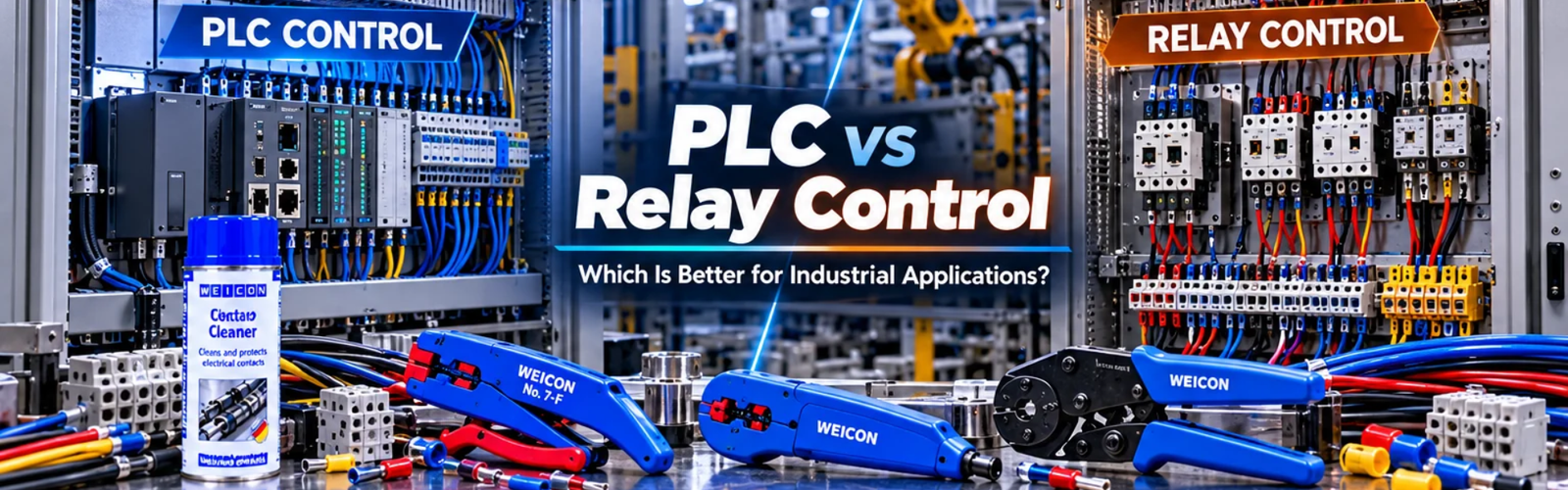
PLC vs Relay Control: Which Is Better for Industrial Applications?
Admin
|
24 Oct 2026
|
18 min read
|
54 views
PLC vs Relay Control: Which Is Better for Industrial Applications?
Industrial machines and control systems need a reliable way to monitor inputs, make decisions and control outputs.
For decades, electromechanical relays have been used to control industrial equipment. They remain useful for simple control circuits and specific applications.
However, as machines become more complex, many businesses have moved towards Programmable Logic Controllers (PLCs).
A PLC can perform many of the functions traditionally handled by relay-based control systems while providing additional capabilities such as:
- Programmable logic
- Timers
- Counters
- Analog signal processing
- Communication
- Diagnostics
- Data handling
- Machine monitoring
- Network integration
- Flexible control logic
This leads to an important question:
PLC vs relay control — which is better for industrial applications?
The answer depends on the application.
A relay system can be an excellent choice for a simple control circuit.
A PLC can be significantly more practical when a machine requires complex logic, frequent changes, diagnostics, communication or future expansion.
Understanding the differences between the two can help engineers, maintenance teams, machine builders and industrial businesses choose the right control architecture.
What Is Relay Control?
A relay is an electrically operated switching device.
A traditional relay contains components such as:
- Coil
- Contacts
- Normally open (NO) contacts
- Normally closed (NC) contacts
- Mechanical switching mechanism
When the relay coil receives an electrical signal, its contacts change state.
This allows one electrical signal to control another circuit.
For example:
A push button can energise a relay.
↓
The relay changes its contacts.
↓
The contacts energise a motor contactor.
↓
The motor starts.
Multiple relays can be combined to create control logic.
This approach is commonly known as relay logic or relay-based control.
What Is a PLC?
A Programmable Logic Controller (PLC) is an industrial computer designed to control machines and processes.
A PLC typically consists of:
- CPU
- Power supply
- Digital input modules
- Digital output modules
- Analog input modules
- Analog output modules
- Communication interfaces
- Programming software
A PLC continuously reads inputs, executes its programmed logic and updates outputs.
A simplified PLC control process looks like:
Inputs → PLC Program → Outputs
For example:
A proximity sensor detects a product.
↓
The PLC receives the signal.
↓
The PLC evaluates the programmed conditions.
↓
The PLC activates an output.
↓
The conveyor or machine performs the required action.
This allows complex machine sequences to be controlled through software rather than relying entirely on physical wiring.
PLC vs Relay Control: The Basic Difference
The fundamental difference is how the control logic is implemented.
Relay Control
The control logic is primarily created through:
Physical wiring + relays + contacts
PLC Control
The control logic is primarily created through:
PLC hardware + programmed logic
With relay control, changing the logic often requires changing physical wiring.
With a PLC, many logic changes can be made through the PLC program.
This is one of the major reasons PLCs have become widely used in industrial automation.
PLC vs Relay Control Comparison
| Feature | Relay Control | PLC Control |
| Logic | Physical wiring | Software |
| Programming | Not required | Required |
| Modification | Wiring changes | Program changes |
| Complex logic | Difficult | Easier |
| Diagnostics | Limited | Extensive |
| Timers | Physical timer relays required | Built into software |
| Counters | Additional hardware | Software functions |
| Analog signals | Additional equipment | Analog modules |
| Communication | Limited | Multiple communication options |
| Expansion | Can become complicated | Generally easier |
| Physical wiring | High for complex systems | Reduced |
| Maintenance | Troubleshooting wiring | Program + hardware diagnostics |
| Initial simplicity | Excellent for simple circuits | More setup required |
| Complex automation | Less suitable | Highly suitable |
How Relay Control Works
Consider a simple motor start/stop circuit.
The circuit may contain:
- Start push button
- Stop push button
- Relay or contactor
- Auxiliary contact
- Motor
- Overload protection
When the operator presses the start button, the control circuit energises the contactor.
The contactor closes its power contacts.
The motor starts.
An auxiliary contact can then maintain the control circuit after the operator releases the start button.
This is a relatively simple control system.
However, imagine adding:
- Multiple motors
- Sensors
- Safety interlocks
- Timers
- Production counters
- Automatic sequences
- Fault detection
- Operator displays
- Variable speed control
- Remote monitoring
The number of relays, contacts and wires can increase rapidly.
This is where PLC control can become more attractive.
How PLC Control Works
A PLC operates according to its programmed control logic.
A simplified sequence is:
Step 1 — Read Inputs
The PLC reads signals from devices such as:
- Push buttons
- Proximity sensors
- Limit switches
- Pressure sensors
- Temperature sensors
- Encoders
Step 2 — Execute Logic
The PLC processes the input conditions according to its program.
For example:
If Sensor A is ON and Sensor B is OFF, start Motor A.
Step 3 — Update Outputs
The PLC controls output devices such as:
- Contactors
- Solenoid valves
- Motors
- Indicators
- Relays
- Actuators
Step 4 — Repeat
The PLC continuously repeats this process.
This allows the controller to respond to changing machine conditions.
Why Are PLCs Used in Industrial Automation?
PLCs are particularly useful when machines require flexible and programmable control.
A PLC can combine multiple functions within one control system.
For example, one PLC may control:
- Motor starting
- Conveyor movement
- Sensor monitoring
- Timers
- Counters
- Alarms
- Interlocks
- Machine sequences
- Communication
- Operator interfaces
Instead of creating every control function through physical relay wiring, much of the logic can be implemented within the PLC program.
1. Complexity
One of the biggest differences between PLCs and relay systems is their ability to handle complex control logic.
Relay Control
Relay systems are effective for straightforward control functions.
For example:
Start → Motor ON
or:
Stop → Motor OFF
However, as the number of conditions increases, relay logic can become complicated.
PLC Control
A PLC can manage significantly more complex logic.
For example:
If
- Tank level is above minimum
- Emergency stop is reset
- Pump is available
- Pressure is within range
Then
Start Pump 1.
If
Pressure becomes too high
Then
Stop Pump 1 and activate an alarm.
Such logic can be implemented through PLC programming.
2. Ease of Modification
Industrial machines often change over time.
Production requirements may change.
A sensor may be relocated.
A motor sequence may need to be modified.
An additional interlock may be required.
With relay control, such changes can require:
- Rewiring
- Additional relays
- Additional contacts
- Additional terminal blocks
- Additional wiring documentation
With a PLC, many changes can be made by modifying the program.
This does not mean every modification is simple or risk-free.
PLC changes should still be properly tested, documented and implemented by qualified personnel.
3. Wiring Requirements
Relay systems can require extensive wiring.
As the number of control conditions increases, the control panel can become increasingly complex.
This can result in:
- More cables
- More terminals
- More relay modules
- Larger control panels
- More potential connection points
PLC systems can reduce the amount of physical control wiring because much of the logic exists in software.
However, PLC systems still require wiring for:
- Inputs
- Outputs
- Power
- Communication
- Field devices
Therefore, a PLC does not eliminate wiring.
It can, however, reduce the amount of wiring required for complex control logic.
4. Timers
Timers are common in industrial control systems.
For example:
A motor may need to start five seconds after another motor.
A valve may need to remain open for ten seconds.
A conveyor may need to operate for a defined period.
Relay System
A physical timer relay may be required.
PLC System
Timers can typically be implemented through PLC programming.
This makes it easier to modify timing values when the machine process changes.
5. Counters
Industrial machines often need to count events.
Examples include:
- Products produced
- Machine cycles
- Bottles filled
- Components processed
- Packaging operations
With relay-based control, implementing counters may require additional hardware.
PLCs commonly provide counter functions within their programming environment.
For example:
Every time a sensor detects a product → Counter +1
When the counter reaches the required value:
Stop the conveyor.
This can be implemented through PLC logic.
6. Analog Signals
Some industrial applications require more than simple ON/OFF signals.
Examples include:
- Temperature
- Pressure
- Flow
- Level
- Speed
- Position
These are often represented using analog signals.
Depending on the PLC and system design, analog input modules can allow the PLC to process these measurements.
For example:
A pressure transmitter sends a signal to the PLC.
↓
PLC reads the pressure value.
↓
PLC compares it against a programmed limit.
↓
PLC controls a pump or valve.
This type of process control can be significantly more complex to implement using traditional relay logic alone.
7. Diagnostics
Diagnostics are extremely important in industrial maintenance.
When a relay-based machine stops working, technicians may need to inspect:
- Fuses
- Relays
- Contacts
- Wiring
- Terminals
- Sensors
- Contactors
- Power supplies
They may need to trace the circuit manually.
A PLC-based system can provide additional diagnostic information depending on the PLC, programming and connected devices.
For example, the system may indicate:
Sensor 1 OFF
Motor overload ACTIVE
Low pressure
Emergency stop ACTIVE
Communication fault
This can help maintenance teams identify potential causes more efficiently.
8. Communication
Modern industrial automation often involves multiple devices communicating with each other.
These may include:
- PLCs
- HMIs
- Drives
- Servo systems
- Sensors
- Remote I/O
- SCADA systems
- Industrial networks
PLCs can support various communication technologies depending on the controller and modules used.
This allows the control system to become part of a larger automation architecture.
Traditional relay logic has limited capabilities in this area.
9. HMI Integration
A PLC can commonly be connected to an HMI (Human-Machine Interface).
This allows operators to view and interact with machine information.
An HMI can display:
- Machine status
- Production counts
- Temperatures
- Pressure
- Alarms
- Faults
- Motor status
- Setpoints
- Operating parameters
Operators may also be able to adjust authorised settings through the HMI.
This creates a much more flexible operator interface than a simple collection of indicator lights and switches.
10. Maintenance
Maintenance requirements differ between relay and PLC systems.
Relay Control
Maintenance teams may need to inspect physical components such as:
- Relay contacts
- Relay coils
- Wiring
- Terminal connections
- Contactors
- Timers
Mechanical contacts can wear over time.
PLC Control
PLCs have fewer moving parts because the control logic is electronic.
However, PLC systems still require maintenance.
Potential issues can involve:
- Power supply
- Input modules
- Output modules
- Communication
- Sensors
- Wiring
- Network components
- Software
- Program configuration
A PLC does not eliminate maintenance.
It changes the nature of the control system and can provide additional diagnostic capabilities.
11. Reliability
Both relay and PLC systems can be reliable when correctly designed, installed and maintained.
The appropriate choice depends on:
- Application
- Environment
- Component quality
- Installation
- Maintenance
- Control complexity
- Operating conditions
A simple relay circuit may be extremely reliable when it is performing a simple function.
A complex machine may benefit from PLC control because implementing the same logic through relays could create a large number of physical components and connections.
12. Space Requirements
A complex relay-based control system can require:
- Multiple relays
- Timer modules
- Contactors
- Terminal blocks
- Interconnecting wires
As the system grows, the control cabinet can become larger.
A PLC can consolidate many control functions into a smaller number of electronic modules.
This can potentially help reduce control-panel complexity.
However, the final panel size still depends on the complete system design.
13. Cost
Cost should not be evaluated only by comparing the purchase price of one PLC with the price of one relay.
The total system cost can include:
- Components
- Control panel
- Wiring
- Engineering
- Programming
- Installation
- Commissioning
- Maintenance
- Downtime
- Future modifications
For a very simple application, relay control can be economical.
For a complex automation system, PLC control may provide better overall value because it can reduce wiring complexity and make future modifications easier.
PLC vs Relay: Initial Cost
A basic relay control circuit may require only a small number of inexpensive components.
A PLC system may require:
- PLC CPU
- Power supply
- I/O modules
- Programming software
- Communication modules
- Engineering time
Therefore:
Simple application → Relay control may be more economical.
Complex application → PLC may offer better long-term value.
PLC vs Relay: Long-Term Cost
The long-term cost can be affected by:
- Maintenance
- Downtime
- Modifications
- Troubleshooting
- Expansion
- Spare parts
- Engineering time
A relay system that is inexpensive initially may become more expensive if frequent modifications or troubleshooting are required.
Likewise, a PLC system requires specialised programming and technical knowledge.
The best solution should therefore be evaluated based on the total cost of ownership, not simply the initial component price.
When Is Relay Control a Good Choice?
Relay control can still be an excellent solution for certain applications.
Consider relay control when the application is:
- Simple
- Fixed
- Small
- Easy to troubleshoot
- Unlikely to change
- Based primarily on discrete ON/OFF logic
Examples can include:
- Simple motor control
- Basic lighting control
- Simple interlocking
- Basic alarms
- Small control circuits
For these applications, a PLC may introduce unnecessary complexity.
When Is a PLC a Better Choice?
A PLC is generally more appropriate when the application involves:
- Multiple machines
- Complex sequences
- Multiple sensors
- Timers
- Counters
- Analog signals
- Variable speed control
- Motion control
- HMI integration
- Data collection
- Industrial communication
- Frequent modifications
- Future expansion
- Automated diagnostics
Examples include:
- Production lines
- Packaging machinery
- Conveyor systems
- Pumping systems
- Material handling
- CNC-related automation
- Process automation
- Mining equipment
- Manufacturing systems
PLC vs Relay Control for Manufacturing
Manufacturing environments often require flexible control.
A production line may include:
- Conveyors
- Sensors
- Motors
- Drives
- Pneumatic systems
- Safety systems
- Counters
- HMIs
- Robots
- Inspection equipment
A PLC can coordinate these systems through programmed logic.
For example:
Sensor detects product
↓
PLC verifies machine status
↓
PLC activates conveyor
↓
Sensor detects position
↓
PLC stops conveyor
↓
Processing operation starts
↓
PLC monitors completion
↓
Product moves to next station
This type of sequential automation can become difficult to implement and modify using relay logic alone.
PLC vs Relay Control for Mining
Mining environments can place demanding requirements on industrial control systems.
Equipment may experience:
- Dust
- Vibration
- Temperature variation
- Moisture
- Heavy operating conditions
- Continuous operation
Automation systems may need to monitor and control:
- Conveyors
- Pumps
- Motors
- Fans
- Crushers
- Processing equipment
- Sensors
- Safety systems
PLCs can be used as part of these larger control architectures where programmable logic, monitoring and communication are required.
The exact controller and hardware should always be selected according to the operating environment and application requirements.
PLC vs Relay Control for Pump Systems
Consider a simple pump.
A relay system could control a pump based on a float switch.
For example:
Low level → Pump ON
High level → Pump OFF
This may be sufficient for a basic application.
But consider a larger pumping system involving:
- Multiple pumps
- Pressure sensors
- Level sensors
- Alternating pump operation
- Pump fault detection
- Automatic backup
- Variable speed drives
- Remote monitoring
A PLC becomes much more attractive.
The PLC can manage the sequence and monitor multiple conditions.
PLC vs Relay Control for Conveyor Systems
A basic conveyor may only require:
Start → Conveyor ON
Stop → Conveyor OFF
A relay system may be adequate.
However, a complex conveyor system may require:
- Multiple motors
- Proximity sensors
- Product detection
- Emergency stops
- Speed control
- Sequence control
- Jam detection
- Counters
- Communication
A PLC can coordinate these functions through programmed logic.
PLC vs Relay Control for Machine Builders
Machine builders often need flexibility because the machine design may evolve during development.
A PLC can make it easier to:
- Change sequences
- Add sensors
- Modify timing
- Add alarms
- Add HMI functions
- Add communication
- Integrate drives
- Expand I/O
This can be particularly valuable when machines are customised for different customers.
Can PLCs and Relays Be Used Together?
Yes.
A PLC does not necessarily replace every relay in an industrial control system.
Both technologies can work together.
For example:
Sensor → PLC → Relay → Contactor → Motor
The PLC may control a relay output, which then controls another circuit.
Relays can also be used for:
- Isolation
- Interface functions
- Switching
- Interlocking
- Protection
- Connecting different voltage levels where appropriate
Therefore, the choice does not always have to be:
PLC OR Relay
It can also be:
PLC + Relay
PLC Output vs Relay Output
PLCs can have different types of outputs depending on the controller.
Common output technologies include:
- Relay outputs
- Transistor outputs
- Triac outputs
Each has different characteristics.
Relay Output
Uses a physical switching contact.
Potential advantages include flexibility for certain loads and signal types.
Transistor Output
Uses semiconductor switching.
Often suitable for fast switching applications.
Triac Output
Commonly used for suitable AC switching applications.
The correct output type depends on the load, voltage, current, switching frequency and application requirements.
Common Mistakes When Choosing Between PLC and Relay Control
Mistake 1 — Choosing Only Based on Initial Price
The cheapest component does not necessarily produce the lowest total system cost.
Consider:
Purchase + Installation + Engineering + Maintenance + Downtime + Future Changes
Mistake 2 — Using Relays for Highly Complex Logic
Relay logic can become difficult to manage when the number of conditions grows.
Mistake 3 — Using a PLC for an Extremely Simple Application
A PLC is not automatically the best choice for every control system.
A simple relay circuit may be more practical.
Mistake 4 — Ignoring Future Expansion
A machine may be simple today but require additional functionality later.
Consider future requirements before selecting the control architecture.
Mistake 5 — Ignoring Technician Expertise
A PLC-based system requires personnel who can understand:
- PLC programming
- I/O
- Electrical systems
- Diagnostics
- Communication
The availability of technical expertise should be considered.
Mistake 6 — Not Documenting the Control System
Whether using relays or PLCs, proper documentation is important.
Maintain:
- Electrical drawings
- I/O lists
- PLC programs
- Wiring diagrams
- Component information
- Configuration details
- Maintenance documentation
PLC vs Relay Control Decision Checklist
Before selecting a control system, ask:
1. How complex is the application?
Simple → Relay may be suitable.
Complex → PLC may be preferable.
2. How many inputs and outputs are required?
A growing number of I/O points may favour PLC control.
3. Are timers required?
If there are multiple timing functions, PLC control may simplify implementation.
4. Are counters required?
Production counting can be easier with PLC functions.
5. Are analog signals involved?
PLC systems can accommodate suitable analog modules.
6. Is HMI integration required?
A PLC can communicate with an HMI.
7. Will the machine change?
Frequent modifications generally favour programmable control.
8. Is future expansion expected?
Plan the control system accordingly.
9. Does the system require diagnostics?
PLC systems can provide extensive diagnostic capabilities.
10. What is the total cost of ownership?
Look beyond the initial hardware price.
PLC vs Relay Control: Which One Should You Choose?
There is no universal answer.
The correct choice depends on the application.
Choose Relay Control when:
- The control system is simple.
- The logic is fixed.
- The number of conditions is small.
- No advanced communication is required.
- Future modifications are unlikely.
- Simple troubleshooting is preferred.
Consider PLC Control when:
- The machine has complex logic.
- Multiple sensors are involved.
- Timers and counters are required.
- Analog signals are required.
- HMI integration is required.
- Drives or motion systems need to be integrated.
- Machine sequences are complex.
- Future expansion is expected.
- Diagnostics are important.
- Remote monitoring or communication is required.
PLC vs Relay Control: Quick Decision Table
| Application Requirement | Recommended Approach |
| Simple ON/OFF control | Relay |
| Small fixed control circuit | Relay |
| Basic motor starter | Relay / contactor |
| Multiple timers | PLC |
| Multiple counters | PLC |
| Complex sequencing | PLC |
| Analog sensors | PLC |
| HMI integration | PLC |
| Multiple machines | PLC |
| Production line | PLC |
| Data collection | PLC |
| Industrial networking | PLC |
| Frequent modifications | PLC |
| Future expansion | PLC |
| Very simple fixed system | Relay |
| PLC + interface requirements | PLC + relays where appropriate |
The Future of Industrial Control
Industrial control systems are increasingly moving towards connected and programmable architectures.
Modern automation systems can combine:
- PLCs
- HMIs
- VFDs
- Servo drives
- Sensors
- Industrial networks
- SCADA
- Remote monitoring
- Data collection
- Industrial IoT
This does not mean relay control is obsolete.
Relays remain useful components within many industrial electrical systems.
Instead, the industry is moving towards selecting the right technology for the right application.
A relay can be the right solution for a simple control function.
A PLC can be the right solution for a complex automated process.
In many real-world systems, both technologies can work together.
PLC vs Relay Control: Final Verdict
The decision between PLC and relay control should be based on the requirements of the machine rather than simply choosing the newest technology.
For a simple, fixed control circuit, relay control can provide a straightforward and cost-effective solution.
For complex industrial automation involving multiple inputs, outputs, timers, counters, analog signals, machine sequences, HMIs, drives and communication, PLC control generally provides significantly greater flexibility.
The key considerations are:
Complexity + Flexibility + Expansion + Diagnostics + Communication + Maintenance + Total Cost of Ownership
The best control system is the one that provides the required functionality, reliability, maintainability and future flexibility for the specific application.
Frequently Asked Questions
What is the difference between a PLC and a relay?
A relay is an electrically operated switching device, while a PLC is a programmable industrial controller that uses software-based logic to monitor inputs and control outputs.
Is a PLC better than a relay?
Not necessarily. A PLC is generally more suitable for complex and programmable applications, while a relay can be ideal for simple, fixed control circuits.
Are relays still used in industrial automation?
Yes. Relays continue to be used for switching, isolation, interface functions and other industrial control applications.
Why are PLCs used instead of relays?
PLCs can simplify complex control logic and provide features such as timers, counters, diagnostics, communication, analog processing and HMI integration.
Is PLC control more expensive than relay control?
The initial cost may be higher for a PLC system, particularly for a simple application. However, the total cost should also consider engineering, wiring, maintenance, modifications and future expansion.
Can a PLC replace all relays?
Not necessarily. PLCs and relays can be used together in the same industrial control system.
Which is easier to modify: PLC or relay control?
PLC systems are generally easier to modify when the control logic changes because many changes can be made in software rather than by rewiring the control circuit.
Which is easier to troubleshoot?
It depends on the system and the technician's expertise. PLCs can provide useful diagnostic information, while simple relay circuits can be straightforward to troubleshoot.
Can a PLC control motors?
Yes. A PLC can control suitable motor-control equipment such as contactors, VFDs and servo drives.
Can a PLC control a VFD?
Yes. Depending on the equipment and communication architecture, a PLC can control and monitor a VFD using suitable digital, analog or communication interfaces.
Can PLCs be used in mining applications?
Yes. PLCs can form part of industrial automation systems used for equipment and processes in mining, subject to appropriate equipment selection and environmental requirements.
Should I use a PLC or relay for a pump?
For a simple pump controlled by a straightforward level switch, relay control may be sufficient. For multiple pumps, pressure control, sequencing, alarms, variable speed control or remote monitoring, a PLC may be more appropriate.
What information is needed to choose between PLC and relay control?
Consider the number of inputs and outputs, control complexity, timers, counters, analog signals, communication requirements, HMI requirements, future expansion, environmental conditions, maintenance requirements and total cost of ownership.
Conclusion
PLC and relay control systems both have an important role in industrial automation.
The right solution depends on the application.
For simple control systems, relays can provide a straightforward and reliable approach.
For complex automation systems, PLCs can provide greater flexibility, programmability, diagnostics, communication and expansion capabilities.
The most important question is therefore not:
"Is a PLC better than a relay?"
It is:
"Which control architecture is best suited to this particular industrial application?"
Understanding the machine requirements before selecting the control system can help businesses improve reliability, simplify maintenance and avoid unnecessary costs.
For Australian manufacturers, machine builders, mining operations, maintenance teams and industrial businesses looking for PLC, automation and control solutions, LECA can assist with identifying suitable products and technologies for your application.
Need help choosing the right industrial control solution?
Explore Industrial Automation Products
Request a Quote
Talk to a LECA Technical Expert
Explore Industrial Automation Products