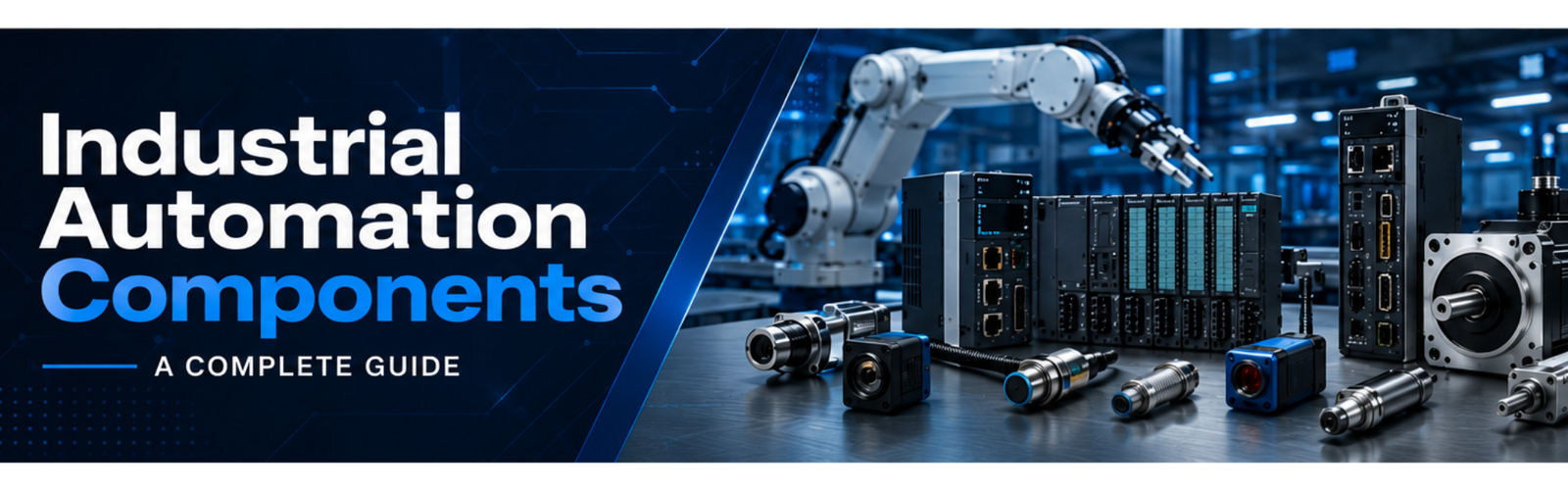
Industrial Automation Components: A Complete Guide
Admin
|
06 Sep 2026
|
13 min read
|
64 views
Industrial Automation Components: A Complete Guide
Industrial automation systems are built from a combination of electrical, electronic, mechanical and digital components that work together to monitor processes, make decisions and control industrial equipment.
From a simple automated machine to a highly integrated manufacturing line, every automation system depends on the right combination of components. Sensors collect information, controllers process that information, communication systems transfer data, and output devices such as motors, valves and actuators perform physical actions.
For Australian manufacturers, OEMs, automation integrators, electrical contractors and industrial maintenance teams, understanding these components is essential when designing new automation systems, upgrading existing equipment or maintaining production machinery.
In this guide, we explain the most important industrial automation components, what they do, how they work together and what businesses should consider when selecting automation products.
What Are Industrial Automation Components?
Industrial automation components are the individual devices and technologies used to build an automated industrial system.
They allow machines and processes to:
- Detect physical conditions
- Collect information
- Process data
- Make programmed decisions
- Control equipment
- Communicate with other systems
- Monitor performance
- Protect machinery and people
- Automate repetitive operations
A typical industrial automation system may contain dozens or even thousands of individual components depending on its size and complexity.
Some systems may only require a few sensors, a PLC and an actuator.
Large manufacturing environments can involve:
- PLCs
- HMIs
- Sensors
- Motors
- Drives
- Controllers
- Industrial networks
- Safety systems
- Robotics
- Vision systems
- Power supplies
- Switchgear
- Control panels
- Communication equipment
The important point is that these components don't operate independently.
They form a connected system where each component has a specific role.
How Industrial Automation Components Work Together
A simple way to understand an automation system is:
Input → Control → Output → Feedback
For example, imagine an automated conveyor system.
Step 1 — Detection
A sensor detects that a product has arrived.
Step 2 — Processing
The sensor sends a signal to a PLC.
Step 3 — Decision
The PLC processes the signal according to its programmed logic.
Step 4 — Action
The PLC sends a command to a motor or actuator.
Step 5 — Feedback
Additional sensors confirm that the required action has taken place.
The process then repeats.
This continuous interaction allows machines to operate automatically while providing operators with information about system performance.
1. Programmable Logic Controllers — PLCs
A Programmable Logic Controller, commonly known as a PLC, is one of the most important components in industrial automation.
A PLC is an industrial computer designed to monitor inputs, process programmed logic and control outputs.
Inputs can come from:
- Sensors
- Switches
- Push buttons
- Encoders
- Safety devices
- Other controllers
Outputs can control:
- Motors
- Valves
- Relays
- Solenoids
- Indicators
- Actuators
- Other equipment
A PLC can execute programmed instructions extremely quickly and repeatedly.
For example:
If Sensor A detects a product, start Conveyor B.
Or:
If temperature exceeds a defined limit, activate the cooling system.
PLCs are widely used because they are designed to operate reliably in industrial environments.
2. Human-Machine Interfaces — HMIs
A Human-Machine Interface, or HMI, provides an interface between an operator and an industrial automation system.
Instead of requiring operators to interact directly with individual components, an HMI can present important information on a screen.
This may include:
- Machine status
- Temperature
- Pressure
- Production counts
- Alarm conditions
- Fault information
- Operating parameters
- Maintenance information
Operators may also be able to:
- Start machines
- Stop machines
- Adjust settings
- Select operating modes
- Acknowledge alarms
A well-designed HMI can make complex industrial systems easier to monitor and operate.
3. Industrial Sensors
Sensors allow automated systems to detect changes in their physical environment.
They are essentially the "eyes and ears" of an automation system.
Common industrial sensors include:
Proximity Sensors
Used to detect whether an object is present without physical contact.
Photoelectric Sensors
Use light to detect objects, distances or changes in position.
Temperature Sensors
Measure temperature within machines or processes.
Pressure Sensors
Monitor pressure in pneumatic, hydraulic and process systems.
Level Sensors
Detect the level of liquids, powders or other materials.
Flow Sensors
Measure the movement of liquids or gases.
Position Sensors
Determine the location or movement of mechanical components.
Encoders
Measure rotational or linear movement and provide position or speed feedback.
The correct sensor depends heavily on the application.
Factors such as operating environment, temperature, distance, material, accuracy and response time should all be considered.
4. Actuators
Actuators convert control signals into physical movement.
If sensors provide information and PLCs make decisions, actuators often perform the physical action.
Examples include:
- Pneumatic cylinders
- Hydraulic cylinders
- Electric actuators
- Solenoid valves
- Servo systems
For example, an automated packaging machine might use a pneumatic cylinder to push a product into a specific position.
5. Electric Motors
Electric motors convert electrical energy into mechanical movement.
They are fundamental to many automated systems.
Motors can operate:
- Conveyors
- Pumps
- Fans
- Compressors
- Machine tools
- Production equipment
- Material handling systems
Different applications require different motor technologies.
Common types include:
- AC motors
- DC motors
- Servo motors
- Stepper motors
Motor selection depends on factors such as speed, torque, precision, load and operating environment.
6. Variable Frequency Drives — VFDs
Variable Frequency Drives, or VFDs, are used to control the speed and operation of AC motors.
Instead of simply turning a motor on or off, a VFD can allow the system to control motor speed according to operating requirements.
Benefits can include:
- Improved process control
- Controlled acceleration
- Controlled deceleration
- Reduced mechanical stress
- Potential energy savings
- Improved motor operation
VFDs are particularly useful in applications such as conveyors, pumps, fans and industrial machinery.
7. Servo Motors and Servo Drives
Servo systems are used where accurate motion control is required.
A servo system can provide precise control over:
- Position
- Speed
- Torque
They are commonly found in applications such as:
- Robotics
- CNC machinery
- Packaging equipment
- Automated assembly
- Precision manufacturing
Servo systems are particularly valuable where ordinary motor control cannot provide the required level of precision.
8. Industrial Power Supplies
Automation components require reliable electrical power.
Industrial power supplies convert electrical power into the appropriate voltage required by control components.
For example, many control systems use DC power for:
- PLCs
- Sensors
- HMIs
- Relays
- Controllers
- Communication devices
A reliable power supply is therefore critical to overall system reliability.
When selecting an industrial power supply, businesses should consider:
- Input voltage
- Output voltage
- Current capacity
- Efficiency
- Environmental conditions
- Protection features
- Installation requirements
9. Industrial Relays
Relays allow electrical circuits to control other circuits.
They can be used for:
- Switching
- Isolation
- Signal control
- Interlocking
- Protection
Relays are commonly used alongside PLCs and other control components.
Different types of relays are suitable for different applications, so correct selection is important.
10. Contactors
Contactors are electrically controlled switching devices commonly used to control higher-power electrical loads.
They are frequently used for controlling:
- Motors
- Heating equipment
- Pumps
- Compressors
- Industrial machinery
A PLC may issue a control signal while a contactor handles the switching of the larger electrical load.
11. Industrial Switches
Switches provide a means of controlling or detecting electrical circuits.
Industrial applications can involve:
- Push buttons
- Selector switches
- Limit switches
- Emergency stop devices
- Rotary switches
Industrial switches are often designed to withstand demanding environments and repeated operation.
12. Industrial Networking Components
Modern automation systems increasingly depend on communication.
Industrial networking components allow machines and devices to exchange information.
These systems can support communication between:
- PLCs
- HMIs
- Sensors
- Drives
- Robots
- SCADA systems
- Industrial computers
Depending on the application, industrial communication may involve technologies and protocols such as Ethernet-based industrial networks and fieldbus systems.
Reliable communication is essential when multiple automation components need to coordinate their operation.
13. SCADA Systems
SCADA stands for:
Supervisory Control and Data Acquisition.
SCADA systems allow operators to monitor and supervise industrial processes.
They can collect information from multiple devices and display it through a central interface.
SCADA can be particularly useful for larger or geographically distributed operations.
Applications can include:
- Manufacturing
- Water treatment
- Energy
- Infrastructure
- Utilities
- Process industries
14. Safety Components
Industrial automation systems must be designed with safety in mind.
Safety-related components can include:
- Emergency stop devices
- Safety relays
- Safety switches
- Light curtains
- Safety controllers
- Interlocking systems
These components can help detect hazardous conditions and place equipment into a safer state.
Safety requirements vary significantly depending on the machine, workplace and applicable regulations.
Safety systems should therefore be designed and implemented by appropriately qualified professionals.
15. Industrial Control Panels
Industrial control panels bring many automation components together in a structured enclosure.
A control panel may contain:
- PLC
- Power supply
- Circuit protection
- Relays
- Contactors
- Terminal blocks
- Network equipment
- Drives
- Safety components
A properly designed control panel helps protect components while providing an organised system for electrical connections and maintenance.
16. Terminal Blocks and Connectors
Terminal blocks provide organised connection points for electrical wiring.
They can simplify:
- Installation
- Testing
- Troubleshooting
- Maintenance
- Wiring management
Industrial connectors are also important where equipment needs to be connected and disconnected reliably.
The correct connector or terminal solution depends on electrical requirements, environmental conditions and installation requirements.
17. Cable Preparation Tools
Reliable electrical connections begin with correctly prepared cables.
Cable preparation can involve:
- Cutting
- Stripping
- Removing insulation
- Preparing conductors
- Preparing cable shielding
- Preparing specialised industrial cables
Professional cable preparation tools can improve consistency and reduce the risk of damaging conductors or insulation.
For electrical professionals and industrial maintenance teams, the correct tools can make installation and maintenance significantly more efficient.
Spleca's range of industrial products can include professional cable preparation and wire stripping solutions for demanding electrical applications.
Internal link:
→ Cable Preparation Tools
Internal link:
→ WEICON Cable Preparation Tools
18. Industrial Adhesives and Sealants
Automation systems also depend on mechanical assembly and maintenance products.
Industrial adhesives and sealants can be used for:
- Component bonding
- Thread securing
- Sealing
- Vibration resistance
- Equipment repair
- Assembly applications
Products such as industrial threadlockers can help prevent fasteners from loosening under vibration.
Industrial adhesives can also provide alternatives or complements to conventional mechanical fastening depending on the application.
The appropriate product depends on factors such as:
- Materials
- Temperature
- Chemical exposure
- Load
- Vibration
- Cure requirements
- Application method
Internal link:
→ Industrial Adhesives
19. Technical Sprays and Maintenance Products
Automation equipment requires regular maintenance.
Technical sprays can support applications such as:
- Cleaning
- Lubrication
- Corrosion protection
- Electrical contact cleaning
- Rust removal
- Component maintenance
For example, contact cleaners can help remove contaminants from suitable electrical contacts, while lubricating products can support appropriate maintenance procedures.
Maintenance products should always be selected according to the manufacturer's instructions and the specific application.
Internal link:
→ Technical Sprays
20. Industrial Communication and Data
Automation is increasingly becoming data-driven.
Modern systems can collect information from machines and processes and use it for:
- Performance monitoring
- Production reporting
- Fault analysis
- Predictive maintenance
- Quality management
- Energy monitoring
This means automation components are no longer simply controlling machines.
They are increasingly contributing to connected industrial ecosystems.
How to Choose the Right Industrial Automation Components
Choosing automation components requires more than comparing prices.
The correct component depends on the application.
Consider these factors.
Application Requirements
First determine what the component needs to do.
Ask:
- What process is being controlled?
- What conditions will the component experience?
- What level of accuracy is required?
- How frequently will it operate?
Environmental Conditions
Industrial environments can expose equipment to:
- Dust
- Moisture
- Heat
- Chemicals
- Vibration
- Corrosion
Components should be suitable for the environment where they will operate.
Electrical Requirements
Consider:
- Voltage
- Current
- Power
- Frequency
- Signal type
- Communication requirements
Incorrect electrical specifications can result in poor performance or equipment damage.
Compatibility
New components should be compatible with existing systems.
Consider compatibility with:
- PLCs
- HMIs
- Sensors
- Drives
- Networks
- Control panels
- Existing machinery
Reliability
Industrial components can affect the reliability of the entire production system.
A low-cost component may not necessarily be the best choice if failure could result in significant downtime.
Consider:
- Manufacturer reputation
- Product quality
- Expected service life
- Environmental rating
- Technical support
- Availability of replacement products
Availability and Support
For Australian businesses, product availability and technical support can be particularly important.
A component that is difficult to source or replace can create unnecessary downtime.
Working with a reliable industrial supplier can make procurement and maintenance easier.
Common Mistakes When Selecting Automation Components
Choosing Based Only on Price
The cheapest component isn't always the most economical choice.
Total cost can include:
- Installation
- Maintenance
- Replacement
- Downtime
- Engineering
- Troubleshooting
Ignoring the Operating Environment
A component suitable for a clean indoor environment may not be suitable for a dusty, wet or corrosive industrial environment.
Overlooking Compatibility
A component may have the required electrical specifications but still be incompatible with the existing control architecture.
Using the Wrong Sensor
Sensor selection must consider the object being detected, distance, material, environmental conditions and required accuracy.
Poor Cable Preparation
Incorrectly prepared cables can result in unreliable electrical connections and unnecessary maintenance problems.
Neglecting Maintenance
Even high-quality automation systems require regular inspection and maintenance.
Industrial Automation Components for Australian Businesses
Australian businesses operate across a wide range of environments, from advanced manufacturing facilities and engineering workshops to mining operations, food processing plants, infrastructure projects and industrial service environments.
This makes application-specific component selection particularly important.
A component used in a controlled manufacturing environment may have very different requirements from one operating in a mining or outdoor environment.
Businesses should consider:
- Operating temperature
- Dust and moisture
- Vibration
- Chemical exposure
- Electrical conditions
- Maintenance access
- Product availability
- Technical support
Choosing the right industrial automation components can help create systems that are reliable, maintainable and appropriate for their intended environment.
Industrial Automation Components and Preventive Maintenance
Automation doesn't remove the need for maintenance.
In fact, the complexity of modern automated equipment makes preventive maintenance even more important.
Maintenance teams should monitor:
- Sensors
- Connections
- Motors
- Drives
- Control panels
- Cables
- Actuators
- Pneumatic systems
- Electrical components
- Communication systems
Regular maintenance can help identify potential problems before they cause unexpected failures.
Products such as technical sprays, industrial cleaners, lubricants, adhesives and cable preparation tools can also form part of a broader maintenance toolkit.
Internal link:
→ Industrial Maintenance Products
Why Component Quality Matters
An industrial automation system is only as reliable as its weakest critical component.
A failed sensor can stop a production process.
A damaged cable can interrupt communication.
A faulty power supply can shut down a control system.
A failed motor or drive can stop machinery.
This is why businesses should consider quality, compatibility, availability and technical support when selecting industrial automation products.
Working with established manufacturers and reliable industrial suppliers can reduce procurement risk and make ongoing maintenance easier.
The Future of Industrial Automation Components
Automation components are becoming increasingly connected, intelligent and capable.
Future industrial systems will continue to incorporate technologies such as:
- Smart sensors
- Connected devices
- Industrial IoT
- Edge computing
- Artificial intelligence
- Machine vision
- Robotics
- Predictive maintenance
- Digital twins
Instead of operating as isolated devices, components are increasingly becoming part of connected industrial ecosystems.
This allows businesses to collect more information from equipment and use that information to improve production, maintenance and decision-making.
Frequently Asked Questions
What are industrial automation components?
Industrial automation components are the devices used to monitor, control, communicate with and operate industrial processes. They can include PLCs, sensors, HMIs, motors, drives, actuators, networking equipment and safety devices.
What is the most important component in an automation system?
There isn't one universally most important component. The importance of each component depends on the application. PLCs are central to many control systems, while sensors, power supplies, drives, actuators and communication equipment can also be critical.
What are the main types of automation components?
Common categories include controllers, sensors, HMIs, actuators, motors, drives, power supplies, relays, contactors, networking components, safety equipment and electrical accessories.
What does a PLC do?
A PLC receives input signals, processes programmed logic and controls output devices. It is commonly used to automate machinery and industrial processes.
What are industrial sensors used for?
Sensors detect physical conditions such as position, temperature, pressure, distance, flow, level and movement and provide this information to control systems.
What is an HMI?
An HMI, or Human-Machine Interface, allows operators to monitor and interact with an industrial automation system.
Why are industrial networking components important?
Networking components allow automation devices and systems to exchange information, enabling coordinated control, monitoring and data collection.
How do I choose the right automation component?
Consider the application, electrical specifications, environmental conditions, compatibility, performance requirements, reliability, availability and technical support.
Where can I buy industrial automation components in Australia?
Businesses should work with an established industrial supplier that can provide suitable products, technical information, product documentation and reliable supply. Spleca supplies industrial automation products and related engineering solutions to businesses across Australia.
Conclusion
Industrial automation components form the foundation of modern automated manufacturing and industrial systems.
From PLCs and sensors to motors, drives, HMIs, actuators, networking equipment and safety devices, every component contributes to the overall performance and reliability of an automation system.
However, successful automation isn't simply about buying individual components.
The components must be correctly selected, integrated, installed, maintained and supported throughout the system's lifecycle.
For Australian manufacturers, OEMs, engineers, electrical contractors and maintenance teams, choosing reliable industrial automation products can help improve operational efficiency, system reliability and long-term productivity.
As automation continues to evolve toward connected, intelligent and data-driven industrial environments, understanding the role of individual components will become increasingly important.
Spleca supports Australian businesses with industrial automation products, electrical components, maintenance products, cable preparation tools, industrial adhesives, technical sprays and engineering solutions designed for a wide range of industrial applications.
Looking for the right industrial automation component for your application?
Explore Spleca's industrial automation products or contact our technical team for assistance.
Explore Industrial Automation Products