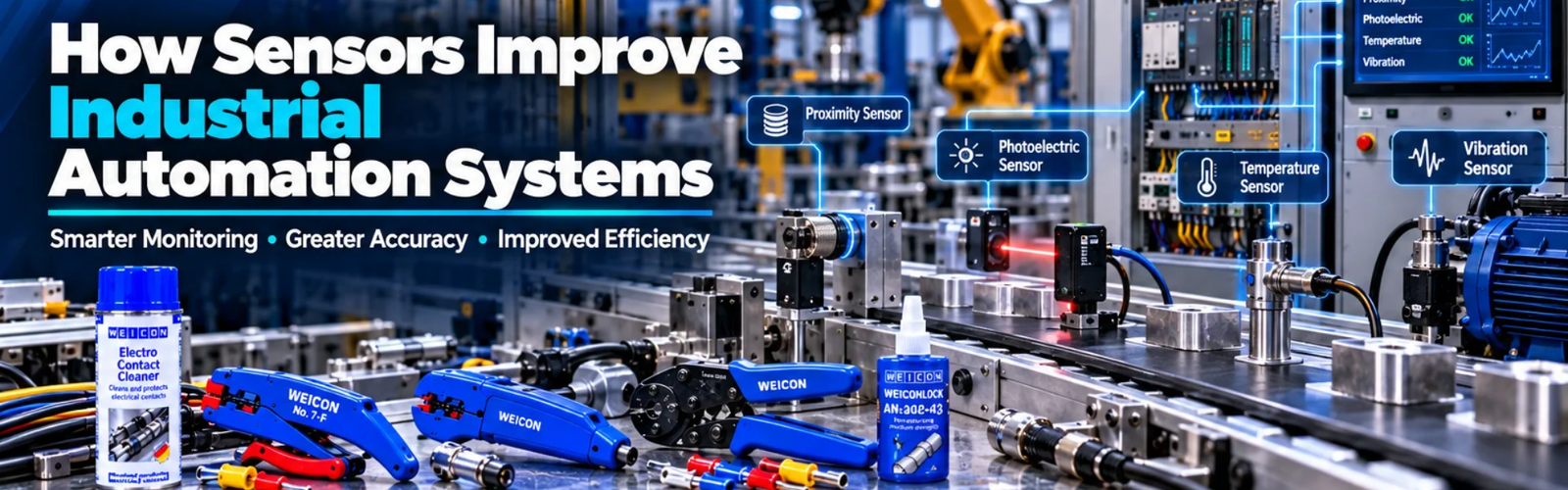
How Sensors Improve Industrial Automation Systems
Admin
|
25 Oct 2026
|
15 min read
|
54 views
How Sensors Improve Industrial Automation Systems
Modern industrial automation depends on one fundamental capability:
The ability to know what is happening in the machine or process.
A PLC, industrial controller or automation system can make decisions only when it receives reliable information about the process.
This is where industrial sensors play a critical role.
Sensors allow automated systems to detect and measure physical conditions such as:
- Position
- Presence
- Distance
- Temperature
- Pressure
- Flow
- Level
- Speed
- Vibration
- Proximity
- Force
- Light
- Motion
The information collected by sensors can then be processed by control systems such as PLCs, allowing machines to automatically respond to changing conditions.
For example:
Sensor detects product → PLC processes signal → Controller makes decision → Machine responds
This simple sequence is at the heart of many automated manufacturing and industrial processes.
Sensors therefore act as the eyes and ears of an industrial automation system.
Without appropriate sensing, an automated machine may not know when to start, stop, adjust, reject, count, measure or respond.
What Are Industrial Sensors?
An industrial sensor is a device that detects a physical condition and converts it into a signal that an automation system can interpret.
Depending on the sensor technology, the output may be:
- Digital
- Analog
- Electrical
- Network-based
- Other application-specific signals
For example, a proximity sensor may detect whether a metal object is present.
A temperature sensor may measure the temperature of a process.
A pressure sensor may measure pressure inside a system.
A photoelectric sensor may detect an object passing through a production line.
The sensor sends this information to the relevant control system.
Why Are Sensors Important in Industrial Automation?
Automation means that machines can perform tasks with limited manual intervention.
To do this effectively, the machine needs information.
Consider a conveyor system.
How does the system know that a product has arrived?
A sensor.
How does the system know that the product has reached the correct position?
A sensor.
How does the system know whether the product is present?
A sensor.
How does the system detect whether the machine has reached a particular position?
A sensor or feedback device.
The automation controller uses these signals to make decisions.
This creates a basic automation cycle:
Detect → Process → Decide → Act
Sensors provide the detect stage.
How Sensors Work With PLCs
Sensors and PLCs frequently work together in industrial automation.
A simplified system can look like:
Sensor → PLC → Output Device → Machine
For example:
Step 1 — Detection
A proximity sensor detects a component.
Step 2 — Signal
The sensor sends a signal to the PLC.
Step 3 — Processing
The PLC evaluates its programmed logic.
Step 4 — Decision
The PLC determines what action is required.
Step 5 — Output
The PLC activates an output.
Step 6 — Machine Action
A motor, valve, actuator, conveyor or other device responds.
This process happens continuously in many automated machines.
Types of Industrial Sensors
There are many different sensor technologies.
The correct choice depends on the application.
Common industrial sensors include:
- Proximity sensors
- Photoelectric sensors
- Inductive sensors
- Capacitive sensors
- Temperature sensors
- Pressure sensors
- Flow sensors
- Level sensors
- Position sensors
- Encoders
- Vibration sensors
- Ultrasonic sensors
- Vision systems
- Force sensors
Each technology is designed to detect different physical conditions.
1. Proximity Sensors
Proximity sensors detect the presence or position of an object without necessarily requiring physical contact.
They are commonly used for:
- Object detection
- Position detection
- Machine automation
- Counting
- Conveyor systems
- Limit detection
For example, a sensor can detect when a component reaches a particular position on a production line.
The PLC can then use that signal to perform the next step in the machine sequence.
2. Inductive Sensors
Inductive sensors are commonly used for detecting suitable metal objects.
Applications can include:
- Metal component detection
- Machine positioning
- Conveyor systems
- CNC machinery
- Assembly equipment
- Industrial automation
For example:
Metal component approaches sensor
↓
Sensor detects component
↓
PLC receives signal
↓
Machine performs next operation
This type of sensing can help automate repetitive positioning and detection tasks.
3. Capacitive Sensors
Capacitive sensors can detect suitable materials based on changes in capacitance.
Depending on the sensor and application, they can be used to detect:
- Plastics
- Powders
- Liquids
- Granular materials
- Non-metallic objects
This makes them useful in applications where an inductive sensor may not be suitable.
4. Photoelectric Sensors
Photoelectric sensors use light to detect objects.
They are commonly used for:
- Product detection
- Counting
- Conveyor automation
- Packaging
- Object positioning
- Presence detection
For example, products travelling along a conveyor can interrupt a light beam.
The sensor detects the interruption.
The PLC receives the signal.
The system can then count or process the product.
5. Temperature Sensors
Temperature is an important process variable in many industries.
Temperature sensors can be used to monitor:
- Machinery
- Motors
- Processes
- Ovens
- Heating systems
- Cooling systems
- Storage environments
The automation system can use temperature information to trigger actions.
For example:
Temperature exceeds setpoint
↓
PLC detects condition
↓
Cooling system activates
or:
Temperature becomes too high
↓
Machine stops
↓
Alarm activates
This can help protect equipment and maintain process conditions.
6. Pressure Sensors
Pressure sensors measure pressure in a suitable system.
They are commonly used in:
- Hydraulic systems
- Pneumatic systems
- Pumps
- Compressors
- Process equipment
- Water systems
- Industrial machinery
For example, a pressure sensor can provide information to a PLC.
The PLC can then control a pump or valve according to programmed conditions.
7. Flow Sensors
Flow sensors measure the movement of liquids or gases through a system.
Applications include:
- Water systems
- Cooling systems
- Process lines
- Pumping systems
- Chemical processes
- Industrial utilities
Monitoring flow can help automation systems determine whether a process is operating correctly.
For example:
Expected flow = normal
Flow suddenly drops = possible problem
The control system can then trigger an alarm or take an appropriate programmed action.
8. Level Sensors
Level sensors can detect or measure the level of material inside tanks, vessels or containers.
Applications can include:
- Water tanks
- Chemical tanks
- Storage vessels
- Process systems
- Material handling
A basic example is:
Tank level low → Pump ON
Tank level reaches required level → Pump OFF
More advanced systems can continuously monitor level and use that information for automated process control.
9. Encoders
Encoders provide information about movement, position or rotation.
They can be used in:
- Servo systems
- CNC machines
- Conveyor systems
- Robotics
- Motion control
- Positioning applications
Encoders can provide feedback that allows a control system to determine how a machine or motor is moving.
This is particularly important when accurate positioning is required.
10. Vibration Sensors
Vibration sensors can monitor the vibration behaviour of machinery.
They may be used on equipment such as:
- Motors
- Pumps
- Gearboxes
- Fans
- Compressors
- Rotating machinery
Changes in vibration can sometimes indicate developing equipment problems.
This information can support condition monitoring and predictive maintenance strategies.
How Sensors Improve Industrial Automation
Sensors provide several important benefits to automated systems.
1. Improved Machine Accuracy
Automation systems often need to know the exact condition or position of equipment.
Sensors provide feedback that can help the controller make appropriate decisions.
For example:
A sensor detects when a component reaches a specific position.
The PLC can then stop the actuator or start the next operation.
This can help improve consistency in repetitive processes.
2. Reduced Manual Intervention
Without automation, operators may need to manually:
- Check product position
- Measure temperature
- Monitor pressure
- Count products
- Inspect levels
- Start or stop equipment
Sensors can automate many of these monitoring functions.
This allows operators to focus on higher-value activities while the automated system handles repetitive detection and measurement tasks.
3. Faster Production
Sensors can provide real-time information to automation systems.
This allows machines to respond quickly.
For example:
Product detected → Machine responds immediately
instead of requiring an operator to manually observe the product and trigger the next operation.
In high-volume manufacturing, these small improvements can become significant.
4. Improved Product Quality
Sensors can help machines monitor whether processes are operating within required conditions.
For example, an automated system may monitor:
- Temperature
- Pressure
- Position
- Speed
- Dimensions
- Presence
- Flow
If a parameter moves outside the programmed range, the system can take an appropriate action.
This can help maintain process consistency.
5. Reduced Machine Downtime
Sensors can help detect abnormal conditions.
For example:
Motor temperature increases
↓
Temperature sensor detects abnormal condition
↓
PLC receives signal
↓
Alarm activates
↓
Maintenance team investigates
Early detection may help prevent certain problems from developing into more serious failures.
The actual effectiveness depends on the sensor, monitoring strategy and application.
6. Predictive Maintenance
Traditional maintenance often follows a fixed schedule.
For example:
Inspect equipment every 500 operating hours.
Condition-based maintenance can instead use equipment data.
Sensors can monitor variables such as:
- Vibration
- Temperature
- Pressure
- Current
- Speed
- Flow
Changes in these parameters can provide useful information about equipment condition.
This can help maintenance teams identify potential issues before a major failure occurs.
7. Better Safety
Sensors can also contribute to machine safety systems when the appropriate safety-rated equipment and architecture are used.
Examples include systems that detect:
- Machine position
- Guard status
- Presence
- Speed
- Pressure
- Emergency conditions
The control system can then perform an appropriate safety response.
However, safety functions must be designed using suitable safety standards, components and engineering practices.
A standard sensor should not automatically be considered a safety device.
8. Better Energy Management
Sensors can provide information about how equipment is operating.
For example, sensors can help monitor:
- Temperature
- Pressure
- Flow
- Operating status
- Production conditions
This information can help identify inefficient operating conditions.
Combined with automation, this can support better control of equipment and potentially reduce unnecessary energy consumption.
9. Automated Counting
Sensors can eliminate the need for manual counting in many production environments.
For example:
Sensor detects product
↓
PLC increments counter
↓
Production count increases
This can be used for:
- Bottling
- Packaging
- Assembly
- Manufacturing
- Material handling
The resulting production data can also be displayed on an HMI or integrated into other systems.
10. Automated Quality Control
Sensors can support automated inspection processes.
Depending on the technology, automated systems can check:
- Presence
- Position
- Size
- Temperature
- Pressure
- Colour
- Shape
- Surface characteristics
Vision systems can be particularly useful for automated inspection where visual characteristics need to be evaluated.
This can help reduce dependence on manual inspection for suitable applications.
Sensors and Industrial Robotics
Robotic systems rely heavily on sensing.
Sensors can provide information about:
- Object presence
- Position
- Distance
- Force
- Movement
For example, a robot may need to know whether a component is correctly positioned before performing an assembly operation.
Without appropriate sensing, the robot may not have enough information to respond to changes in the environment.
Sensors in Conveyor Automation
Conveyors are one of the most common industrial automation applications.
Sensors can be used to determine:
- Whether a product is present
- Product position
- Product count
- Conveyor speed
- Product spacing
- Jam conditions
A typical sequence may look like:
Product detected
↓
PLC receives signal
↓
Conveyor continues
↓
Product reaches destination sensor
↓
PLC stops or redirects conveyor
This allows conveyor systems to operate automatically.
Sensors in Packaging Machinery
Packaging machines often require precise detection.
Sensors can help determine:
- Product presence
- Package position
- Material position
- Filling level
- Label position
- Machine position
For example, a packaging machine may use a sensor to determine when a package is correctly positioned before starting the next operation.
This helps coordinate different machine functions.
Sensors in CNC Applications
CNC machines use various sensing and feedback technologies.
Depending on the machine, these can include:
- Position sensors
- Encoders
- Proximity sensors
- Tool-related sensing
- Temperature monitoring
- Machine status sensors
Feedback allows the machine control system to coordinate movement and machine operations.
Accurate feedback is particularly important in applications where precision and repeatability are required.
Sensors in Mining Applications
Mining environments can present demanding operating conditions.
Equipment may be exposed to:
- Dust
- Vibration
- Moisture
- Temperature variation
- Heavy loads
Sensors can be used to monitor equipment and processes such as:
- Conveyors
- Pumps
- Motors
- Processing systems
- Material levels
- Pressure
- Temperature
- Equipment movement
This information can help automation systems operate equipment according to programmed conditions.
Sensors and Industry 4.0
Sensors are one of the foundational technologies behind Industry 4.0.
Modern industrial systems increasingly connect:
Sensors → PLCs → Networks → HMIs/SCADA → Data Systems
This allows information from machines to become available beyond the individual piece of equipment.
Depending on the architecture, sensor data can support:
- Production monitoring
- Condition monitoring
- Predictive maintenance
- Performance analysis
- Process optimisation
- Remote monitoring
This is one reason sensor technology is becoming increasingly important in modern manufacturing.
Sensors and Industrial IoT
Industrial IoT connects physical industrial equipment with digital systems.
Sensors provide the physical data.
For example:
Temperature sensor
↓
PLC / Controller
↓
Industrial network
↓
Monitoring platform
↓
Maintenance team
The team can then use the information to understand equipment conditions and make informed maintenance or operational decisions.
Digital vs Analog Sensors
One important distinction is between digital and analog signals.
Digital Sensors
A digital signal typically represents discrete states.
For example:
ON / OFF
Detected / Not detected
Open / Closed
These are commonly used for:
- Proximity detection
- Limit switches
- Presence detection
- Basic machine states
Analog Sensors
Analog sensors provide a continuously varying measurement within a defined range.
Examples include measurements of:
- Temperature
- Pressure
- Flow
- Level
For example, instead of simply reporting:
Pressure = HIGH
an analog sensor can provide a measurement that the control system can interpret and use for process control.
The specific signal type and range depend on the sensor and automation architecture.
How to Choose the Right Industrial Sensor
Choosing a sensor should begin with the application.
Consider the following factors.
1. What needs to be detected?
Is it:
- Metal?
- Plastic?
- Liquid?
- Temperature?
- Pressure?
- Position?
- Distance?
- Movement?
2. What is the sensing distance?
Determine how far the sensor needs to detect the target.
3. What environment will it operate in?
Consider:
- Dust
- Water
- Oil
- Chemicals
- Vibration
- Temperature
- Outdoor exposure
4. What output is required?
Determine whether the control system requires:
- Digital
- Analog
- Network communication
- Other specialised outputs
5. What response speed is required?
High-speed applications may require sensors with appropriate response characteristics.
6. What accuracy is required?
A simple presence-detection application may have different requirements from a precision measurement application.
7. What materials are being detected?
Sensor selection can depend heavily on the target material.
8. How will the sensor communicate with the control system?
Confirm compatibility with:
- PLC
- Controller
- HMI
- Industrial network
- Other automation equipment
Common Industrial Sensor Mistakes
Mistake 1 — Selecting a Sensor Based Only on Price
The cheapest sensor is not necessarily the best choice.
Consider:
Sensor + Installation + Reliability + Maintenance + Downtime
Mistake 2 — Ignoring the Environment
A sensor operating in a clean indoor environment may have different requirements from one operating in:
- Mining
- Manufacturing
- Outdoor environments
- Wet areas
- High-temperature areas
Mistake 3 — Selecting the Wrong Sensing Technology
An inductive sensor may be excellent for detecting suitable metal targets but may not be appropriate for every material.
Always match the sensing technology to the application.
Mistake 4 — Ignoring Installation
Even a suitable sensor can perform poorly if:
- It is incorrectly positioned.
- The sensing distance is unsuitable.
- Wiring is incorrect.
- Environmental conditions are ignored.
Mistake 5 — Ignoring Maintenance
Sensors can become affected by:
- Dust
- Dirt
- Oil
- Physical damage
- Misalignment
- Wiring problems
Regular inspection may be important depending on the application.
Industrial Sensor Selection Checklist
Before choosing a sensor, document:
Application:
Target object/material:
Detection requirement:
Sensing distance:
Required accuracy:
Required response speed:
Operating temperature:
Environmental conditions:
Moisture exposure:
Dust exposure:
Chemical exposure:
Required output:
PLC/controller:
Communication requirements:
Installation limitations:
Maintenance requirements:
This information can make sensor selection significantly easier.
Sensors vs Manual Inspection
Manual inspection still has an important role in industrial operations.
However, sensors can automate repetitive monitoring tasks.
Manual process
Operator observes machine
↓
Operator identifies condition
↓
Operator takes action
Automated process
Sensor detects condition
↓
PLC processes signal
↓
Machine responds
Automation can therefore improve speed and consistency for suitable applications.
Sensors and Machine Reliability
Reliable automation depends on reliable information.
If a sensor provides incorrect information, the control system may make the wrong decision.
For example:
Incorrect sensor signal
↓
Incorrect PLC decision
↓
Incorrect machine action
This means sensor selection, installation, calibration where applicable and maintenance are important parts of the overall automation system.
The Role of Sensors in Modern Automation
Industrial automation is moving towards increasingly connected and intelligent systems.
The overall architecture may include:
Sensors
↓
PLC / Controller
↓
HMI
↓
Industrial Network
↓
SCADA / Monitoring
↓
Data Analysis
↓
Maintenance / Operations
Sensors are therefore much more than simple detection devices.
They provide the information that allows industrial systems to understand what is happening in the physical environment.
Frequently Asked Questions
What are industrial sensors?
Industrial sensors are devices that detect or measure physical conditions such as temperature, pressure, position, distance, flow, level, vibration or object presence and provide information to an automation or control system.
Why are sensors important in industrial automation?
Sensors provide real-time information about machines and processes, allowing controllers such as PLCs to make decisions and control equipment automatically.
How do sensors work with PLCs?
A sensor detects a physical condition and sends a signal to the PLC. The PLC processes that signal according to its programmed logic and controls the appropriate output.
What are the most common types of industrial sensors?
Common types include proximity, inductive, capacitive, photoelectric, temperature, pressure, flow, level, vibration and position sensors.
Can sensors reduce machine downtime?
Sensors can help detect abnormal conditions and provide information that supports monitoring and maintenance. Their effectiveness depends on the sensor, application and overall monitoring strategy.
Can sensors be used for predictive maintenance?
Yes. Sensors can monitor parameters such as vibration, temperature, pressure and other operating conditions that may provide useful information for condition-based or predictive maintenance strategies.
What is the difference between digital and analog sensors?
Digital sensing typically provides discrete states such as ON/OFF, while analog sensing provides a continuously varying measurement within a defined range.
How do sensors improve manufacturing?
Sensors can support automated detection, counting, positioning, process monitoring, quality control and machine operation, helping improve consistency and reduce manual intervention in suitable applications.
How do sensors support Industry 4.0?
Sensors provide physical data that can be collected by controllers and connected systems, supporting monitoring, analytics, predictive maintenance and other Industry 4.0 applications.
How do I choose the right industrial sensor?
Consider what needs to be detected, the target material, sensing distance, accuracy, response speed, environmental conditions, output requirements, controller compatibility and installation requirements.
Conclusion
Sensors are one of the fundamental building blocks of modern industrial automation.
They allow machines and control systems to detect and respond to real-world conditions.
From a simple proximity sensor detecting a component on a conveyor to sophisticated sensing systems monitoring machinery condition, sensors provide the information required for automated decision-making.
They can support:
- Automated machine control
- Improved process consistency
- Product counting
- Position detection
- Quality control
- Equipment monitoring
- Predictive maintenance
- Safety systems
- Energy management
- Industry 4.0
- Industrial IoT
The most important consideration is selecting the right sensor for the specific application.
The target material, sensing distance, environment, accuracy, response time, output and control architecture all need to be considered.
For Australian manufacturers, mining operations, machine builders, maintenance teams and industrial businesses, LECA can assist with industrial automation and sensing solutions suited to your application requirements.
Need help selecting the right industrial sensor?
Explore Industrial Automation Products
Request a Quote
Talk to a LECA Technical Expert
Explore Industrial Automation Products