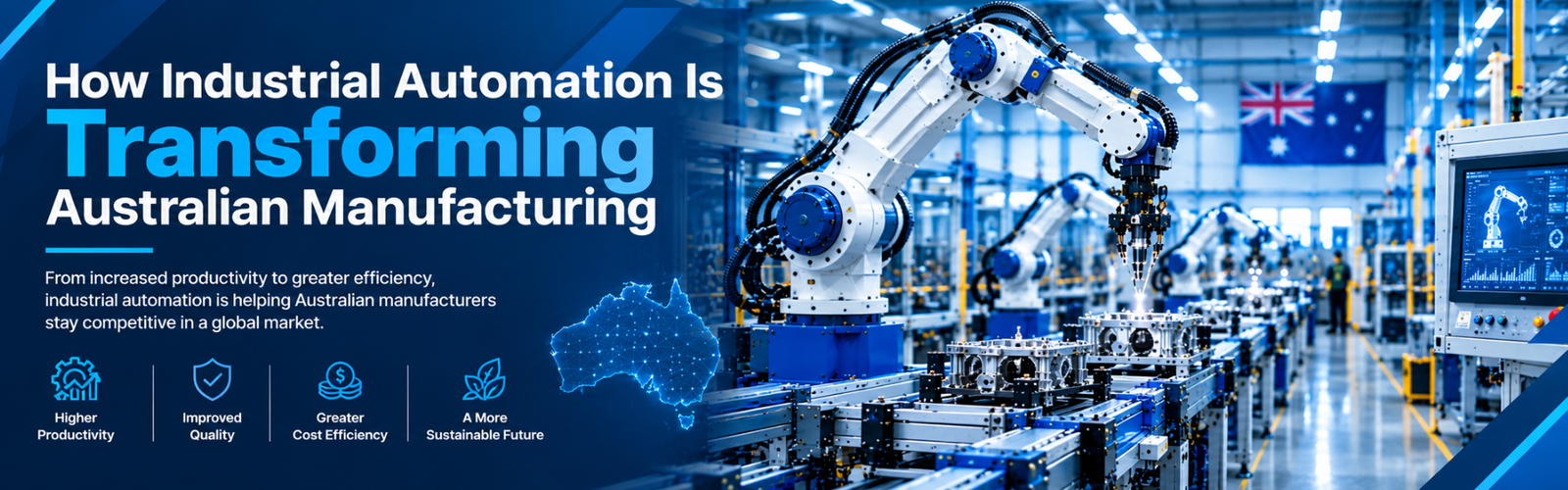
How Industrial Automation Is Transforming Australian Manufacturing
Admin
|
06 Sep 2026
|
14 min read
|
57 views
How Industrial Automation Is Transforming Australian Manufacturing
Australian manufacturing is entering a period of significant technological change.
Manufacturers are increasingly looking beyond traditional production methods and adopting automation, robotics, connected equipment, industrial software, advanced sensors and data-driven technologies to improve the way they design, produce, monitor and maintain products.
Industrial automation is playing an important role in this transformation.
From automated assembly lines and robotic systems to programmable logic controllers, sensors, industrial networking and intelligent monitoring, automation technologies are helping manufacturers create more consistent, efficient and connected production environments.
For Australian businesses, this transformation is particularly important.
Manufacturers operate in a competitive global environment while managing challenges such as productivity, labour availability, operating costs, supply-chain resilience, quality requirements and the need to respond quickly to changing customer demand.
The solution isn't necessarily to automate everything.
Instead, successful manufacturers are identifying specific processes where automation can provide measurable improvements and gradually building smarter production environments around them.
In this article, we explore how industrial automation is transforming Australian manufacturing, the technologies involved, the benefits manufacturers can achieve and what businesses should consider when beginning their automation journey.
What Is Manufacturing Automation?
Manufacturing automation is the use of machines, control systems, software, sensors and other technologies to perform or control manufacturing processes with reduced manual intervention.
A traditional production process may depend heavily on operators to:
- Move materials
- Inspect products
- Operate machines
- Measure components
- Control processes
- Record production information
- Perform repetitive assembly tasks
An automated manufacturing process can use technology to perform many of these activities consistently.
For example, a production line could use:
Sensors → PLC → Motor → Conveyor → Inspection System → Packaging
The system continuously monitors the production process and performs programmed actions based on information received from sensors and other devices.
More advanced manufacturing environments can add:
- Robotics
- Machine vision
- Industrial IoT
- Artificial intelligence
- Predictive maintenance
- Automated quality control
- Real-time analytics
- Digital twins
This creates a connected manufacturing environment where machines don't simply perform tasks—they can also provide valuable information about how the production process is performing.
Why Is Automation Becoming More Important for Australian Manufacturers?
Manufacturing businesses need to remain competitive while maintaining quality and productivity.
Automation can help address several operational challenges.
Productivity
Automated systems can perform repetitive processes consistently and at predictable speeds.
Quality
Automated inspection and controlled processes can reduce variations caused by manual operations.
Labour
Automation can reduce the amount of repetitive manual work required and allow employees to focus on more technical and higher-value activities.
Safety
Automation can reduce direct human interaction with certain hazardous or physically demanding processes.
Downtime
Connected monitoring and automation systems can provide better visibility into equipment performance.
Data
Automated systems can collect operational information that helps businesses make better decisions.
The Australian Government's National Robotics Strategy specifically identifies robotics and automation as technologies that can support Australian competitiveness and productivity.
1. Automation Is Improving Manufacturing Productivity
One of the most obvious advantages of automation is the ability to improve production efficiency.
Automated machinery can perform repetitive tasks consistently without the variations that can occur during manual operations.
Consider a manufacturing process that requires the same component to be positioned thousands of times each day.
A manual process may require an operator to:
- Pick up the component.
- Position it.
- Inspect it.
- Perform the assembly.
- Move it to the next stage.
- Repeat the process.
An automated system can use sensors, actuators, robotics and control systems to perform much of this sequence automatically.
The operator can instead focus on:
- Monitoring
- Quality management
- Maintenance
- Troubleshooting
- Process improvement
This doesn't necessarily mean removing workers.
It means changing how workers interact with the production process.
2. Automation Is Reducing Repetitive Work
Manufacturing contains many repetitive activities.
Examples include:
- Material handling
- Packaging
- Sorting
- Assembly
- Labelling
- Inspection
- Machine loading
- Machine unloading
Repetitive tasks can consume significant amounts of employee time.
Automation allows businesses to redesign these processes so machines perform repetitive operations while people concentrate on tasks requiring judgement, technical knowledge and problem-solving.
This can also make manufacturing roles more focused on engineering, programming, maintenance and system management.
3. Robotics Are Changing Production Lines
Industrial robots have become increasingly important in modern manufacturing.
Robotic systems can perform tasks such as:
- Assembly
- Welding
- Painting
- Palletising
- Pick and place
- Machine tending
- Packaging
- Inspection
Robots are particularly useful for repetitive tasks where consistent movement and positioning are important.
A robotic system may operate alongside other automation components including:
- PLCs
- Sensors
- Servo drives
- Motors
- Safety systems
- Vision systems
- Industrial networks
The robot is therefore usually one part of a larger automated production system.
4. Machine Vision Is Improving Quality Control
Quality control is another area where automation can make a significant difference.
Machine vision systems use cameras, lighting and software to inspect products and identify specific characteristics.
Depending on the application, vision systems can detect:
- Incorrect positioning
- Surface defects
- Missing components
- Incorrect labels
- Product dimensions
- Colour variations
- Assembly errors
Automated inspection can allow manufacturers to inspect products at high speed while maintaining consistent inspection criteria.
This can be particularly valuable in high-volume production environments.
5. Sensors Are Making Machines More Intelligent
Sensors are fundamental to automation.
They allow machines to understand what is happening around them.
Manufacturing systems can use sensors to monitor:
- Temperature
- Pressure
- Position
- Speed
- Distance
- Vibration
- Flow
- Level
- Presence
For example, a proximity sensor can determine whether a component has reached a particular position.
A temperature sensor can monitor the temperature of a manufacturing process.
A pressure sensor can identify changes in a pneumatic or hydraulic system.
By continuously collecting information, sensors give control systems the information they need to make decisions.
6. PLCs Are Controlling Modern Manufacturing Systems
Programmable Logic Controllers remain one of the most important technologies in industrial automation.
A PLC can receive information from sensors and other input devices, process programmed logic and control machinery.
For example:
Sensor detects product → PLC processes signal → actuator moves product → sensor confirms position.
This cycle can happen repeatedly and extremely quickly.
PLCs can control:
- Conveyors
- Pumps
- Motors
- Valves
- Packaging systems
- Assembly equipment
- Production machinery
They can also communicate with HMIs, drives, sensors and other industrial systems.
7. Connected Equipment Is Creating Smarter Factories
Traditional automation primarily focused on controlling machines.
Modern manufacturing is increasingly focused on connecting machines and collecting data.
Connected equipment can provide information about:
- Machine performance
- Production rates
- Equipment faults
- Energy consumption
- Operating conditions
- Maintenance requirements
This information can then be analysed to identify opportunities for improvement.
The result is a move toward more data-driven manufacturing.
8. Industry 4.0 Is Changing How Manufacturers Think
Industry 4.0 represents the broader transformation toward connected and intelligent manufacturing.
It combines automation with digital technologies such as:
- Industrial IoT
- Artificial intelligence
- Machine learning
- Robotics
- Cloud systems
- Data analytics
- Digital twins
- Connected sensors
The objective isn't simply to make machines automatic.
It is to create manufacturing environments where equipment, systems and people can work together using real-time information.
CSIRO describes digital manufacturing as incorporating technologies including robotics, artificial intelligence and the Internet of Things, with applications involving real-time monitoring and control.
9. Automation Is Helping Manufacturers Improve Quality
Consistency is extremely important in manufacturing.
Manual processes can introduce variations caused by:
- Operator technique
- Fatigue
- Measurement differences
- Process timing
- Human error
Automation can execute predefined processes consistently.
For example, an automated assembly system can position components according to programmed parameters.
An automated inspection system can check every product against defined criteria.
An automated dispensing system can apply controlled quantities of adhesive or other materials.
This consistency can contribute to improved product quality.
10. Automation Can Help Reduce Manufacturing Downtime
Unexpected downtime can have a significant impact on manufacturing operations.
When a critical machine stops, the consequences can include:
- Lost production
- Delayed orders
- Additional labour costs
- Maintenance expenses
- Supply-chain disruption
Automation can help businesses monitor equipment and identify abnormal conditions.
For example, connected sensors can monitor:
- Temperature
- Vibration
- Pressure
- Motor performance
- Electrical conditions
When abnormal conditions are detected, maintenance teams can investigate before the problem becomes a larger failure.
This approach supports preventive and predictive maintenance strategies.
11. Predictive Maintenance Is Becoming More Important
Traditional maintenance often follows a schedule.
For example:
Inspect machine every month.
Predictive maintenance uses equipment data to understand when maintenance may actually be required.
Data can potentially identify patterns associated with equipment deterioration.
This can help maintenance teams move from:
Reactive Maintenance
"Something failed. Fix it."
to:
Preventive Maintenance
"Inspect and maintain it regularly."
and eventually toward:
Predictive Maintenance
"Data indicates this component may require attention."
Automation and connected sensors provide much of the information needed to support this transition.
12. Automation Is Improving Workplace Safety
Manufacturing environments can involve:
- Heavy machinery
- High temperatures
- Moving equipment
- Repetitive operations
- Hazardous processes
- Difficult-to-access areas
Automation can reduce the need for people to perform certain high-risk tasks directly.
Robots can handle heavy or repetitive operations.
Automated systems can monitor hazardous conditions.
Safety systems can detect dangerous situations and initiate predefined responses.
However, automation itself does not automatically make a workplace safe.
Proper engineering, risk assessment, machine guarding, safety systems, training and maintenance remain essential.
13. Automation Is Helping Address Labour Challenges
Australian businesses across different industries face changing workforce and skills requirements.
Automation can help manufacturers reduce their dependence on manual repetitive tasks while increasing demand for technical capabilities.
Modern manufacturing environments increasingly require people with skills in:
- Electrical engineering
- Mechanical engineering
- Automation
- PLC programming
- Robotics
- Data analysis
- Maintenance
- System integration
This means automation can change the type of skills required within a manufacturing business rather than simply eliminating the need for workers.
14. Automation Is Improving Production Flexibility
Traditional production systems can sometimes be difficult to change.
Modern automated systems can be designed to support more flexible manufacturing.
For example, programmable systems can allow manufacturers to change:
- Production sequences
- Machine parameters
- Product configurations
- Packaging formats
- Operating speeds
This can help businesses respond to changing customer requirements.
Flexible automation is particularly valuable when manufacturers produce multiple product variations rather than one high-volume product.
15. Automation Is Improving Traceability
Modern customers and industries increasingly require better visibility into production.
Automated systems can collect information such as:
- Production time
- Machine status
- Batch information
- Inspection results
- Operator information
- Equipment conditions
This can support traceability and quality management.
For regulated or highly controlled industries, accurate production records can be particularly valuable.
16. Automation Can Improve Energy Management
Industrial businesses can use connected systems to monitor energy consumption.
Data can help identify:
- High-energy equipment
- Unusual consumption
- Inefficient operating conditions
- Peak usage periods
Manufacturers can then investigate opportunities to improve energy efficiency.
Variable frequency drives, efficient motors and intelligent control systems can also contribute to better energy management depending on the application.
17. Automation Is Supporting Local Manufacturing
Automation isn't only about making individual machines faster.
It can also contribute to broader manufacturing competitiveness.
When businesses can produce efficiently, maintain consistent quality and respond quickly to changing requirements, they can potentially strengthen their position in domestic and international markets.
The Australian Government has identified advanced manufacturing as strategically important and has highlighted technologies including robotics and automation as part of Australia's future industrial capability.
18. Automation Is Helping OEMs Build Smarter Equipment
Original Equipment Manufacturers can use automation technologies to develop machines with:
- Automated control
- Remote monitoring
- Intelligent diagnostics
- Data collection
- Connected systems
- Improved safety
OEMs can also integrate sensors, PLCs, HMIs, drives and other components into complete machine solutions.
For Australian OEMs, choosing reliable industrial components is therefore an important part of equipment design.
19. Industrial Products Are an Important Part of Automation
Automation isn't only about PLCs and robots.
Reliable supporting products are equally important.
Manufacturers may require:
- Electrical components
- Sensors
- Connectors
- Cable preparation tools
- Wire stripping tools
- Industrial adhesives
- Sealants
- Technical sprays
- Lubricants
- Cleaning products
- Maintenance chemicals
For example, an automated machine can have sophisticated control technology but still experience problems caused by:
- Poor cable preparation
- Loose connections
- Corrosion
- Contamination
- Poor lubrication
- Inadequate maintenance
This is why automation should be considered as a complete system.
20. The Role of Industrial Maintenance in Automated Manufacturing
The more automated a production environment becomes, the more important equipment reliability can become.
A failure in one critical component can potentially stop an entire production line.
Manufacturers should therefore develop structured maintenance programs covering:
- Electrical equipment
- Sensors
- Motors
- Drives
- Control panels
- Cables
- Pneumatic systems
- Mechanical components
- Automation equipment
Maintenance products such as technical sprays, industrial cleaners, lubricants, adhesives and repair products can support appropriate maintenance activities.
What Does an Automated Factory Look Like?
A modern automated manufacturing facility may contain multiple interconnected layers.
Layer 1 — Physical Equipment
- Motors
- Conveyors
- Pumps
- Valves
- Machines
- Robots
Layer 2 — Sensors
- Temperature sensors
- Proximity sensors
- Pressure sensors
- Position sensors
- Vision systems
Layer 3 — Control
- PLCs
- Motion controllers
- Safety controllers
Layer 4 — Operator Interface
- HMIs
- Control stations
Layer 5 — Supervisory Systems
- SCADA
- Manufacturing software
- Production monitoring
Layer 6 — Business & Data Systems
- Analytics
- Enterprise systems
- Cloud platforms
- Reporting
These layers can work together to create a connected manufacturing environment.
Should Every Australian Manufacturer Automate?
No.
Automation should be driven by business requirements rather than technology trends.
Before investing, manufacturers should ask:
What problem are we trying to solve?
Is it:
- Labour-intensive work?
- Quality inconsistency?
- Production bottlenecks?
- Safety?
- Downtime?
- Capacity?
- Traceability?
What is the expected return?
Consider:
- Equipment cost
- Installation
- Engineering
- Training
- Maintenance
- Expected productivity improvement
- Potential downtime reduction
Can we automate gradually?
A manufacturer doesn't necessarily need to transform an entire factory immediately.
A better approach may be to start with one process, measure the result and then expand.
A Practical Automation Roadmap for Australian Manufacturers
Stage 1 — Identify
Find repetitive, inefficient or high-risk processes.
Stage 2 — Measure
Record:
- Cycle time
- Labour requirements
- Downtime
- Defect rates
- Production volume
Stage 3 — Prioritise
Select the processes where automation is likely to create the greatest value.
Stage 4 — Design
Determine the required:
- Sensors
- Controllers
- Motors
- Drives
- Actuators
- Safety equipment
- Networking
- Software
Stage 5 — Implement
Install and integrate the automation system.
Stage 6 — Train
Train operators, engineers and maintenance teams.
Stage 7 — Measure
Compare results against the original baseline.
Stage 8 — Improve
Use operational data to identify additional opportunities.
What Are the Challenges of Industrial Automation?
Automation offers significant opportunities, but manufacturers need to plan carefully.
Initial Investment
Automation equipment and engineering can require significant capital investment.
Integration
New automation equipment may need to communicate with existing machinery.
Skills
Businesses require people who can operate and maintain modern automation systems.
Maintenance
Automated systems still require regular inspection and maintenance.
Cybersecurity
Connected industrial systems introduce additional cybersecurity considerations.
Change Management
Employees need appropriate training when processes and responsibilities change.
The Future of Australian Manufacturing
The future of manufacturing will increasingly involve the integration of physical production with digital technologies.
Factories are likely to become more:
- Connected
- Automated
- Data-driven
- Flexible
- Intelligent
- Predictive
Robotics, AI, industrial IoT, machine vision and advanced analytics will continue developing alongside established automation technologies.
However, the core principles of manufacturing will remain the same:
Quality. Reliability. Productivity. Safety. Efficiency.
Technology is simply providing manufacturers with new tools to achieve those objectives.
How Spleca Supports Australian Industrial Businesses
Building and maintaining an automated manufacturing environment requires access to reliable industrial products.
Spleca supplies industrial automation products, electrical components, maintenance products, technical sprays, industrial adhesives, cable preparation tools and other engineering solutions for industrial businesses across Australia.
Our product range is designed to support applications across:
- Manufacturing
- Automation
- Mining
- Automotive
- Electrical engineering
- Food processing
- Infrastructure
- Marine
- OEM manufacturing
- Industrial maintenance
Whether you're maintaining an existing automated production line or working on a new industrial project, selecting the right products is an important part of achieving reliable long-term performance.
Explore Spleca's industrial automation products to find solutions for your application.
Frequently Asked Questions
What is industrial automation in manufacturing?
Industrial automation in manufacturing is the use of machines, control systems, sensors, software and other technologies to automate or control manufacturing processes with reduced manual intervention.
How is automation changing Australian manufacturing?
Automation is helping Australian manufacturers improve productivity, consistency, safety, process monitoring and equipment management while supporting more connected and flexible production environments.
What are examples of manufacturing automation?
Examples include robotic assembly, automated packaging, machine vision inspection, conveyor systems, automated material handling, CNC systems and automated production-line control.
What technologies are used in smart manufacturing?
Smart manufacturing can involve PLCs, sensors, robotics, industrial IoT, machine vision, artificial intelligence, data analytics, SCADA and connected industrial networks.
Can small manufacturers benefit from automation?
Yes. Small and medium manufacturers can automate individual repetitive or inefficient processes without necessarily implementing a completely automated factory.
Does industrial automation replace workers?
Automation can reduce repetitive manual work, but modern automated manufacturing still requires people for engineering, programming, maintenance, supervision, quality management and decision-making.
What is Industry 4.0?
Industry 4.0 refers broadly to the integration of digital technologies, connected systems, automation and data into modern industrial and manufacturing operations.
How can automation reduce downtime?
Automation can provide continuous monitoring of equipment and process conditions. When combined with preventive or predictive maintenance, this information can help identify potential equipment problems earlier.
What products are required for manufacturing automation?
Depending on the application, manufacturers may require PLCs, sensors, HMIs, motors, drives, actuators, electrical components, networking equipment, cable preparation tools, adhesives, technical sprays and maintenance products.
How can Spleca help Australian manufacturers?
Spleca supplies industrial automation products, electrical components, maintenance products, technical sprays, industrial adhesives, cable preparation tools and related engineering solutions for businesses across Australia.
Conclusion
Industrial automation is changing Australian manufacturing by connecting machines, people, data and processes in increasingly sophisticated ways.
From sensors and PLCs to robotics, machine vision, industrial networking and connected monitoring systems, automation technologies are helping manufacturers create more productive, consistent and flexible operations.
However, successful automation doesn't mean simply replacing manual processes with machines.
The most effective approach is to identify specific business problems, determine where automation can provide measurable value, select appropriate technologies and continuously improve the system using operational data.
For Australian manufacturers, this creates an opportunity to build smarter and more competitive production environments while developing the technical capabilities needed for the future of industry.
As automation continues to evolve, reliable industrial products will remain an essential part of the equation.
Looking to improve your manufacturing or industrial automation setup?
Explore Spleca's industrial automation products and engineering solutions or speak with our team about your application.
Explore Industrial Automation Products